









|
Getting your Trinity Audio player ready...
|
By: Ariella Haviv
In the heat of New York City’s 2025 mayoral contest, a controversy unlike any other has emerged — one not rooted in housing policy, policing, or transit, but in questions of foreign influence, cultural patronage, and the integrity of American democracy. At its center stands Zohran Mamdani, the progressive firebrand Assemblyman-turned-mayoral candidate, whose meteoric rise has been complicated by revelations surrounding his family’s ties to Qatar’s royal family, particularly the cultural patronage extended to his mother, acclaimed filmmaker Mira Nair, by Sheikha Al-Mayassa bint Hamad Al-Thani, sister of the ruling emir of Qatar.
The allegations — meticulously detailed by investigative journalist and author Peter Schweizer — first appeared in Schweizer’s research on Gulf state soft power and were later expanded upon during a recent appearance on Fox News’ “Life, Liberty & Levin” – also known as The Mark Levin Program, where he described the Qatari connection as a “modern-day influence campaign disguised as artistic philanthropy.” According to Schweizer, Qatar’s long history of investing in Western academics, artists, and think tanks serves a single purpose: to shape political and cultural narratives in its favor, while masking its authoritarian rule and alleged sponsorship of extremist movements.
As Jewish Breaking News and other outlets have reported, Schweizer’s findings have pushed what once seemed an obscure issue into the center of the mayoral debate — a conversation that now extends well beyond campaign finance and into the murky terrain of global politics and soft power.
The public record, as Schweizer and others have noted, already paints a telling picture. Qatari state-backed institutions — notably the Doha Film Institute, chaired by Sheikha Al-Mayassa — have bankrolled and promoted Mira Nair’s projects for over a decade. Among them is Nair’s 2012 film The Reluctant Fundamentalist, which the institute reportedly financed in full at a cost of $15 million. The film, which explored the tensions between the Muslim world and post-9/11 America, drew praise for its artistry but criticism for its sympathetic portrayal of anti-Western sentiment.
The partnership between Nair and Qatar did not end there. Her 2009 film Amelia was featured prominently at the Doha Tribeca Film Festival, a Qatari initiative launched in collaboration with U.S. entertainment executives to bolster the emirate’s cultural standing. In 2022, a lavish stage adaptation of Nair’s iconic Monsoon Wedding was staged in Doha — produced by Qatar Airways and Qatar Creates, and timed to coincide with the FIFA World Cup.
As The New York Post later reported, Sheikha Al-Mayassa is considered one of the most influential cultural financiers in the world, presiding over billions in art investments and creative partnerships meant to position Doha as a global cultural hub. But Schweizer warns that such projects are not purely aesthetic. “These investments are about influence,” he told Mark Levin. “When you have a foreign regime with Qatar’s record investing millions in the family of a rising American politician, the presumption of innocence is not enough. The pattern itself demands scrutiny.”
In June 2025, the story took a dramatic turn when Sheikha Al-Mayassa publicly began promoting Mamdani’s mayoral campaign on social media — amplifying positive polls, reposting campaign videos, and even using “fire emojis” to celebrate clips featuring Mamdani and his mother.
To critics, this was no innocent gesture. As Jewish Insider reported, the sheikha’s overt support appeared to cross the line between cultural patronage and political endorsement. “This isn’t about cinema anymore,” one political consultant told the outlet. “When a member of the Qatari royal family is posting campaign content about a New York City mayoral race, you have to ask why.”
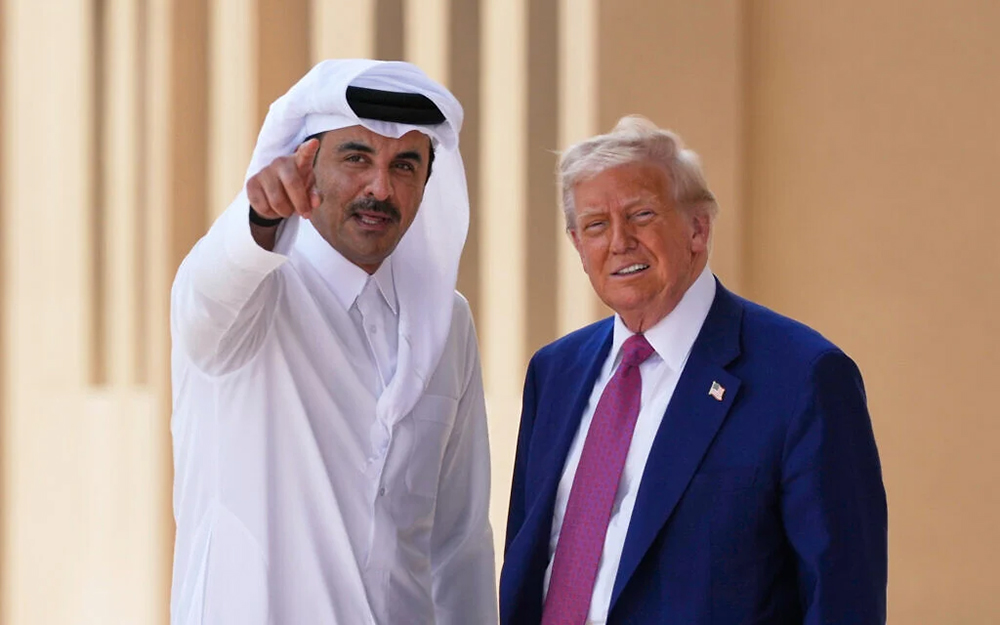
Qatar, under mounting international criticism for its human rights record and alleged financing of Hamas and other Islamist organizations, has been accused of leveraging cultural relationships to soften its image abroad. “Soft power,” Schweizer explained on Levin’s program, “works best when it’s invisible. You don’t need to own the politician — you just need to own the ecosystem around them.”
For his part, Zohran Mamdani has forcefully denied any direct financial ties to Qatar. His campaign spokeswoman dismissed Schweizer’s findings as a “manufactured distraction,” insisting the candidate “has never received funding from Qatari institutions” and “remains committed to universal human rights.” Mamdani himself has characterized the controversy as “a smear by association.”
Yet, as Jewish Breaking News observed, what the campaign hasn’t said is often as notable as what it has. Mamdani’s team has not clarified whether his mother’s Qatari-backed earnings ever indirectly supported his political career — through campaign contributions, promotional work, or shared expenses. Nor has the campaign addressed whether any private communication occurred between the Mamdani family and Sheikha Al-Mayassa.
This ambiguity has become the controversy’s central fault line. “Transparency should be effortless for someone who claims to represent reform,” Schweizer argued. “If there’s nothing to hide, open the books.”
At its core, the Mamdani-Qatar debate raises a profound question about the intersection of art, money, and power. Is foreign patronage of an artist inherently suspect if that artist’s child later enters politics? Or does the burden of proof lie on those making the accusation?
Critics see troubling implications. They point to Qatar’s monarchical structure, severe anti-LGBTQ laws, and restrictions on press and speech — policies that clash sharply with the progressive values Mamdani espouses in New York. They also highlight Mira Nair’s silence on these contradictions. While outspoken about gender and racial issues in the West, Nair has rarely addressed Qatar’s treatment of women, laborers, or minorities, even as she benefited from its cultural largesse.
“Selective morality is its own form of hypocrisy,” one political scientist told Jewish Breaking News. “You can’t campaign for social justice in New York while your family profits from a regime that criminalizes homosexuality.”
Supporters, however, argue that the scrutiny verges on xenophobia. They maintain that Nair’s work transcends politics and that cultural funding, whether from Qatar or elsewhere, does not imply ideological alignment. “The arts are global,” one Mamdani ally told the New York Post. “To say otherwise is to impose guilt by geography.”
While much of the attention centers on Nair, Mamdani’s father, Professor Mahmood Mamdani, also has minor ties to Qatar. In 2009, he delivered a lecture at Georgetown University in Qatar, sponsored by the Arab Democracy Foundation, though no evidence suggests he received ongoing funding. Still, as Schweizer observed, “influence rarely flows through one channel — it’s a web.”
For now, no concrete evidence shows that Mamdani’s campaign has been financed by Qatari interests. But as the New York Post noted, the perception of foreign influence can be politically fatal, particularly in a race already dominated by concerns about integrity and transparency.
Ultimately, the Mamdani controversy has become less about provable corruption and more about symbolic credibility. For a candidate whose brand rests on moral clarity and progressive authenticity, proximity to one of the world’s most criticized regimes is a heavy burden.
As a recent editorial stated, “The question isn’t whether Qatar owns Mamdani, but whether New Yorkers can afford to overlook the appearance of influence in an age when soft power often masquerades as art.”
For now, the evidence is circumstantial. But as Schweizer warned, the story may only be beginning: “Every influence operation starts in whispers — and ends in revelation.”



