



















|
Getting your Trinity Audio player ready...
|
The consequences of perpetuating minority student victimhood
By: Richard L. Cravatts
As the Maoist-like purges on university campuses continue, yet another faculty member has suffered the consequences of speaking words that may not be spoken and having views that are forbidden at universities where woke students, pretending to be supremely tolerant, indict others with their actual intolerance and join with faculty and administrators in suppressing views that they will not and cannot abide.
The latest victim is Charles Negy, an associate professor in the University of Central Florida’s Psychology Department. Negy’s thought-crime? In now-deleted tweets, Negy, who has taught at UCF for 22 years and presumably enjoys the protection oftenure, questioned one of the prevailing absolutes on university campuses: namely, that what is called “systemic racism” permeates and defines American society, and that even on university campuses—those places where the most enlightened and sensitive of all citizens reside—racism still shows itself in a dark undercurrent of bigotry, bias, and repressed hatred for non-white others.
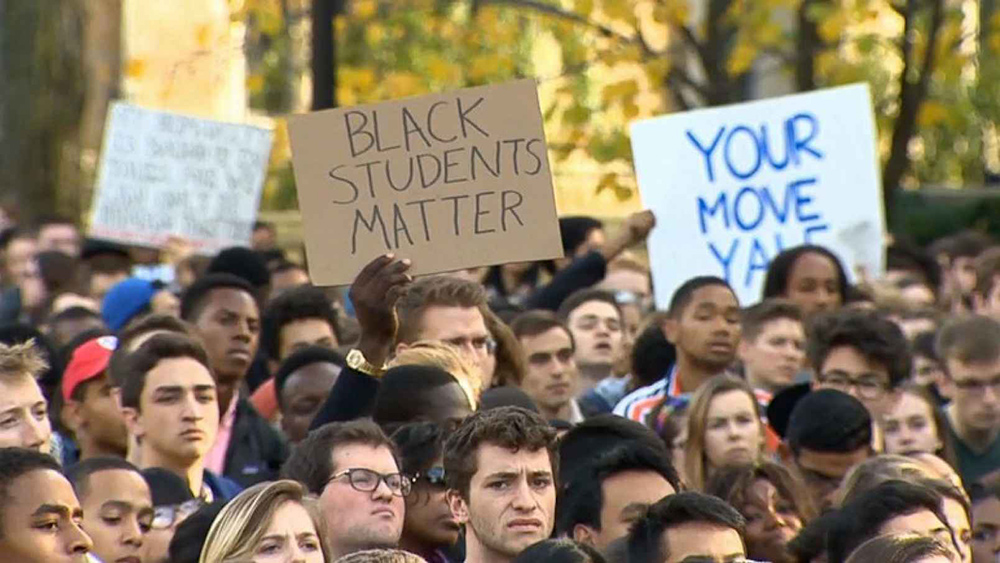
The ubiquity of race obsession on campuses in the post-George Floyd age of Black Lives Matter has shown itself at schools other than UCF, as well. At Princeton University, as one noteworthy example, self-inflicted racial guilt was so prevalent that in September the University’s president, Christopher L. Eisgruber, published a self-flagellating open letter in which he bemoaned the fact that “[r]acism and the damage it does to people of color persist at Princeton” and that “racist assumptions” are “embedded in structures of the University itself.”
Negy rejected this notion and made the mistake of publicly questioning the idea that racism is so prevalent, so unrelenting that it defines all of our interactions and is the reason why, Negy mused, that Asians, as one visible example, thrive academically, economically, and socially while blacks do not.
“If Afr. [sic] Americans as a group,” Negy tweeted, “had the same behavioral profile as Asian Americans (on average, performing the best academically, having the highest income, committing the lowest crime, etc.), would we still be proclaiming ‘systematic racism’ exists?” What Negy suggested, of course, is heresy in the victim-centered culture of academia, where personal responsibility and initiative are discounted, and the oppression of the dominant white culture is assumed to be the principal impediment to the personal achievement of non-white groups.
White people, it is widely assumed, are “privileged” and control the culture and the levers of power; and black people struggle against these cultural and economic defenses at a fundamental disadvantage—all stemming from the country’s original sin of slavery. White people, because they are believed to be essentially racist just by virtue of being white, are implicitly racist, should experience white guilt, and must publicly acknowledge and atone for their racist inclinations.
Professor Negy challenged that notion, suggesting that decades of affirmative action, race-based preferences in hiring and college admissions, and set asides and other benefits of the welfare state have actually given black people advantages not shared with their white peers, that black people enjoy a type of privilege, too. “Black privilege is real,” Negy wrote in another now-deleted tweet. “Besides affirm. [sic] action, special scholarships and other set asides, being shielded from legitimate criticism is a privilege. But as a group, they’re missing out on much needed feedback.”
This was all too much for the sensitive and tolerant souls on the UCF campus, and a Change.org petition, which garnered some 30,000 signatures, was soon circulating in which Negy’s firing was demanded. UCF president Alexander Cartwright, who apparently was eager to satisfy the mob and fire the tenured professor for his offensive thoughts, did recognize that, as a public institution, UCF had to respect and honor Negy’s constitutional right to express any ideas he wished to, admitting in an interview that “The Constitution restricts our ability to fire him or any other University employee for expressing personal opinions about matters of public concern. This is the law.”
Any view which asks black people to be responsible for their own successes and failures, of course, contradicts the prevailing belief that blacks are perennial victims of white oppression and white privilege, that their social and economic failure is the result of systemic racism, and that their options in life are hobbled by the legacy of slavery, living in a racist country, and suffering because of a system of oppression that is both institutionalized and designed to maintain the status quo in which a white society benefits from and creates racial inequity. Negy challenged that orthodoxy.
“The first tweet was a sincere question,” he explained in responding to the criticisms of the original tweet. “When or how will we know when the U.S. has eradicated ‘systemic racism?’ What is the marker we will use for declaring systemic racism no longer exists?”
In defending the controversial comment about black privilege, Negy modified his language, but the sentiment was the same. “Perhaps I should not have used the word ‘privilege,’” he admitted. “I could have said there are advantages to being a minority in the U.S. But we’d simply be playing a game of words. The point is still the same, there are benefits/advantages/privileges to being black in the U.S..”
Negy suggested that the privilege he ascribes to blacks is different than the one commonly thought to be enjoyed by whites, that is, that white people have the privilege of power and being the dominant segment of American society, and thus retain power and control. Black privilege, Negy thinks, is a different type of advantage—the advantage inherent in the way that blacks are insulated from criticism and, as self-defined victims, do not have to take responsibility for their decisions and personal behavior. “The fact that people feel the need to protect African Americans from scrutiny and will vilify anyone who does–that is a privilege,” Negy observed. “All groups are of equal value and worth. African Americans are our equals. This country belongs to them as much as it does to any other group. But they are not above scrutiny.”
Negy’s experience—and the veritable inquisition he has endured as the administration marshaled considerable resources(including a 244-page investigative report) to force his resignation or build a case for his dismissal—is not, of course, unique, particularly in the Black Lives Matter era. At Harvard University, for example, one of the recent faculty targets was David Kane, Preceptor in Statistical Methods and Mathematics in the university’s Department of Government, who was the subject of condemnation for questioning some of the universally-accepted notions about race when some of his assiduous students uncovered racist posts he had allegedly written on his website EphBlog. over the course of several years under the pseudonym “David Dudley Field ’25.”
One of Kane’s posts noted that Williams alum Duncan Robinson (Kane is a 1988 graduate of Williams College) was a high-ranking NBA player this season. “Is the NBA prejudiced against white players?” it asked. “Would Robinson have been undrafted if he were Black?,” suggesting the existence of “Black Supremacy” in the NBA, echoing Negy’s controversial notion of “black privilege.”
(To be continued next week)
Richard L. Cravatts, Ph.D., is a Freedom Center Journalism Fellow in Academic Free Speech, President Emeritus of Scholars for Peace in the Middle East, and author of Dispatches From the Campus War Against Israel and Jews.



