



























|
Getting your Trinity Audio player ready...
|
Sotheby’s to Auction Off Oldest Surviving Hebrew Bible; 1,100 Year Old Codex Sassoon Could Net Up to $50M
Current owner is Jacob (Jacqui) Safra, the heir of a Syrian Lebanese-Swiss banking fortune
Edited by: Fern Sidman
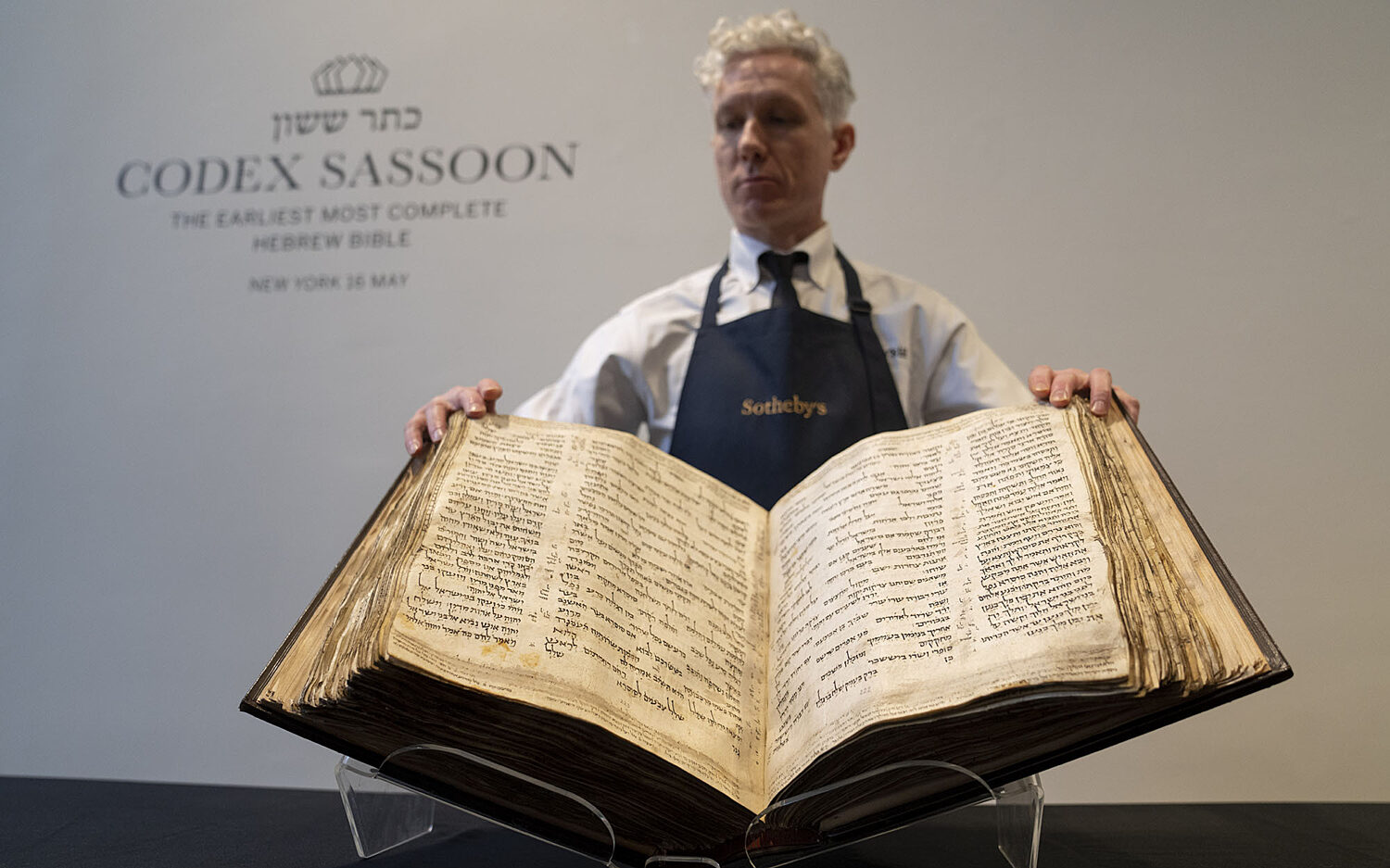
Sotheby’s will auction off the oldest surviving, nearly complete Hebrew Bible, known as the Codex Sassoon, the auction house announced in February, according to a report on the ArtNews.com web site. The 1,100-year old volume carries an estimate of $30 million to $50 million, which could make it the most valuable historical document ever sold at auction.
In November 2021, billionaire and Top 200 art collector Ken Griffin set a record when he paid $43.2 million for a first printing of the US Constitution at a Sotheby’s auction, Reuters reported in February. The rare copy of the Constitution that was sold was one of just 11 surviving copies from the official first printing produced for the delegates to the Constitutional Convention and for the Continental Congress, as was reported by the AP at the time. It was the only copy that remained in private hands.
The Codex is named after businessman, philanthropist and Judaica collector David Solomon Sassoon, (1880–1942), a passionate collector of Judaica and Hebraic manuscripts. Dating to the late 9th or early 10th century, Codex Sassoon contains all 24 books of the Hebrew Bible – missing only 12 leaves – and precedes the earliest entirely complete Hebrew Bible, the Leningrad Codex, by nearly a century. Sassoon acquired the Bible in 1929 and assembled one of the most significant private collections of Judaica and Hebraica manuscripts in the 20th century, Reuters reported. The document offers a critical link bridging Jewish oral tradition to the modern Hebrew Bible.
Significantly, Codex Sassoon contains faithful notes of the Masorah, commentary that ensures the biblical text’s proper inscription and recitation. One such note refers to “the great teacher, Aaron ben Moses ben Asher” and his work on al-taj, the traditional honorific of the Aleppo Codex, suggesting the Masorete scribe who copied the Masorah of Codex Sassoon may have consulted the revered volume when it resided in Tiberias or Jerusalem in the 10th or 11th century.
ArtNews.com reported that according to Sotheby’s, it predates the earliest entirely complete Hebrew Bible, the Leningrad Codex, by nearly a century. While the Aleppo Codex at the Israel Museum is older than the Codex Sassoon, almost two-fifths of its pages are missing.
The Aleppo Codex was assembled in 930 and was later completed with Masoretic notes by Aaron ben Moses ben Asher, a preeminent Bible scholar responsible for correcting the Codex to match the tradition he’d inherited about how the words should be spelled, vocalized and accented. The Aleppo Codex subsequently served as an exemplar for scribes to ensure that they’d copied the Bible properly. Today, unfortunately, fewer than 300 of the approximately 487 original folios of the Aleppo Codex survive.
The last of the Dead Sea Scrolls – the most important surviving ancient Judaic manuscripts – date to the 1st century C.E., but it wasn’t until the early Middle Ages that scholars known as Masoretes began to create a body of notes that standardized the text of the Hebrew Bible, which had remained in flux since antiquity, as was stated by Sotheby’s.
One of the most well-known books to emerge from this project was the Aleppo Codex, assembled circa 930. It was later completed with Masoretic notes by Aaron ben Moses ben Asher, a preeminent Bible scholar responsible for correcting the Codex to match the tradition he’d inherited about how the words should be spelled, vocalized and accented. The Aleppo Codex subsequently served as an exemplar for scribes to ensure that they’d copied the Bible properly. Today, unfortunately, fewer than 300 of the approximately 487 original folios of the Aleppo Codex survive.
Scholars have long been aware of the Codex Sassoon but it has remained largely out of public view, Sotheby’s said in a press release, as was reported by CNN.
According to Sotheby’s, it was not until recently that the current owner, collector Jacob (Jacqui) Safra, had the Codex Sassoon carbon dated, confirming it was older than the Aleppo Codex and the Leningrad Codex, two other major early Hebrew Bibles, Reuters reported.
ArtNews.com reported that Safra is the heir of a Syrian Lebanese-Swiss banking fortune. In January, Safra sold two paintings by the Italian 17th-century painter Artemisia Gentileschi through an Old Masters auction at Sotheby’s New York.
“Codex Sassoon has long held a revered and fabled place in the pantheon of surviving historic documents and is undeniably one of the most important and singular texts in human history,” Sotheby’s Global Head of Books & Manuscripts Richard Austin said in a statement, as was reported by ArtNews.com. “With such eminence, the Codex has an incomparable presence and gravitas that can only be borne from more than one thousand years of history.”
Reuters reported that Sotheby’s said the Codex Sassoon had been dated to either the late 9th or early 10th century on both scientific and paleographic grounds and contains almost the entirety of the Bible. The oldest copies of Biblical text ever found were the Dead Sea Scrolls that were discovered in caves in 1947.
Sharon Mintz, Sotheby’s senior Judaica specialist, books and manuscripts, told CNN in February that “this is the most important document to come to auction ever.”
Mintz said this “astonishing record” is likely to generate huge interest from bidders, CNN reported. “This is the most significant document that I have ever had the pleasure of examining, researching and holding,” she added.
The Hebrew Bible is the foundation of the three Abrahamic faiths: Judaism, Christianity and Islam. Reuters reported that the Hebrew Bible contains 24 separate books organized into three parts — the Pentateuch, the Prophets and the Writings.
CNN reported that the ancient Hebrew bible consists of 792 parchment pages made from animal skins — and weighing about 26.5 pounds. Mintz described it as a “lavish production that only the most wealthy could have afforded.”
The current owner purchased the codex in 1989, said Mintz, and is now “delighted to be able to share it with the world,” CNN reported.
The codex, or manuscript in book form, will be available for public viewing for the first time in 40 years next week at Sotheby’s London, according to the Reuters report. The last time the Codex Sassoon was publicly exhibited was in 1982 at the British Museum, according to the ArtsNews.com report.
Jews in antiquity came to rely on oral tradition passed down through generations to understand and preserve the message of the Bible, Sotheby’s added in their statement, CNN reported.
According to the Israel Museum that houses the Dead Sea Scrolls, the Aleppo Codex was badly damaged in a fire at the community’s synagogue in 1947 and today “no more than 295 of the original 487 leaves [pages] survived, CNN reported. ” By contrast, the Sassoon codex is only missing 12 full pages so, according to Sotheby’s, “is thus the earliest, most complete copy of the Hebrew Bible extant.”
CNN reported that an entry from the early 11th century refers to a sale by Khalaf ben Abraham, perhaps in Israel or Syria, to a man called Isaac ben Ezekiel al-Attar, who later transferred it to his two sons.
The next location mentioned in the annotations came in the 13th century when it was dedicated to the synagogue of Makisin (present-day Markada in northeastern Syria), as was reported by CNN. It was likely rebound at this stage, according to Sotheby’s, and inscribed with the words “consecrated to the Lord God of Israel to the synagogue of Makisin,” the report indicated.
Makisin was later destroyed and the codex was entrusted to a community member called Salama bin Abi al-Fakhr who pledged to return it to the synagogue in the event of regeneration, CNN reported, but the synagogue was never rebuilt and the codex continued on its odyssey until it was acquired by Sassoon in 1929.
To calculate the price estimate of the Codex Sassoon, Austin told the New York Times a committee started discussing the number two years ago, ArtNews.com reported. It took into consideration the production cost of more than 100 animal skins, the careful calligraphy of a single writer, and its monumental historical value. It also looked at the two previous record-breaking sales of historic documents: the Codex Leicester, a Leonardo da Vinci manuscript bought by Bill Gates in 1994 for $30.8 million, ArtNews.com reported.
The live auction of the object will take place at Sotheby’s the morning of May 16.
Another auction house that deals with rare Judaica items as well as ancient books and other texts is known as Genazym.
According to a JTA report of March 21st, David Wachtel, the former Judaica consultant for Sotheby’s auction house told then that “Genazym has come on like a freight train into the world of Jewish auctions. Some of the prices realized are far beyond what this market has seen before.”
Since Genazym’s first auction in 2017, it has sold some 1,900 books, manuscripts and other collectible documents for about $26 million plus commission, roughly $12 million above total starting prices, according to an analysis by the Jewish Telegraphic Agency of auction records on Genazym’s website. The JTA also reported that Genazym has increasingly outperformed the longest-standing Judaica auction firms in New York and Jerusalem.
One of the auction house’s owners, in a rare public comment, ventured that Jewish buyers are craving a connection with their heritage, as was reported by the JTA. What’s clear is that at a time when traditional libraries are cutting back on buying Jewish texts, Genazym is tapping into an emerging luxury market among Orthodox Jews — and fueling the rise of religious texts as both a status symbol and investment vehicle in some communities.
The JTA reported that Rabbi Pini Dunner, who collects rare Jewish books, said investing in Judaica is likely attractive for some in the Hasidic community, whose religious observance is stricter than that of congregants at his Modern Orthodox synagogue in the Los Angeles area.
“There are people I know here in Beverly Hills who’ve got car collections worth tens of millions of dollars,” Dunner told the JTA. “In the Hasidic world that has no currency, just as the wow factor of a Picasso has no currency. An original manuscript or first-edition of the Noam Elimelech has a real wow factor, particularly if you can tell people the book sold for more than a million dollars at a Genazym auction.”



