(AP) — For years, the people of Aleppo bore the brunt of bombardment and fighting when their city, once Syria’s largest and most cosmopolitan, was among the civil war’s fiercest battle zones. Even that didn’t prepare them for the new devastation and terror wreaked by this week’s earthquake.
The natural disaster piled on many man-made ones, multiplying the suffering in Aleppo and Syria more broadly.
Fighting largely halted in Aleppo in 2016, but only a small number of the numerous damaged and destroyed buildings had been rebuilt. The population has also more recently struggled with Syria’s economic downslide, which has sent food prices soaring and residents thrown into poverty.
MORE ON THE EARTHQUAKE
– Hope fading as deaths in Turkey, Syria quake near 12,000
– Scenes of devastation as Turkey, Syria quake kills thousands
– How long can people survive in the rubble of an earthquake?
The shock of the quake is all too much.
Hovig Shehrian said that during the worst of the war in Aleppo, in 2014, he and his parents fled their home in a front-line area because of the shelling and sniper fire. For years, they moved from neighborhood to neighborhood to avoid the fighting.
ADVERTISEMENT
“It was part of our daily routine. Whenever we heard a sound, we left, we knew who to call and what to do,” the 24-year-old said.
“But … we didn’t know what to do with the earthquake. I was worried we were going to die.”
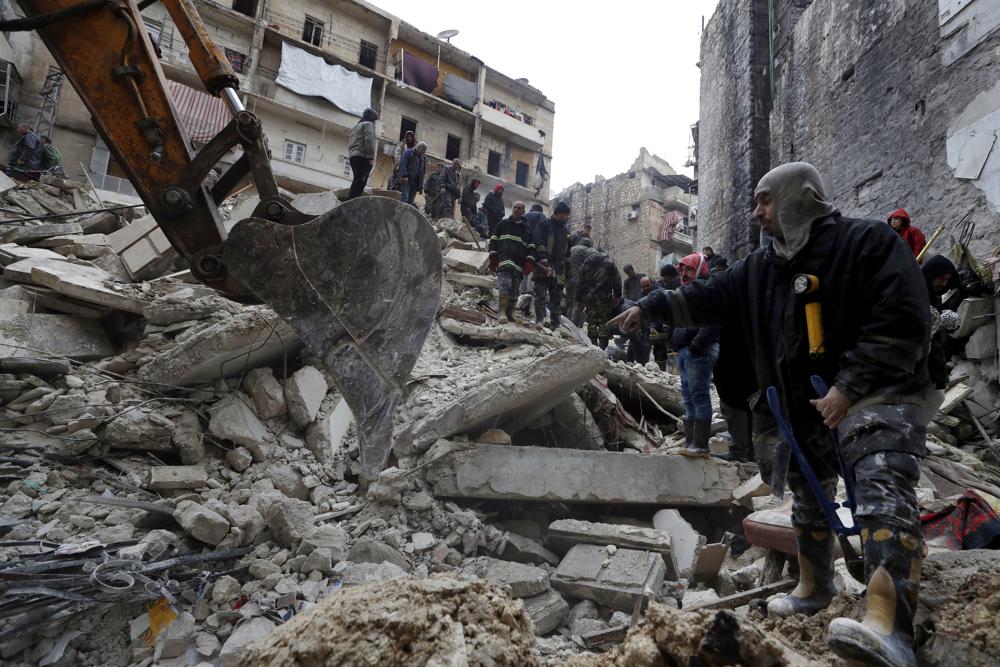
Monday’s pre-dawn 7.8-magnitude quake, centered about 70 miles (112 kilometers) away in Turkey, jolted Aleppans awake and sent them fleeing into the street under a cold winter rain. Dozens of buildings across the city collapsed. More than 360 people were killed in the city and hundreds of others were injured. Workers were still digging three days later through the rubble, looking for the dead and the survivors. Across southern Turkey and northern Syria, more than 11,000 were killed.
Even those whose buildings still stood remain afraid to return. Many are now sheltering in schools. A Maronite Christian monastery took in more than 800 people, particularly women, children and the elderly, crammed into every room.
“Until now we are not sleeping in our homes. Some people are sleeping in their cars,” said Imad al-Khal, the secretary-general of Christian denominations in Aleppo, who was helping organize shelters.
For many, the earthquake was a new sort of terror — a shock even after what they endured during the war.
ADVERTISEMENT
For Aleppo, the war was a long and brutal siege. Rebels captured the eastern part of the city in 2012, soon after Syria’s civil war began. For the next years, Russian-backed government forces battled to uproot them.
Syrian and Russian airstrikes and shelling flattened entire blocks. Bodies were found in the river dividing the two parts of the city. On the government-held western side, residents faced regular mortar and rocket fire from opposition fighters.
A final offensive led to months of urban fighting, finally ending in December 2016 with government victory. Opposition fighters and supporters were evacuated, and government control imposed over the entire city. Activist groups estimate some 31,000 people were killed in the four years of fighting, and almost the entire population of the eastern sector was displaced.
ADVERTISEMENT
Aleppo became a symbol of how President Bashar Assad succeeded in clawing back most opposition-held territory around Syria’s heartland with backing from Russia and Iran at the cost of horrific destruction. The opposition holds a last, small enclave in the northwest, centered on Idlib province and parts of Aleppo province, which was also devastated by Monday’s quake.
But Aleppo never recovered. Any reconstruction has been by individuals. The city’s current population, no higher than 4 million, remains below its pre-2011 population of 4.5 million. Much of the eastern sector remains in ruins and empty.
Buildings damaged during the war or built shoddily during the fighting regularly collapse. One collapse, on Jan. 22, left 16 people dead. Another in September killed 11 people, including three children.
Aleppo was once the industrial powerhouse of Syria, said Armenak Tokmajyan, a non-resident fellow at Carnegie Middle East who is originally from the city. Now, he said, it’s economically marginalized, basic infrastructure in gas and electricity is lacking, and its population – which had hoped for improvements after fighting ended – only saw things get worse.
ADVERTISEMENT
They have also now experienced the physical — and psychological — blow of the earthquake, Tokmajyan said. “It left them wondering, do they really deserve this fate or not? I think the trauma is big and it will take some time until they swallow this really bitter pill after (more than) 10 years of war.”
Rodin Allouch, an Aleppo native, covered the war for a Syrian TV station.
“I used to be on the front line, getting video shots, getting scoops. I was never scared. Rockets and shells were falling and everything, but my morale was high,” he recalled.
The earthquake was different. “I don’t know what the earthquake did to us exactly. We felt we were going to join God. It was the first time in my life I got scared.”
During the war, he had to leave his neighborhood in the eastern sector and rent an apartment on the western side. But the quake has displaced him yet again. As their building shook, he, his wife and four children fled to a nearby garden. Allouch said he won’t return until the building is inspected and repaired. It still stands, but has many cracks. The family will instead stay in a ground-floor store front nearby that he rented.
ADVERTISEMENT
“It is safer to be down (on ground floor) if there is an earthquake,” he said, but complained that there is no fuel for heating. “Life is so miserable.”
Many others in Aleppo have been displaced more than once.
Farouk al-Abdullah fled his farm south of Aleppo city during the war. Since then, he has been living with his two wives, 11 children and 70-year-old mother in Jenderis, an opposition-held town in Aleppo province.
Their building there collapsed completely in the earthquake, though the entire family was able to escape.
He said the earthquake, with its destruction everywhere and its aftermath -- watching rescue crews pull bodies out of the rubble -- “are much more horrible than during the war.”
And while war may be senseless, those in it often have a cause they are sacrificing for and wrest some meaning out of the death and destruction.
The war’s devastation in Aleppo at least “is somehow a proof that we weren’t defeated easily,” said Wissam Zarqa, an opposition supporter from the city who was there throughout the siege and now lives in the Turkish capital Ankara.
“But the destruction of natural disasters is all pain and nothing else but pain.”
New York City’s mayor rejected calls Monday to stop having police officers enforce social distancing during the coronavirus crisis after one was caught on video pulling a stun gun on a man and violently taking him to the ground, and Gov. Andrew Cuomo laid out criteria for reopening the state’s economy region by region.
Mayor Bill de Blasio called Saturday’s confrontation in Manhattan’s East Village “very troubling” and “absolutely unacceptable” but contended it was an outlier among “tens of thousands of interactions between police officers and civilians over the last weeks that went very well.”
The officer was stripped of his gun and badge and placed on desk duty pending an internal investigation.
The police department assigned 1,000 officers to social distancing patrols over the weekend as New Yorkers ventured outside to enjoy warm weather. They’ll also be part of a new effort to distribute 7.5 million protective masks over the next few weeks.
“You can’t do effective enforcement without the NYPD and the NYPD is more than up to the job,” de Blasio said.
Bystander video posted on social media showed plainclothes officer Francisco Garcia slapping 33-year-old Donni Wright in the face, punching him in the shoulder and dragging him to a sidewalk after leveling him in a crosswalk.
Police spokesperson Sgt. Mary Frances O’Donnell said Wright “took a fighting stance against the officer” when he was ordered to disperse.
A few minutes earlier, officers arrested two other people on the same block for allegedly failing to comply when asked to disperse.
Police Commissioner Dermot Shea said Monday that officers recovered a stun gun that may have belonged to one of the people, a small amount of marijuana and close to $3,000 in cash.
“Exactly what was going on there is still somewhat under investigation,” Shea said.
Joo-Hyun Kang, the director of the police watchdog Communities United for Police Reform, said: “Public health professionals and community organizations, not the NYPD, should be responsible for educating New Yorkers about the importance of social distancing and creating new norms.”
Tina Luongo, a lawyer with the Legal Aid Society, said the city needs to “seriously reconsider social distancing enforcement that leads to escalations involving the use of tasers and violent assaults.”
Even the head of the city’s largest police union said officers “should get out of the social distancing enforcement business altogether.”
Pat Lynch, the president of the Police Benevolent Association, called the situation “untenable” and blamed city leaders for “vague guidelines and mixed messages, leaving the cops on the street corners to fend for ourselves.”
“Nobody has a right to interfere with a police action. But now that the inevitable backlash has arrived, they are once again throwing us under the bus,” Lynch said in a statement after de Blasio spoke Monday.
Wright was arrested on charges including assault on a police officer and resisting arrest, but the Manhattan district attorney’s office said it would defer prosecution pending further investigation.
Despite the latest fiasco, de Blasio said the police department has made great strides overall in reducing its use of force in recent years by training all its officers in deescalation techniques and by building stronger relationships within communities.
“What you saw there is more and more of a rarity,” de Blasio said at a news conference Monday. “We have work to do, unquestionably, but the progress is very clear to see.”
The number of people dying from coronavirus in the state dipped again, to 226 fatalities Sunday, Cuomo said. That’s the fewest number of deaths in a day since March 28, when 237 people died.