





























|
Getting your Trinity Audio player ready...
|
From the joyful naming of a baby to the lonely burial of a parent, finding ways to carry on
By: Aharon Loschak
Everyone knows that Jewish life-cycle events are communal affairs. Be it a circumcision, a wedding, or unfortunately, a shiva house, Jews traditionally celebrate, and mourn, together. With the global pandemic of COVID-19 foisting social-distancing rules on billions of people worldwide and keeping them at home, Jews marking various stages of the lifecycle have hit upon an unprecedented dilemma: how?
Yet, as Jews from New York City to Johannesburg to rural Maine are rediscovering, the essence of Jewish life is not a miles-long guest lists or buffet tables heaping with food, but rather affirming the Jewish people’s bond with G‑d and carrying on the tradition that began at Sinai. The following stories tell the tale of a people carrying on their tradition under some of the most trying circumstances.
An Intercontinental ‘Brit Milah’
Alexander Rosemberg is the deputy regional director of the Anti-Defamation League (ADL) in the New York and New Jersey region, and lives with his wife, Vivian, in Jersey City, N.J. This year was particularly special for them, as they were expecting their first child at the end of March. As both hail from large families, typical gatherings are always a big bash, the average Shabbat dinner incorporating 40 attendees. For the brit of their son, they were expecting nothing less than a party with a planned 100 or so people from around the world.
Family members abroad had plane tickets in hand, and everyone was waiting for the anticipated moment to arrive when cries of “Mazal tov!” could be heard, and everyone would sit together for the joyous seudat mitzvah meal.
And then things started to slowly clamp down. Work moved from the office to the home, the country entered into lockdown, and Alex was hearing from other expecting friends that they weren’t even letting expectant dads into labor and delivery wards.
It was Rabbi Levi Heber, their mohel—the trained professional scheduled to perform the circumcision—who first suggested to the Rosembergs that maybe they should consider scaling things down. While it was initially thought that the party was still on, albeit on a smaller scale, by the time Vivian and their new baby left the hospital, it was clear that this brit would have to be something entirely different.
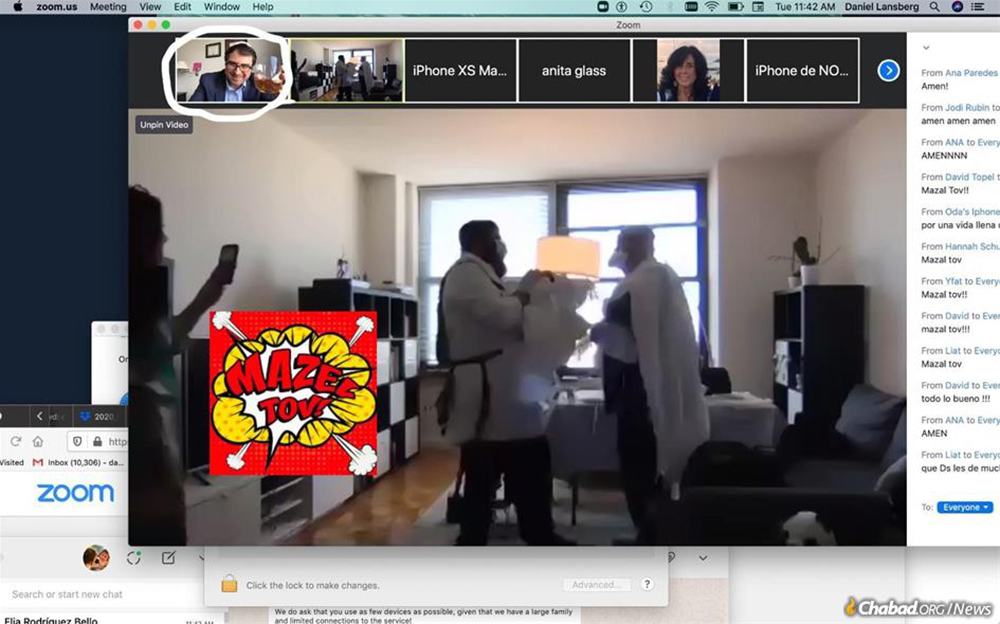
“It was immediate family only,” Rosemberg told Chabad.org. “We were all wearing gloves and masks, taking extreme measures to maintain maximum caution. While it was very small at home, I purchased a license for Zoom video conferencing, and between everyone who logged on, we were joined by probably 150 people or more.”So while the event at home was very small, the global audience was actually bigger than it would otherwise have been. Of course, the most important aspect of the celebration—a Jewish boy entering the covenant of Abraham—took place without a hitch.
“Did our new son, Rafael Jacob miss out? I don’t know,” said Rosemberg. “But we’re grateful that we were able to celebrate the simcha and still share it with so many people this way.”
Rabbi Jonathan Fox works for the Chevra Kadisha, the Jewish burial society, in Johannesburg, South Africa, where the organization assumes an outsized role of tending to the overall needs of not only those who have passed, but also the elderly and other populations requiring care. It is in that context that he serves as the rabbi for the residents of the Sandringham Gardens retirement home.
Never would he have imagined that their retirement home minyan would one day become a baby-naming hotspot for the global Jewish community.
As it turns out, the residents of Sandringham Gardens entered into lockdown at the very beginning of the crisis, not letting anyone in or out. The entire home has tested negative for the virus, so the administration saw no need to cancel the thrice daily minyan in the home.
As word got out that there is a COVID-safe minyan at the bottom tip of the African continent, requests started coming in to perform the duties that only a minyan can perform—for instance,naming newborn baby girls, which is done at the Torah on days it is read, Mondays, Thursdays or Shabbat.
At this point, Fox is naming a whole list of newborn babies across the globe three times a week. “We feel very privileged to provide this service,” he said. “On schedule for tomorrow, we have naming services for babies in Montreal, the United Kingdom and Israel.
With video recordings circulating on social media via WhatsApp, Facebook and Instagram, this small minyan of elderly residents in South Africa are literally a connection point between the entire Jewish world.
From the beginning of the pandemic, as synagogues began closing in various locations, Chabad.org created a kaddish saying service in a similar, isolated location . Thousands of individuals have filled out the forms in multiple languages, and each morning kaddish is recited for the departed.
So while most may be stuck at home, the modern world affords ways for girls to be named and Kaddish said, safely, on the other side of the world.
Dancing With the Bride and Groom on Instagram
Jewish weddings are lovely affairs, with guests, spirits and a whole lot of hoisting young brides and grooms up in the air. Ilana Ybgi was waiting for that special moment, as she and her fiancé, Srulick, were planning their big day in a countryside cricket club in Shenly, England, for close family and friends. Both based in Brooklyn, N.Y., they were eagerly awaiting the moment that they would join up with family and friends and celebrate their wedding together.
As has become a familiar storyline, when the calendar turned to mid-March, Srulik phoned his fiancé and struck up the conversation about changing their plans. With U.S. travel bans in place from Europe, it was becoming clear that the wedding would probably have to be local, in New York, with family and friends having to miss the celebration.
It was March 12—a few weeks before the planned wedding on March 30 in London. After a flurry of phone calls, particularly with Devorah Benjamin of Chevrah Simchas Chosson VeKallah of Crown Heights, a wedding was arranged a mere week later on March 19.
“It was surreal to go from inviting so many people to telling them, ‘Don’t come!’ ” said Ilana. “Once we moved the wedding to New York and the situation developed to what it was, I was forced to tell my own mother not to come to my wedding.
“It’s a harsh reality. Our wedding was nothing like I would have ever imagined. If someone had told me that I would be holding my phone during my own wedding and putting the ceremony on Instagram, I would have never believed them! But that’s what happened.”
Ultimately, the wedding went on, and via the wonders of technology, many people joined in.
From the comfort of their living rooms, video attendees dressed up, donned makeup and danced the night away with the young couple establishing a new home in the People of Israel. For as much as a global pandemic can keep the Jewish people in their own homes, it cannot keep Jewish life from continuing..



