









|
Getting your Trinity Audio player ready...
|
By: Russ Spencer
The State of the Union address is, by tradition, a moment in which the republic pauses to take its own measure, a ritualized encounter between executive authority and legislative scrutiny conducted under the watchful eyes of the nation. Yet the address delivered on Tuesday night by President Donald Trump unfolded less as a stately constitutional pageant than as a tableau of political confrontation, one that has since reverberated across the media landscape.
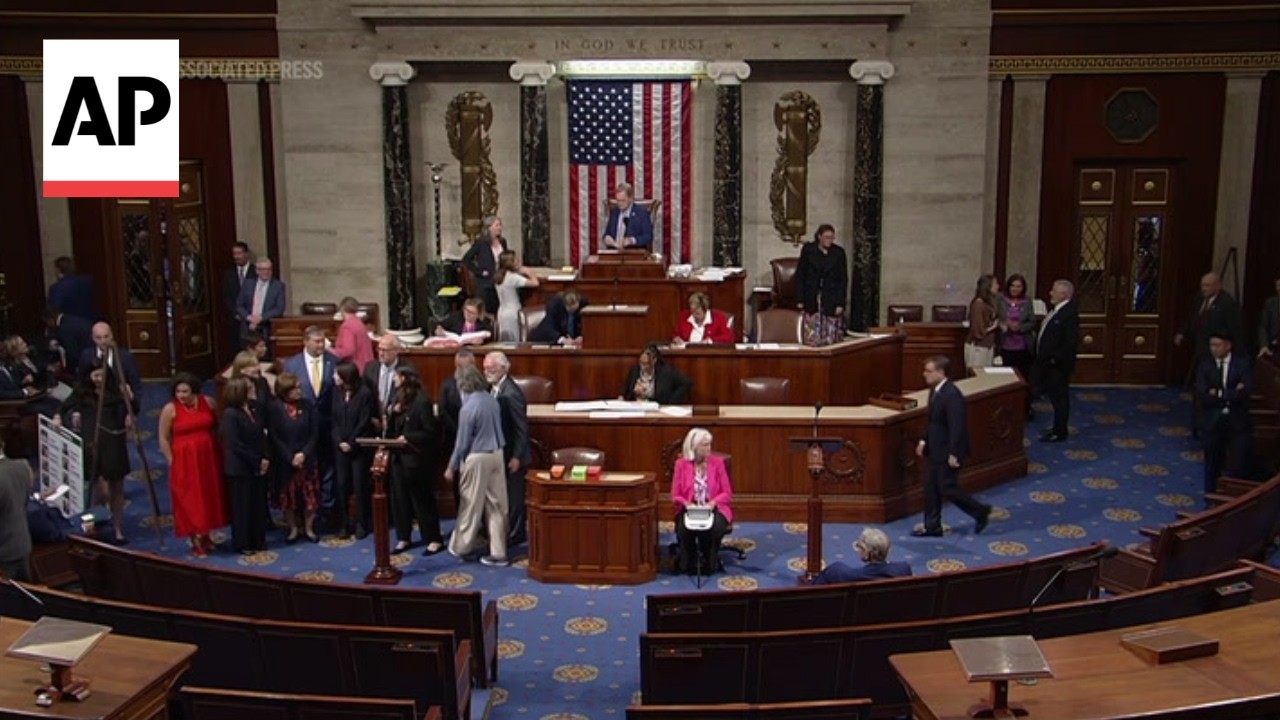
As reported on Wednesday by NBC News, the spectacle of Democratic Representatives Ilhan Omar of Minnesota and Rashida Tlaib of Michigan heckling the president from the House floor during his remarks on immigration and alleged fraud investigations in Minnesota ignited a new round of acrimony that now threatens to further erode what remains of Washington’s fragile civic comity.
From the outset, the address was framed by the president as a declaration of resolve on border security and the rule of law, themes that have defined his political identity and resonated with a constituency weary of what it perceives as governmental lassitude. NBC News reported that as Trump spoke about curbing illegal immigration and the alleged misuse of public funds within certain community networks in Minnesota, Omar and Tlaib rose to challenge him vocally.
Omar shouted back that the president should be “ashamed,” while Tlaib interjected with accusations of mendacity. The interruptions culminated in the pair later shouting, “You have killed Americans,” a charge they appeared to link to recent deaths involving federal immigration agents in Minnesota. In the charged atmosphere of the chamber, the decorum traditionally expected of lawmakers dissolved into open confrontation.
The president’s response, delivered the following day on his social media platform, was characteristically unvarnished. In remarks highlighted by NBC News, Trump excoriated the two congresswomen in language that blended personal invective with political denunciation.
He castigated their behavior as unbefitting elected officials and suggested, in a formulation that has long animated his supporters, that those who demonstrate what he views as hostility toward American sovereignty and civic norms “should be sent back from where they came.” The president’s rhetoric was undeniably incendiary, yet to many of his supporters it encapsulated a broader frustration with lawmakers they believe have elevated ideological grandstanding over responsible governance.
The confrontation was swiftly seized upon by Democratic leaders as evidence of what they characterize as the president’s penchant for xenophobic provocation. House Minority Leader Hakeem Jeffries condemned the remarks as “disgraceful,” while Rep. Pete Aguilar framed Omar and Tlaib as authentic representatives of their communities.
Yet such defenses have rung hollow for critics who argue that the congresswomen’s conduct during the address exemplified a disregard for institutional respect and an inclination toward performative disruption. The House chamber, in this view, is not a forum for heckling but a constitutional space where dissent, however fervent, must be articulated through procedures that preserve the dignity of the institution.
For Trump’s allies, the episode crystallizes what they regard as a persistent pattern of antagonism from a progressive wing of the Democratic Party that appears more invested in symbolic confrontation than in constructive policymaking. The NBC News report repeatedly noted that Omar and Tlaib have become emblematic figures in this intra-party dynamic, often positioning themselves as insurgent voices against the administration’s immigration policies and foreign policy stances.
Their heckling of the president during a constitutionally mandated address was thus interpreted by many conservatives not as principled dissent but as an extension of a long-running strategy of spectacle.
The president’s critics have sought to situate his remarks within a broader narrative of racially charged rhetoric dating back to his first term, when he famously urged certain progressive lawmakers to “go back” to the countries from which they or their families originated. NBC News has recounted those earlier controversies, including campaign rallies in which crowds were encouraged to chant against Omar.
Yet supporters of the president counter that such criticisms obscure a more fundamental issue: the legitimacy of holding elected officials accountable for what they perceive as divisive conduct and policy positions that undermine national cohesion. In their telling, Trump’s language, while abrasive, reflects an impatience with lawmakers who, in their view, have failed to demonstrate allegiance to the nation’s foundational principles.
The episode also drew in cultural figures, as the president extended his critique to actor Robert De Niro, who had appeared at a Democratic counter-event dubbed the “State of the Swamp.” NBC News reported that Trump derided De Niro’s remarks as emblematic of a celebrity class disconnected from the lived realities of ordinary Americans. This rhetorical broadside against Hollywood figures is a familiar motif in Trump’s political lexicon, reinforcing his self-styled image as a tribune of the “forgotten” citizenry against elite disdain.
What emerges from the coverage by NBC News is a portrait of a polity increasingly fractured not merely by policy disagreements but by divergent conceptions of political legitimacy and decorum. For the president and his supporters, the interruptions by Omar and Tlaib were emblematic of a deeper crisis in democratic norms, wherein opposition is expressed through disruption rather than deliberation.
The State of the Union in this view, was not merely heckled; it was symbolically assaulted by lawmakers who prioritize ideological theater over the sober responsibilities of governance.
The president’s insistence that the nation has the right to expect loyalty and respect from its representatives speaks to a populist ethos that privileges cohesion over cosmopolitan pluralism. While detractors decry this stance as exclusionary, supporters frame it as a necessary corrective to a politics of grievance that fractures the body politic along ethnic and ideological lines.
The broader implications of the episode extend beyond the immediate exchange of barbs. The NBC News report noted that Omar has previously linked heightened threats against her to the president’s rhetoric, an assertion that has fueled debate over the relationship between political speech and political violence.
Yet critics of the congresswoman argue that such claims risk conflating legitimate criticism with incitement, thereby insulating public figures from accountability for their own conduct. In a democratic society, they contend, robust debate inevitably entails sharp rhetoric, and the remedy for offensive speech lies in counter-speech rather than censorship or moral panic.
At a moment when the nation confronts challenges ranging from border security to economic uncertainty and global instability, the spectacle of lawmakers heckling the president during the State of the Union has struck many observers as emblematic of a political culture unmoored from its own traditions. The president’s defenders argue that Trump’s unapologetic response reflects a refusal to normalize what they see as an erosion of respect for constitutional rituals. In this reading, his rebuke of Omar and Tlaib was less a personal attack than a broader assertion of executive authority against what he perceives as legislative unruliness.
Yet the confrontation also underscores the precariousness of America’s civic fabric. The language deployed by both sides—heckles from the House floor, invective from the president’s social media feed—reveals a polity in which symbolic gestures increasingly supplant substantive engagement. NBC News has documented how such episodes reverberate through partisan media ecosystems, hardening attitudes and diminishing the space for mutual recognition.
In the final analysis, the tumultuous State of the Union and its aftermath illuminate a paradox at the heart of contemporary American politics. The president’s supporters view his combative rhetoric as a necessary bulwark against the corrosive influence of radical progressivism. His critics see in the same words an erosion of presidential decorum and a perpetuation of divisive tropes.
Between these poles lies a citizenry increasingly fatigued by spectacle yet captive to its rhythms. Whether the republic can recover a mode of political engagement that tempers passion with restraint remains an open question—one that will continue to be debated, chronicled and contested in the pages and broa



