


























|
Getting your Trinity Audio player ready...
|
By: Fern Sidman
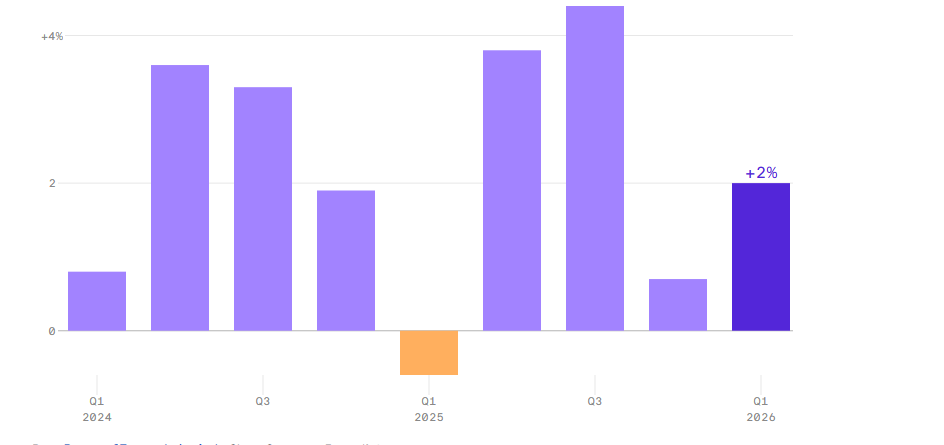
In a striking convergence of macroeconomic resilience and technological consolidation, newly released data indicates that the United States economy expanded by 2% in the first quarter of 2026, outperforming every other member of the G7 and dramatically eclipsing the European Union’s anemic 0.1% growth rate. The figures, which underscore America’s continued dominance in global economic leadership, are complemented by a parallel and equally consequential trend: the overwhelming concentration of the world’s most valuable technology companies investing heavily in Israel’s innovation ecosystem.
Taken together, these developments reflect a profound recalibration of global economic gravity—one defined not only by national growth metrics but by the strategic alignment of capital, talent, and technological infrastructure.
The 2% growth rate recorded by the United States stands in stark contrast to the broader stagnation observed across advanced economies. Germany, Europe’s industrial powerhouse, posted a modest 0.3% expansion. France reported flat growth, while the United Kingdom registered a subdued 0.5%. The European Union as a whole barely moved, with output rising just 0.1%.
Economists attribute the American outperformance largely to robust business investment, particularly in artificial intelligence and advanced computing sectors. These industries have emerged as the principal engines of growth, fueling productivity gains and attracting unprecedented levels of capital.
Yet the report also contains a note of caution. Consumer spending—long the backbone of the American economy—showed signs of deceleration during the quarter. Analysts pointed to rising global energy prices, exacerbated by ongoing military tensions involving Iran and disruptions in the Strait of Hormuz, as key factors contributing to inflationary pressures.
This dual dynamic—strong corporate investment alongside softening consumer demand—illustrates the complex nature of the current economic landscape.
Against this macroeconomic backdrop, the composition of global corporate power reveals a striking pattern. The world’s most valuable companies are overwhelmingly concentrated in the technology sector, with valuations that dwarf those of traditional industries.
At the apex stands Nvidia, commanding a staggering market capitalization of $5.23 trillion. Close behind is Alphabet, the parent company of Google, at $4.8 trillion. Apple follows with $4.3 trillion, while Microsoft holds a valuation of $3.08 trillion.
Amazon, at $2.93 trillion, continues to dominate e-commerce and cloud computing. Taiwan Semiconductor Manufacturing Company, or TSMC, is valued at $2.135 trillion, reflecting its central role in the global semiconductor supply chain. Broadcom, at $2.03 trillion, and Saudi Aramco, at $1.753 trillion, round out the upper tier.
Tesla, valued at $1.608 trillion, Meta at $1.54 trillion, and Samsung at $1.205 trillion complete the list of corporate giants that define the modern economic order.
What distinguishes this cohort is not merely their scale, but their shared orientation toward innovation, particularly in artificial intelligence, semiconductors, and digital infrastructure.
Perhaps the most striking revelation is that 10 out of these 11 companies maintain a significant presence in Israel—and, in many cases, are actively expanding their operations there.
This is not incidental. It reflects a deliberate strategic calculus rooted in Israel’s reputation as a global leader in high-technology research, cybersecurity, and artificial intelligence.
Nvidia, the world’s most valuable company, has established one of its most critical international hubs in Israel. The company operates five major research and development sites, employing more than 5,000 workers.
In a recent expansion, Nvidia consolidated its operations into 18 floors of a prominent Tel Aviv tower. More significantly, the company has announced plans to develop a new campus that will employ 10,000 people.
Chief Executive Officer Jensen Huang has been unequivocal in his commitment. As of March 2026, he described Israel as Nvidia’s “second home,” emphasizing its central role in the company’s global artificial intelligence strategy.
Google’s presence in Israel dates back to 2005, when it established a major research and development center. Today, the company employs approximately 2,000 employees across facilities in Tel Aviv and Haifa.
These centers focus on artificial intelligence, machine learning, and cloud computing—areas that are integral to Google’s long-term growth.
Apple’s Israeli operations constitute its second-largest research and development presence worldwide. The company maintains major facilities in Herzliya, Haifa, and Jerusalem, employing roughly 2,000 engineers.
Its investment trajectory has been marked by strategic acquisitions, including Anobit and PrimeSense, which have enhanced its capabilities in data storage and sensor technology.
The construction of a new 32-floor office tower in Herzliya Pituah further underscores Apple’s commitment to expanding its footprint.
Microsoft’s engagement with Israel dates back to 1991, when it established its first research and development center outside the United States. Today, the company operates multiple facilities across Herzliya, Tel Aviv, Haifa, Nazareth, and Beer Sheva.
These centers focus on artificial intelligence, cybersecurity, and cloud technologies, employing thousands of professionals.
Amazon has developed a multifaceted presence in Israel, encompassing high-tech development, cloud computing through Amazon Web Services, and local e-commerce initiatives.
The company is actively expanding its logistics infrastructure and seller ecosystem, signaling a long-term commitment to the market.
While TSMC does not operate large-scale manufacturing facilities in Israel, its partnerships with local firms are deeply significant. Through collaborations with companies such as Avnet ASIC Israel Ltd., TSMC provides access to advanced chip production technologies, including 4-nanometer processes.
These relationships are critical for Israeli startups developing cutting-edge artificial intelligence solutions.
Broadcom’s Israeli operations serve as a major research and development hub, employing approximately 750 to 800 engineers. The company’s integration into the local ecosystem has been reinforced through multiple acquisitions of Israeli startups.
Tesla entered the Israeli market in 2021 and has since expanded to include 5 retail locations, multiple service centers, and an extensive Supercharger network.
The company’s growing presence reflects the increasing adoption of electric vehicles and advanced energy technologies in the region.
Meta maintains a substantial research and development presence in Israel, employing between 800 and 900 individuals. Its facilities in Tel Aviv and Herzliya focus on advanced technologies, even as the company faces scrutiny over content moderation policies.
Samsung’s operations in Israel span research, investment, and consumer markets. The Samsung R&D Institute Israel, established in 1997, focuses on semiconductor and imaging technologies.
The company holds a commanding 48% to 50% share of the Israeli smartphone market and has invested heavily in local innovation, including the $150 million acquisition of Corephotonics.
The concentration of global corporate investment in Israel is not merely a statistical curiosity. It reflects a deeper alignment between the needs of the world’s most advanced companies and the capabilities of Israel’s technology sector.
Israel offers a unique combination of highly skilled talent, a robust startup ecosystem, and a culture of innovation that is particularly well-suited to the demands of artificial intelligence and cybersecurity.
For companies operating at the frontier of technological change, these attributes are invaluable.
The implications of this trend extend far beyond Israel itself. As the United States continues to lead global economic growth, its corporate champions are increasingly relying on international hubs of innovation to maintain their competitive edge.
Israel’s prominence in this network underscores its role as a critical node in the global technology supply chain.
At the same time, the integration of these companies into Israel’s economy reinforces the country’s strategic importance, both economically and geopolitically.
The juxtaposition of strong U.S. economic performance and the deepening engagement of the world’s most valuable companies with Israel points to the emergence of a new axis of global power.
This axis is defined not by geography alone, but by the convergence of innovation, capital, and strategic vision.
As the global economy continues to evolve, the relationship between American corporate leadership and Israeli technological expertise is likely to play an increasingly central role in shaping the future of growth and stability.
Whether viewed through the lens of macroeconomic data or corporate strategy, the message is clear: the center of gravity in the global economy is shifting—and those who understand its trajectory will be best positioned to navigate the challenges and opportunities that lie ahead.



