





















|
Getting your Trinity Audio player ready...
|
By: Fern Sidman
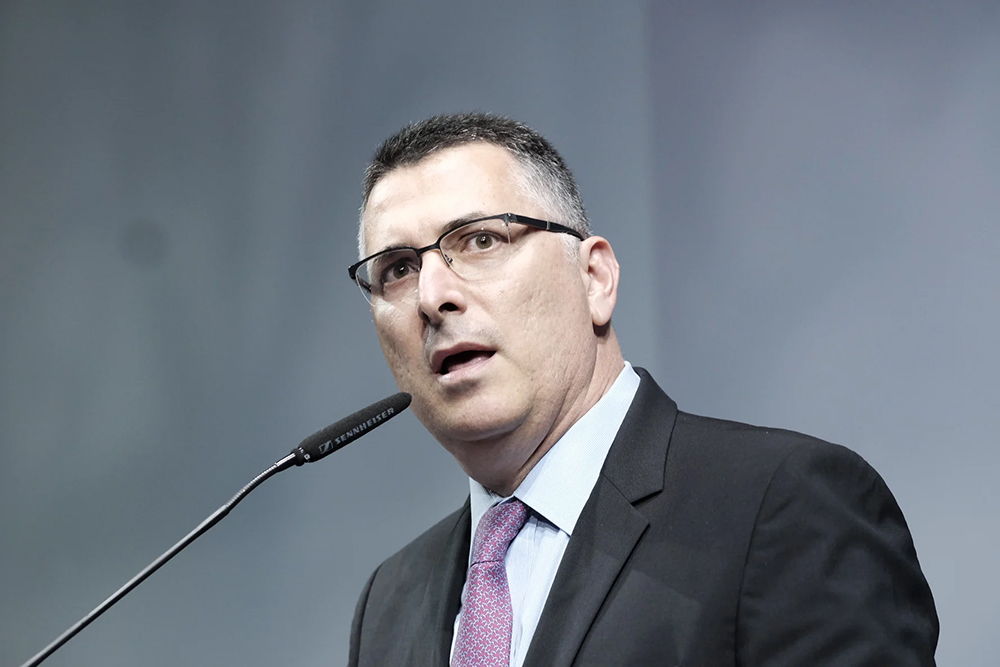
Israeli Foreign Minister Gideon Sa’ar issued a chilling warning this week during a high-profile international conference on antisemitism, declaring that efforts to impose a foreign arms embargo on Israel amid its ongoing multi-front war could precipitate “another Holocaust”—this time on the soil of the Jewish state. Sa’ar’s remarks, delivered at the International Holocaust Remembrance Alliance (IHRA) Conference in Jerusalem, were reported by the Jewish News Syndicate (JNS) and drew immediate attention from both domestic and international observers.
Speaking from the Israeli Ministry of Foreign Affairs, Sa’ar did not mince words when addressing the growing calls among several European governments, particularly Spain, to implement sanctions and halt weapons sales to Israel. These calls have emerged in response to Israel’s sustained military campaign in Gaza, where the Israel Defense Forces (IDF) continue operations against Hamas, designated as a terrorist organization by the United States, European Union, and others.
“What is the meaning of actions or calls—by politicians or countries—to impose an arms embargo on Israel when everybody around wants to eliminate it?” Sa’ar asked, as quoted by JNS.
“If these initiatives are successful, Israel will simply be eliminated,” he said. “There will be another Holocaust—this time on the soil of the Land of Israel.”
The foreign minister’s comments were delivered in the presence of international dignitaries, Jewish leaders, and historians convened for the IHRA conference, which focused on the resurgence of global antisemitism, particularly in the aftermath of the October 7, 2023 Hamas attacks, which ignited the current war in Gaza. According to the information provided in the JNS report, Sa’ar used the moment not only to condemn the double standards applied to Israel’s defense policies, but to draw a direct historical line between Jewish vulnerability during the Holocaust and current efforts to deprive Israel of military sovereignty.
Sa’ar underscored that calls for an arms embargo represent more than just misguided foreign policy—they amount to a strategic assault on the right of Jewish self-defense. His remarks highlighted what many in Israel see as a deep hypocrisy: while nations acknowledge Israel’s right to exist, they simultaneously attempt to limit its ability to defend that existence.
“This is, in fact, a way to deprive the Jewish nation of the means to defend itself—means we so lacked during the long years of exile and the period of the Holocaust,” Sa’ar told attendees, as was reported by JNS.
Spain has taken a lead role in pushing for an international arms embargo against Israel, citing concerns over civilian casualties in Gaza and urging stronger international pressure on the Netanyahu government to cease military operations, the JNS report explained. Sa’ar’s remarks appeared to be a direct response to Spain’s actions and rhetoric.
Israeli officials have expressed growing frustration over what they see as selective moral outrage from European leaders, many of whom have remained relatively silent about the actions of Hamas or Iran-backed proxies in Lebanon and Yemen while vocally criticizing Israeli military operations.
The JNS report emphasized that this issue is not just about military hardware, but about Israel’s existential right to maintain strategic parity in a region filled with hostile actors—including Hezbollah in Lebanon, the Houthis in Yemen, and Iran’s Revolutionary Guard—many of which are equipped with precision weaponry, drones, and missiles.
In a follow-up statement made during a tour of Yad Vashem, Israel’s national Holocaust museum, Sa’ar elaborated further. While reiterating his grave concerns, he offered a measure of reassurance to the public and Israel’s allies.
“I don’t think [the arms embargo] will be successful,” Sa’ar said, according to JNS. “But if it were to succeed, the result would be Israel’s elimination—because it would not have the tools to defend itself in our neighborhood.”
“Removing Israel’s right and ability to defend itself,” he continued, “can only mean one thing: a Second Holocaust.”
His remarks, made while surrounded by the solemn memorials of Jewish suffering during World War II, struck a powerful emotional chord. According to the information contained in the JNS report, foreign diplomats in attendance were visibly moved by the setting and the symbolism—underscoring the stakes of the ongoing debate about arms and sovereignty.
JNS has consistently reported on the escalating military threats facing Israel from multiple directions. In addition to Hamas in Gaza, Israel has faced attacks from Hezbollah in the north, drone launches from Syria, and increasing threats from Iran. The Israeli government has repeatedly stated that any weakening of its defense capability would embolden its enemies and endanger not just military personnel, but civilians across the country.
For Israel, the lessons of the Holocaust are not abstract. As the JNS report noted, the collective memory of global inaction during the Nazi era informs Israeli defense policy to this day. The state was built on the foundational belief that Jews must never again be defenseless, and any international move that undermines that security is viewed with existential urgency.
The IHRA conference in Jerusalem served as a platform not only for remembrance, but for a global call to action against rising antisemitism and political maneuvering that threatens Jewish safety. Sa’ar’s statements, as covered by JNS, framed the arms embargo debate as a moral litmus test for the international community: Will the world once again abandon the Jewish people in the name of political expediency?
In a geopolitical environment where the line between criticism of Israeli policy and outright antisemitism is often blurred, Sa’ar’s message was unequivocal. “Never again,” he implied, must not become “not again unless it’s politically inconvenient.”
As the Jewish state navigates the most complex and dangerous regional war in its modern history, Foreign Minister Gideon Sa’ar’s remarks at the IHRA conference serve as both a warning and a plea. As reported by JNS, the proposal of an arms embargo is not merely a diplomatic gesture—it is a potential death sentence for a nation surrounded by enemies.
Whether or not European leaders heed the gravity of that warning remains to be seen. But in Jerusalem this week, the message was clear: a secure Israel is a necessity—not a negotiable privilege.