


























|
Getting your Trinity Audio player ready...
|
By: Fern Sidman
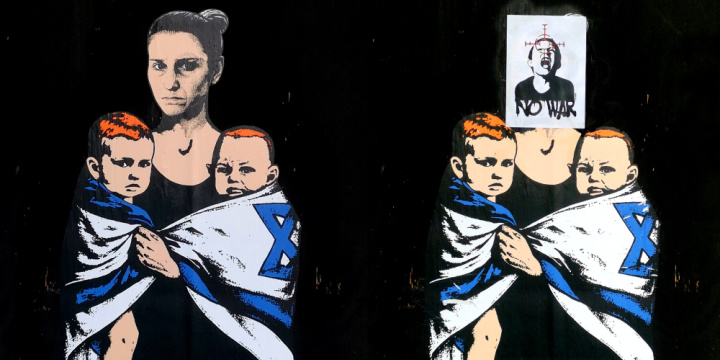
A mural commemorating Shiri, Kfir, and Ariel Bibas — the young Israeli mother and her two red-haired children murdered in Hamas captivity — was vandalized Thursday in Milan, Italy, during a memorial service at the city’s synagogue honoring victims of the Palestinian terror group’s October 7, 2023, massacre. The act of desecration occurred just meters from the Qatar Consulate, where the mural had been prominently displayed since earlier this month.
As The Algemeiner reported on Friday, vandals plastered a poster bearing the words “NO WAR” over the face of 32-year-old Shiri Bibas, transforming the commemorative image into a chilling mockery. The poster, featuring a target symbol on the forehead of a young boy, directly obscured the visage of the murdered Israeli mother, whose story had become a global emblem of civilian suffering at the hands of Hamas terrorists.
The vandalized mural — titled “October 7, The Hostages” — was created by acclaimed Italian pop artist and activist AleXsandro Palombo, known internationally for his politically charged works addressing human rights, inclusion, and antisemitism.
Unveiled on October 7, 2025, the second anniversary of Hamas’s genocidal rampage through southern Israel, the artwork depicts Shiri Bibas holding her two sons, Kfir (4) and Ariel (9 months), draped in an Israeli flag. Against a stark black background, the children’s vivid orange hair — a visual symbol of innocence and defiance — radiates in haunting contrast.
The image, as The Algemeiner report noted, has been hailed as one of the most striking tributes to the victims of October 7 — a day when Iran-backed Hamas operatives slaughtered 1,200 Israeli civilians, including babies, the elderly, and entire families, and kidnapped 251 hostages into Gaza.
For Milan’s Jewish community, Thursday’s synagogue commemoration was intended to be a solemn remembrance of those victims — among them the Bibas family, whose abduction and killing became one of the most emotionally searing symbols of Hamas’s brutality. The vandalism, timed to coincide with that event, was seen by many as an act of calculated cruelty.
Eyewitnesses told The Algemeiner that the defacement was discovered only hours after mourners had gathered inside Milan’s historic synagogue for prayers and readings marking the anniversary.
“It was deliberate, provocative — someone wanted to send a message,” said one attendee, who asked to remain anonymous for security reasons. “To cover a murdered mother’s face with the word peace while placing a target on a child’s forehead is grotesque. It’s not pacifism. It’s desecration.”
The vandalism has sparked condemnation from Italian Jewish leaders and international observers alike, who view the act as part of a broader wave of antisemitic hostility in Europe since the start of the Israel–Hamas war.
As The Algemeiner reported, Italian authorities are investigating whether the attack was politically motivated, given that the mural’s placement outside the Qatar Consulate — a country long accused of financing Hamas — may have been intended to provoke controversy.
In a statement provided to The Algemeiner, a spokesperson for AleXsandro Palombo said the artist was “deeply saddened but not surprised” by the vandalism, describing it as evidence of the very hatred the mural sought to expose.
“The kidnapping of a mother and her two young children, the waiting, the appeals, and the tragic outcome generated a strong collective identification, turning their story into a symbol of civilian vulnerability,” the spokesperson said. “The artwork serves as a testimony: it documents a historical event, denounces violence, and calls for public reflection.”
The mural had quickly become a local landmark — an impromptu place of mourning where residents left candles, flowers, and drawings of orange-haired children. Its destruction, observers say, has reopened wounds in a community still struggling to confront both the memory of October 7 and the persistence of antisemitic hate.
Speaking to The Algemeiner, Ruth Dureghello, former president of Rome’s Jewish community said, “This was an attack not only on a painting, but on memory itself. It’s an attempt to erase empathy — to replace remembrance with moral confusion.”
The Bibas mural is not the first of Palombo’s works to be targeted. In recent years, several of his pieces confronting antisemitism and terror have been vandalized, defaced, or destroyed — often within hours of their unveiling.
According to the information provided in The Algemeiner report, a mural dedicated to Nova Festival survivor Vlada Patapov was damaged just hours after being installed on October 7, 2024, while another depicting three Holocaust survivors was smeared with graffiti before being salvaged and transferred to Rome’s Shoah Museum for preservation.
Palombo’s earlier mural, “Never Again Is Now”, painted in Milan to highlight the persistence of antisemitism in contemporary Europe, was repeatedly defaced and ultimately painted over entirely. That piece, too, was later acquired by the Shoah Museum, where it now stands as a permanent exhibit — a testament, as Palombo said, to “the fragility of memory and the endurance of hate.”
The defacement in Milan is part of a disturbing trend: across Europe, Jewish memorials, Israeli art installations, and even Holocaust education centers have increasingly become targets for vandalism, often under the guise of “anti-war” activism.
As The Algemeiner has documented in multiple reports, the post-October 7 period has seen a surge in antisemitic vandalism — from Stars of David scrawled on Jewish homes in Paris and Berlin to the desecration of Israeli hostage posters in London and Amsterdam.
The recurring message, Jewish leaders warn, is that public empathy for Israeli victims has itself become controversial, distorted by propaganda and ideological extremism.
“What we are witnessing,” one Milan community leader told The Algemeiner, “is the normalization of hate disguised as political dissent. These vandals don’t want peace. They want to erase Jewish suffering from the narrative of war.”
The symbolism of the Bibas mural — a mother clutching her children in an unthinkable moment of terror — directly contradicts the slogans now used to justify such desecrations. “No War,” the words on the poster that defaced Shiri Bibas’s image, was intended as a pacifist plea; yet placed upon her face, it became a mockery of her murder, a twisted inversion of compassion.
For Israelis and Jews worldwide, the Bibas family’s ordeal encapsulated the most wrenching aspects of Hamas’s cruelty. Video footage from October 7 showed Hamas gunmen dragging Shiri Bibas and her two ginger-haired boys from their home in Kibbutz Nir Oz. The image of Kfir, a baby in diapers, being carried into Gaza became one of the war’s most haunting symbols.
For months, the family’s fate remained unknown, despite public appeals from Israeli and international officials. In December 2023, Hamas claimed that Shiri and her sons had been killed in an Israeli airstrike — a claim never verified, but later confirmed by Israel following intelligence and recovered evidence.
The Bibas family’s story, as The Algemeiner has repeatedly chronicled, resonated globally because it captured both the horror of civilian abduction and the indifference of those who deny it happened.
Their faces have since appeared in murals, exhibitions, and memorials from Tel Aviv to Rome, symbolizing not political struggle, but human tragedy.
In a follow-up statement to The Algemeiner, Palombo vowed to restore the Milan mural immediately.
“They tried to silence compassion, but art will speak again,” he said. “Each time they deface it, we will repaint it — brighter, louder, and with more conviction.”
The artist confirmed that he has received numerous messages of support from across Italy’s Jewish and non-Jewish communities, as well as from Israeli consular officials. Plans are already underway to re-create the Bibas mural permanently within a secure space at Milan’s Shoah Memorial Museum, alongside other works documenting antisemitic violence and remembrance.
“The Bibas family is now part of our shared memory,” Palombo told The Algemeiner. “They are the faces of innocence lost — and we owe them truth, not erasure.”
The vandalism in Milan, though shocking, has only underscored what Jewish commentators have long warned: that remembrance itself has become a battlefield.
As The Algemeiner report observed, the attack on Palombo’s mural is not merely an act of political protest — it is a moral litmus test for a continent still grappling with its historical failures to protect Jews in times of crisis.
The haunting image of Shiri, Kfir, and Ariel Bibas — their red hair glowing against the black — was meant to preserve memory. Its defacement, paradoxically, ensures that the message endures even more strongly: that the fight against hate is not fought only on the battlefield, but on the walls of cities, in the conscience of societies, and in the resilience of those who refuse to let memory die.
In the words of The Algemeiner’s editorial following the attack: “The vandals may cover faces, but they cannot erase truth. The Bibas family belongs not only to Israel’s grief, but to humanity’s moral ledger — a reminder that civilization begins with remembrance.”