











|
Getting your Trinity Audio player ready...
|
Tommy Robinson Fires Up Huge London Rally, Calls Supporters to Prepare for “Battle of Britain”
By: Fern Sidman
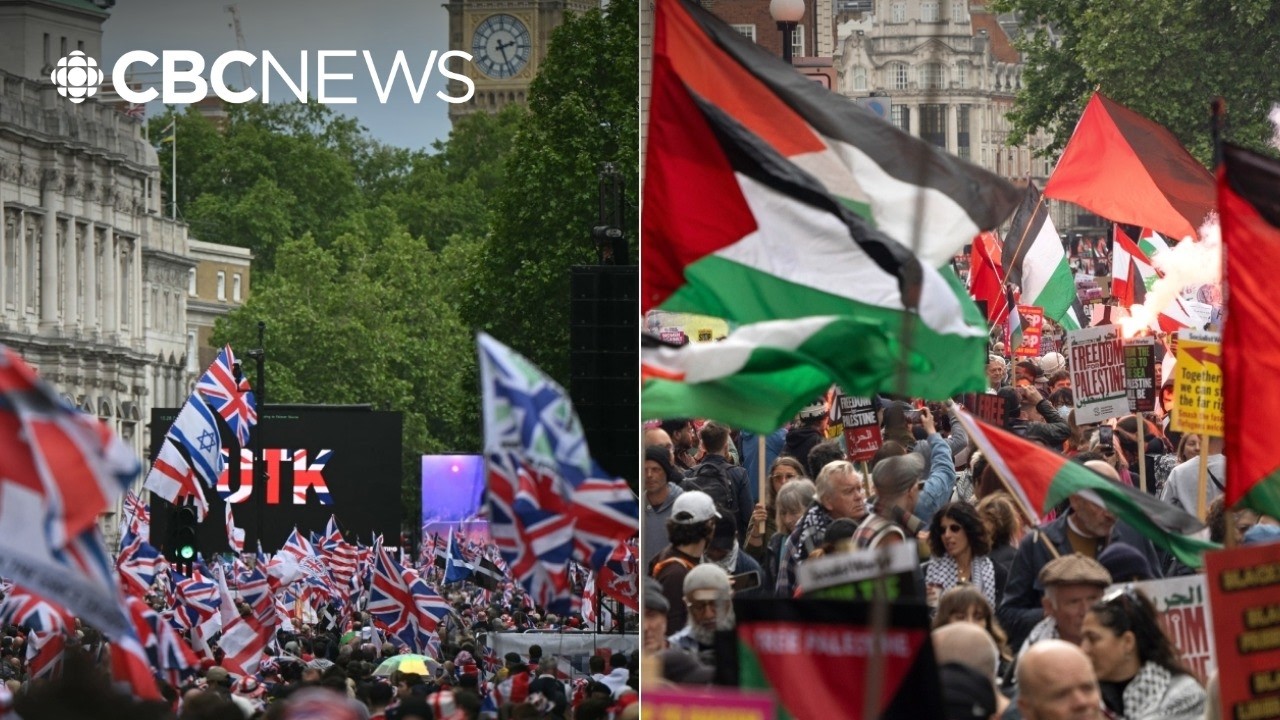
In a dramatic and deeply consequential display of public mobilization, tens of thousands of demonstrators converged upon central London on Saturday for the second consecutive year in what organizers have termed the“Unite the Kingdom” rally—an event that has rapidly evolved into one of the most closely scrutinized and symbolically charged political gatherings in contemporary Britain.
As reported by The Guardian of the UK, the rally—led by pro-Britain activist Tommy Robinson, also known as Stephen Yaxley-Lennon—drew a substantial crowd to Parliament Square, underscoring both the persistence and the growing resonance of a movement that seeks to reframe national identity, civic engagement, and political participation in an era of profound societal transformation.
The scale of the demonstration itself has become a focal point of competing narratives. While police estimates placed attendance at approximately 60,000 individuals, organizers asserted that participation reached far higher levels, pointing as well to the vast online audience that followed the proceedings via livestream. Regardless of the precise figure, the turnout represented a formidable mobilization, one that, as The Guardian observed, “still dwarfs anything ever managed by the English Defense League,” the organization with which Robinson first gained national prominence.
Addressing the assembled crowd in Parliament Square, Robinson delivered remarks that were both urgent and aspirational, framing the moment as one of historic consequence. “Are you ready for the battle of Britain?” he asked, eliciting a resounding response from supporters. Yet he was equally emphatic in clarifying the nature of that “battle,” urging participants to channel their energies into democratic engagement rather than confrontation. “We’re not asking anyone to go out and fight,” he declared. “We have to get political, we have to get involved.”
This emphasis on electoral participation and grassroots activism marked a notable evolution in Robinson’s public messaging. “2029 we have an election,” he reminded the crowd. “If you don’t register to vote, if you don’t get involved, if you don’t become activists, we are going to lose our country forever.” Such language, while undeniably charged, reflects a broader effort to reposition the movement from one defined primarily by protest to one oriented toward institutional influence.
Indeed, Robinson explicitly encouraged his supporters to engage with existing political structures, stating, “I’m not going to tell you which political party you need to join… I don’t care if it’s Reform, if it’s Advance, or it’s Restore, or it’s the Conservative party. We have to locally get involved in politics.” This call for pluralistic political participation suggests an attempt to broaden the movement’s appeal beyond any single ideological or organizational framework.
The rally’s thematic elements further underscored its emphasis on identity and tradition. As The Guardian reported, many participants carried wooden crosses and chanted “Christ is king,” while others donned red hats emblazoned with slogans such as “Make England Great Again.” The visual and rhetorical motifs of the event conveyed a strong sense of cultural affirmation, resonating with attendees who perceive themselves as advocating for continuity in the face of rapid change.
Yet the gathering was not without controversy. Critics, including the campaign group Hope Not Hate, characterized the movement as “deeply worrying,” asserting that its continued scale represents a “significant threat.” Such assessments, widely cited by The Guardian, reflect ongoing concerns about the rhetoric and associations surrounding the movement. At the same time, the persistence of large-scale turnout suggests that these criticisms have not diminished its capacity to mobilize supporters.
The broader political context in which the rally occurred adds further layers of significance. In the weeks preceding the event, the United Kingdom experienced a notable electoral shift, with Reform UK securing more than 1,350 council seats and gaining control of 13 councils. These developments, concentrated in regions such as Essex and Sunderland, have been interpreted by some analysts as indicative of a broader realignment within British politics.
Against this backdrop, the government’s response to the rally has drawn intense scrutiny. In a move that has sparked widespread debate, authorities blocked 11 foreign nationals—described by Prime Minister Keir Starmer as “far-right agitators”—from entering the country ahead of the event. Among those affected was Polish politician Dominik Tarczyński, who addressed the crowd via video link, declaring, “He could ban me. He will not cancel you. And believe me, there will be a day I will be back.”
This decision has been widely interpreted as an attempt to shape the narrative surrounding the rally, particularly by limiting international media coverage. Critics argue that such measures risk undermining fundamental principles of press freedom and transparency. The exclusion of journalists, in particular, has been viewed by many observers as a troubling precedent, raising questions about the extent to which the government is willing to intervene in the dissemination of information during politically sensitive events.
The optics of this decision were further amplified by the scale of the policing operation. The Metropolitan Police deployed approximately 4,000 officers, supported by drones, helicopters, dogs, and armored vehicles, at a reported cost of £4.5 million.
Despite the magnitude of the deployment, authorities emphasized that both events proceeded “largely without significant incident.” By 7:30 p.m., police had made 43 arrests across both demonstrations, a figure that, while not insignificant, suggests that the vast majority of participants engaged in peaceful protest. A police spokesperson acknowledged that “while this may seem high,” the overall conduct of the events remained orderly.
The presence of a concurrent pro-Palestinian “Naqba” demonstration further complicated the dynamics of the day. Calls for the destruction of Israel were heard as part of an organized campaign to delegitimize the Jewish State. The decision to permit both gatherings underscores the delicate balance that authorities must strike in safeguarding the right to protest while maintaining public order. However, the contrasting approaches to different groups have fueled perceptions of inconsistency, particularly in light of the restrictions imposed on foreign participants in the “Unite the Kingdom” rally.
Political leaders were quick to weigh in on the events. London Mayor Sadiq Khan expressed gratitude to “our dedicated Metropolitan Police officers, security services and transport staff,” while emphasizing the importance of protecting “the right to protest peacefully.” At the same time, he reaffirmed that “Londoners will always reject those who seek to divide our communities.”
Justice Secretary David Lammy adopted a more critical tone, asserting that the rally’s organizers were “spreading hatred and division” and “do not reflect the Britain I’m proud of.” Yet he also acknowledged that “peaceful protest is a fundamental right,” pledging that authorities would act “swiftly” should demonstrations turn violent.
Amid these official responses, the voices of participants themselves offered a more personal perspective on the issues at stake. One of the most poignant contributions came from Siobhan Whyte, whose daughter Rhiannon was murdered in a 2024 attack in Walsall. Addressing the crowd, Whyte delivered a searing critique of the government’s leadership. “Keir Starmer… has failed us. He has failed my daughter Rhiannon,” she said. “I believe she would still be alive today if this disgusting excuse of a man had not been in control.”
Such testimony, deeply emotional and profoundly subjective, resonated with many in attendance, highlighting the ways in which broader political debates intersect with individual experiences of loss and insecurity.
The rally also featured expressions of gratitude toward figures perceived as supportive of the movement. Robinson led chants in honor of Elon Musk, stating, “None of this would have happened if it wasn’t for one man. Thank you Elon on behalf of Great Britain.” This acknowledgment reflects the increasingly globalized nature of political discourse, in which digital platforms and high-profile individuals play a significant role in shaping narratives.
At the same time, the presence of extremist elements within the crowd—such as the distribution of flyers advocating for a “future for white people”—cannot be ignored. These materials, reported by The Guardian, underscore the challenges inherent in managing large, heterogeneous movements in which a wide range of perspectives may be represented.
Ultimately, the “Unite the Kingdom” rally stands as a complex and multifaceted phenomenon—one that encapsulates both the aspirations and the tensions of contemporary British society. It is a manifestation of grassroots mobilization, a reflection of shifting political currents, and a focal point for debates over identity, governance, and the limits of state authority.
The government’s decision to restrict foreign participation and media coverage has only heightened the significance of the event, raising fundamental questions about the balance between security and freedom, control and transparency. In seeking to manage the narrative, authorities may have inadvertently amplified it, drawing greater attention to the very issues they sought to contain.
As Britain navigates this moment of uncertainty and change, the events in London serve as a reminder that the vitality of democratic life depends not only on the institutions of governance but on the willingness of citizens to engage, to question, and to make their voices heard. Whether one views the “Unite the Kingdom” movement with sympathy or concern, its emergence as a force in the public sphere is undeniable—and its implications will likely reverberate far beyond the streets of Parliament Square.



