













|
Getting your Trinity Audio player ready...
|
By: Fern Sidman
In an era saturated with documentaries that claim authority over the worlds they depict, “God Speaks Yiddish” emerges as a work of rare intellectual humility and artistic restraint—qualities that paradoxically render it all the more profound. Directed by film auteur Tuvia Tenenbom and rooted in his internationally acclaimed literary work, “Careful Beauties Ahead” the film does not purport to decode the enigmatic universe of the Mea Shearim neighborhood in Jerusalem. Instead, it accomplishes something far more ambitious: it invites the viewer to inhabit that world without the presumption of mastery.
From its opening frames, the documentary establishes a tone that is both contemplative and disarmingly intimate. Where lesser works might impose a didactic narrative upon their subject, “God Speaks Yiddish” unfolds with a patient attentiveness that borders on reverence. It is not a film that explains; it is a film that listens. This is a cinematic experience defined not by exposition, but by presence.
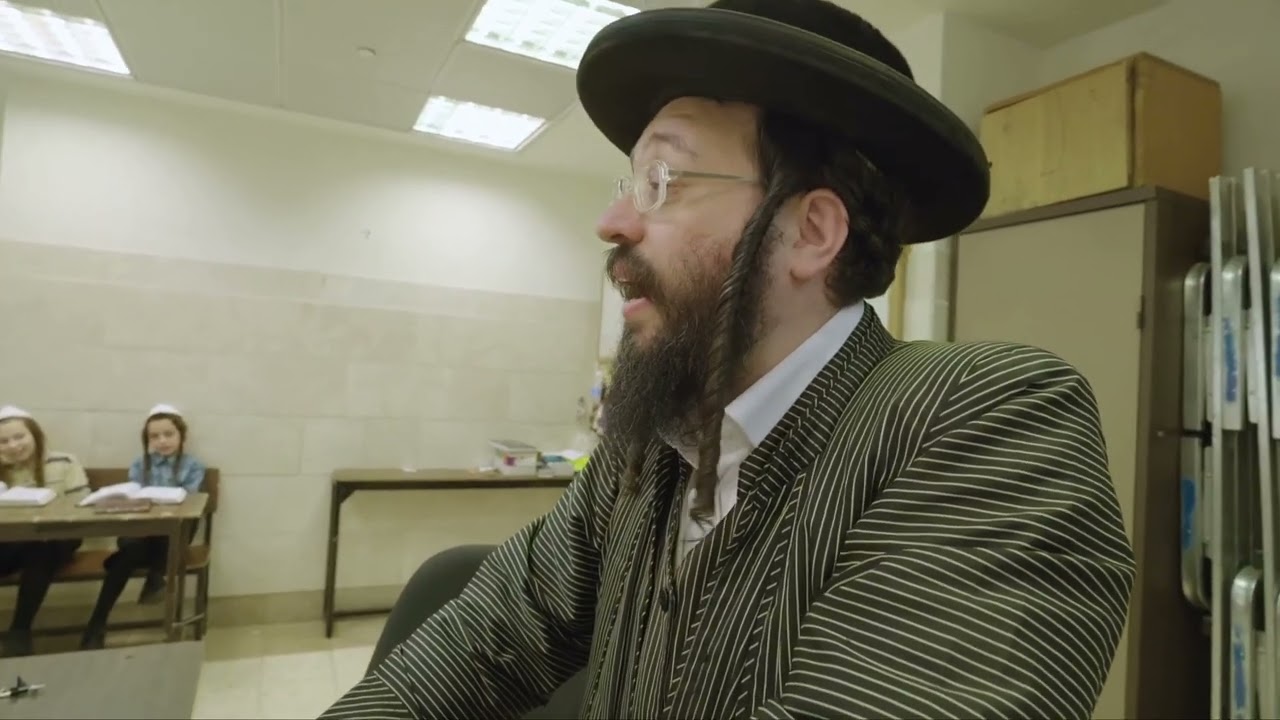
The setting—Mea Shearim, one of Jerusalem’s most insular and misunderstood ultra-Orthodox neighborhoods—has long been the subject of speculation, mythologizing, and, at times, overt hostility from external observers. Tenenbom’s approach is to dismantle these preconceived notions not through argument, but through immersion. The camera lingers in narrow alleyways, modest interiors, and communal spaces, capturing the rhythms of daily life with an almost ethnographic precision. Yet, unlike traditional ethnography, the film resists the impulse to categorize or interpret. It simply observes.
This observational ethos is reinforced by the cinematographic work of Florian Krauss and Isi Tenenbom, whose visual language is one of deliberate understatement. The camera rarely asserts itself; instead, it remains at eye level, quietly attentive to the minutiae of human interaction. Faces are studied, gestures are recorded, and silences are allowed to breathe. The result is an immersive experience that gradually dissolves the barrier between observer and observed.
One of the film’s most striking achievements lies in its treatment of time. In a cinematic landscape often driven by urgency and spectacle, “God Speaks Yiddish” adopts a cadence that mirrors the life it portrays. Scenes unfold with deliberate slowness, allowing the viewer to acclimate to a temporal rhythm defined by repetition, ritual, and continuity. Prayer, conversation, and movement are not merely depicted; they are experienced. The passage of time itself becomes a narrative device, subtly reshaping the viewer’s perception.
The film’s intellectual richness is further enhanced by a series of compelling figures who appear throughout its duration. The presence of Motty Steinmetz introduces an element of transcendent musicality, where the human voice becomes an instrument of devotion. His performances offer a rare glimpse into the spiritual dimensions of a community often reduced to caricature.
In contrast, the inclusion of Dan Schueftan provides a more analytical perspective, one that is at times provocative and unflinchingly direct. His commentary creates a productive tension within the film, juxtaposing external interpretation with internal experience. This dialectic is not resolved; rather, it is allowed to persist, underscoring the film’s commitment to complexity.
Equally compelling is the appearance of Israel Meir Hirsh of Neturei Karta, whose presence embodies a deeply rooted ideological tradition passed down by his father. Hirsh’s perspective is unapologetically distinct and some might say historically grounded, offering insight into a worldview that remains largely repugnant. His contributions serve not as definitive explanations, but as fragments of a larger, more intricate mosaic.
At the center of this cinematic endeavor is Tenenbom himself, whose personal history infuses the film with an additional layer of resonance. Born into an ultra-Orthodox European rabbinical family, he departed that world at the age of 17, embarking on a journey that would take him through Israeli military service and into a career spanning literature and theater. “God Speaks Yiddish” represents a return—not merely in a geographical sense, but in an emotional and intellectual one.
This duality—of insider and outsider, of belonging and estrangement—permeates every frame of the film. The camera, much like its director, occupies a liminal space, simultaneously familiar with and distanced from its subject. This tension is not a flaw but a defining strength. It allows the film to navigate its subject with both intimacy and critical distance, avoiding the pitfalls of both romanticization and alienation.
The documentary’s narrative structure is equally noteworthy for its refusal to conform to conventional expectations. There is no overarching thesis, no definitive conclusion, no moment of revelatory clarity. Instead, meaning emerges gradually, through the accumulation of anecdotes, observations, and fleeting interactions. Conversations unfold organically, often without resolution. Silences linger, inviting contemplation rather than closure.
This open-endedness is perhaps the film’s most daring attribute. In a cultural moment characterized by a demand for immediate understanding and definitive answers, “God Speaks Yiddish” insists on the value of uncertainty. It challenges the viewer to relinquish the desire for comprehension and to embrace the ambiguity inherent in any encounter with the unfamiliar.
The film’s international reception further attests to its significance. The project has achieved remarkable success across multiple linguistic and cultural contexts, with editions of the accompanying book reaching bestseller status in Germany, Israel, and beyond. This global resonance underscores the universality of the film’s central inquiry: how does one engage with a world that resists easy explanation?
Recognition has followed accordingly. The documentary’s accolade as Best Documentary 2024 at the Indie Film Festival Berlin is not merely a testament to its technical excellence, but to its intellectual courage. It is a film that dares to be quiet in a noisy world, to be patient in an impatient age.
Yet perhaps the most compelling aspect of “God Speaks Yiddish” is its ethical stance. By refusing to impose meaning upon its subject, it accords its participants a degree of dignity rarely afforded in documentary cinema. They are not reduced to symbols or case studies; they are allowed to exist in their full complexity. This approach transforms the act of viewing into a form of engagement that is both respectful and deeply human.
The film’s availability to a global audience ensures that its impact extends far beyond the confines of festival circuits. It invites viewers from diverse backgrounds to enter a world that is at once particular and universal, unfamiliar and deeply resonant.
In the final analysis, “God Speaks Yiddish” stands as a singular achievement in contemporary documentary filmmaking. It is not a work that seeks to answer questions, but one that compels the viewer to reconsider the very nature of inquiry. It reminds us that some worlds cannot be decoded, only experienced—and that in that experience lies a form of understanding far more profound than any explanation.
The film’s power resides in its willingness to remain unresolved. It is a cinematic meditation on the limits of knowledge, the richness of lived experience, and the enduring mystery of human existence.
To watch “God Speaks Yiddish” is not merely to observe another culture; it is to confront the boundaries of one’s own perception. And in that confrontation, the film achieves something extraordinary: it transforms the act of viewing into an act of reflection, and the screen into a mirror.



