





























Israel’s Entrepreneurial Powerhouses: How Technion and Tel Aviv University Are Shaping the Future of Global Innovation
By: Fern Sidman
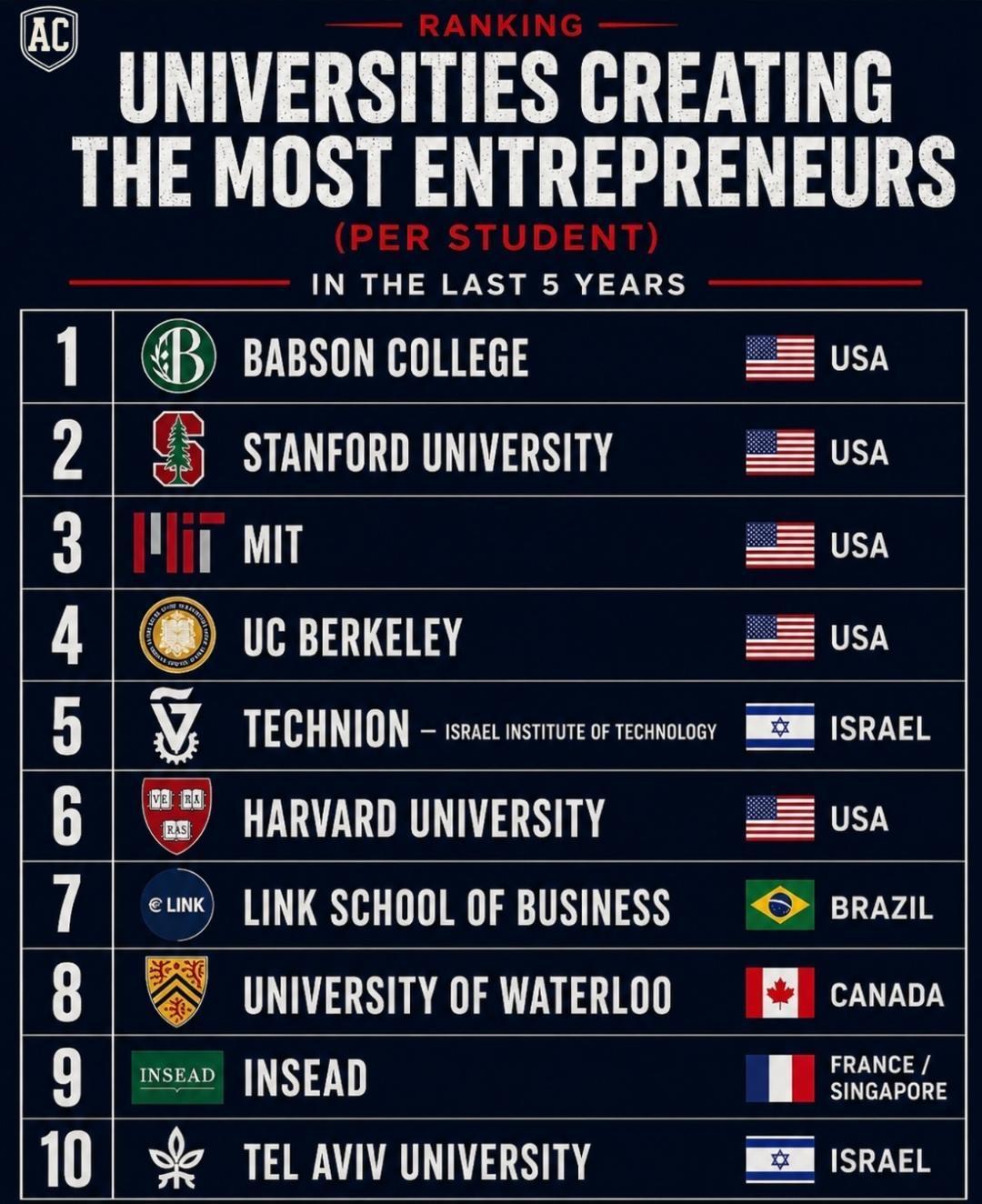
In an era in which technological ingenuity, scientific discovery, and entrepreneurial dynamism increasingly define national influence, two Israeli institutions have once again secured their place among the world’s most consequential engines of innovation. Recent global rankings highlighting universities that produce the greatest number of entrepreneurs per student over the past five years placed the Technion – Israel Institute of Technology and Tel Aviv University among the world’s top 10 institutions for cultivating entrepreneurial talent.
The distinction is far more than a symbolic academic accolade. It represents a profound affirmation of Israel’s enduring status as the “Start-Up Nation” and underscores the extraordinary influence these universities exert not merely on Israel’s economy, but on the global technological landscape itself.
In a ranking dominated by prestigious American institutions such as Stanford University, MIT, Harvard University, and UC Berkeley, the appearance of two Israeli universities is a remarkable achievement for a nation of fewer than 10 million people. According to multiple analyses based on venture-capital-backed startup formation, Israel stands alone outside the United States in placing two universities among the global entrepreneurial elite.
The accomplishment speaks volumes about the culture of innovation that has become deeply embedded within Israeli higher education.
At the heart of that success stands the Technion in Haifa, a university whose influence on modern technology is difficult to overstate.
Founded in 1912, decades before the establishment of the State of Israel itself, the Technion has long served as one of the intellectual pillars upon which the nation’s scientific and economic development was built. Over more than a century, it has evolved into a global center for engineering, computer science, biotechnology, artificial intelligence, energy research, aerospace development, and advanced manufacturing.
Its alumni have become synonymous with Israeli innovation. Recent entrepreneurship rankings show that Technion graduates have founded hundreds of venture-backed companies and have collectively raised tens of billions of dollars in investment capital. According to Technion reports based on PitchBook data, graduates have established more than 1,000 companies led by approximately 1,300 entrepreneurs, generating more than $43 billion in funding.
Such numbers are not merely statistics. They represent life-saving medical technologies, revolutionary cybersecurity systems, advanced artificial intelligence applications, breakthrough semiconductor designs, cutting-edge renewable energy innovations, and transformative software platforms used by millions around the world.
The Technion’s entrepreneurial ecosystem has become so influential that it now operates extensive innovation programs specifically designed to transform scientific discoveries into commercial ventures. Through initiatives such as t:hub, students and researchers receive mentorship, startup training, networking opportunities, and access to investors capable of turning academic concepts into global enterprises.
The university’s impact extends well beyond Israel’s borders. Technion-trained engineers, scientists, and entrepreneurs have played central roles in the creation and expansion of companies operating in cybersecurity, medical technology, telecommunications, cloud computing, autonomous systems, and artificial intelligence. The institution’s reputation has become so formidable that many multinational corporations maintain close ties with its research community.
The university’s leadership in entrepreneurship is hardly accidental. The Technion actively cultivates a culture that encourages risk-taking, invention, and commercialization. Rather than viewing academic research as an isolated intellectual exercise, it encourages students to see innovation as a vehicle for solving real-world challenges while creating economic value.
Equally impressive is the performance of Tel Aviv University, which has emerged as one of the world’s most prolific incubators of entrepreneurial talent.
Ranked among the leading universities globally for producing venture-backed founders, Tel Aviv University has become a cornerstone of Israel’s innovation ecosystem. Several studies and rankings place it as the highest-ranked institution outside the United States in entrepreneurship metrics.
Its graduates have helped create hundreds of successful startups that collectively have raised tens of billions of dollars in venture capital funding. Recent data indicate that Tel Aviv University alumni founded approximately 736 companies and attracted more than $30 billion in venture investment over the past decade.
The university’s extraordinary entrepreneurial success is closely linked to its location in the heart of one of the world’s most vibrant innovation hubs.
Tel Aviv has become synonymous with technological disruption and startup creation. The city consistently ranks among the world’s premier startup ecosystems, attracting billions of dollars in investment and generating companies that compete on a global scale. Recent international rankings elevated Tel Aviv to 4th place worldwide among startup ecosystems, surpassing many far larger metropolitan centers.
Tel Aviv University sits at the center of that ecosystem. Its researchers collaborate with industry leaders, venture capital firms, entrepreneurs, and multinational corporations. Students are immersed in an environment where startup creation is not viewed as an exception but as a natural extension of academic achievement.
The institution’s Coller School of Management has become particularly renowned for entrepreneurship education and innovation leadership. Multiple international rankings have recognized its programs for producing founders who go on to create high-growth companies and attract substantial venture capital investment.
Yet the significance of these universities extends far beyond financial metrics. Their graduates are helping to address some of humanity’s most pressing challenges.
Israeli entrepreneurs emerging from Technion and Tel Aviv University are developing technologies aimed at improving healthcare outcomes, enhancing cybersecurity defenses, increasing agricultural productivity, combating climate change, advancing artificial intelligence, and transforming transportation systems.
In many cases, innovations originating from these institutions have had profound humanitarian implications.
Israeli-developed medical technologies save lives in hospitals around the world. Cybersecurity firms founded by Israeli entrepreneurs protect governments, corporations, and critical infrastructure from increasingly sophisticated digital threats. Artificial intelligence systems developed by Israeli innovators are reshaping industries ranging from finance to healthcare.
The impact is both economic and societal. These universities have become global exporters not merely of technology but of talent, ideas, and solutions.
Their success also challenges conventional assumptions regarding the relationship between national size and global influence.
Israel’s population is smaller than that of many major metropolitan areas, yet its universities consistently compete with and often outperform institutions located in vastly larger countries with substantially greater resources.
The explanation lies partly in culture. Israeli higher education has long emphasized creativity, independent thinking, problem-solving, and intellectual audacity. Students are encouraged to question assumptions, challenge existing frameworks, and pursue unconventional solutions.
Those characteristics are precisely the qualities that successful entrepreneurs require. They are also qualities that both the Technion and Tel Aviv University have cultivated with remarkable consistency over decades.
The latest rankings therefore represent more than an academic triumph. They serve as confirmation that Israel’s model of integrating research excellence, entrepreneurial education, technological innovation, and industry collaboration continues to produce extraordinary results.
As global economies increasingly depend upon innovation-driven growth, institutions capable of producing visionary entrepreneurs will wield growing influence over the future.
In that regard, the Technion and Tel Aviv University occupy a position of exceptional distinction.
Their graduates are not merely creating companies. They are creating industries, redefining technological frontiers, generating employment, attracting investment, and developing solutions to challenges that affect billions of people.
At a time when innovation has become one of the most important currencies of the modern world, these two Israeli universities stand as powerful reminders that intellectual capital remains among a nation’s most valuable resources.
Their place among the world’s top entrepreneurial institutions is neither accidental nor temporary. It is the product of decades of scientific excellence, educational rigor, and a relentless commitment to transforming ideas into reality.
The result is a legacy that extends far beyond Israel’s borders and continues to shape the future of the global economy itself.



