


















By: Fern Sidman
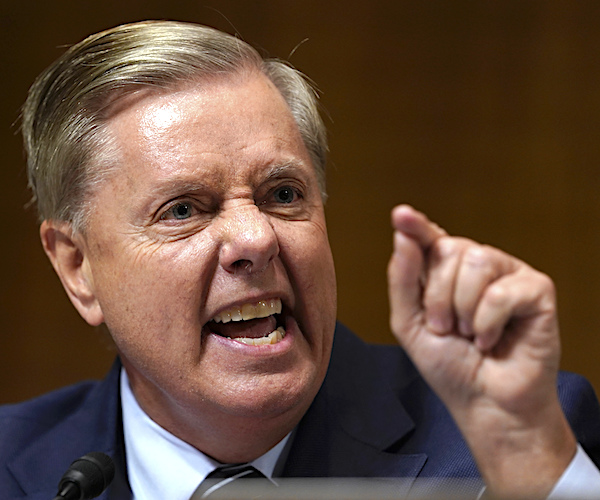
As debate intensifies over the contours of a potential diplomatic agreement between the United States and Iran, Republican Senator Lindsey Graham has emerged as one of the most prominent voices expressing concern about reports describing the possible framework of a future accord. According to a report on Friday by Israel National News, Graham welcomed President Trump’s rejection of Iranian media accounts regarding the proposed arrangement, while simultaneously warning that any agreement resembling previously reported details would raise profound strategic, financial, and national security concerns.
The remarks come at a pivotal moment in the evolving relationship between Washington and Tehran, as negotiations continue against the backdrop of months of military confrontation, economic pressure, and international diplomatic maneuvering. Israel National News reported that Graham’s comments reflected both support for the Trump administration’s efforts to weaken Iran militarily and economically and apprehension about the possibility that Tehran could receive substantial benefits without sufficiently dismantling the infrastructure that has long alarmed American policymakers and regional allies.
In a statement highlighted by Israel National News, Graham expressed relief that President Trump had publicly challenged reports emanating from Iranian media outlets regarding the substance of a proposed deal. “I am very glad to hear from President Donald Trump that Iranian media reports about the so-called deal are fake because the deal as described by Iran would be awful,” Graham stated.
The senator’s comments underscore the degree to which competing narratives have emerged regarding the negotiations. While Iranian officials have suggested that significant sanctions relief and economic benefits could be part of a future settlement, American officials have insisted that any agreement would be based on performance, verification, and strict compliance with obligations imposed on Tehran.
According to the Israel National News report, Graham emphasized that recent American military operations and economic pressure campaigns have significantly altered the strategic balance in the region. “President Trump and our military deserve a lot of credit for making Iran the weakest they’ve been since 1979 through a combination of highly effective military strikes and a crushing blockade,” Graham said.
That assessment reflects a view widely held among many congressional Republicans who believe that sustained pressure has substantially diminished Iran’s military capabilities, weakened its regional influence, and created conditions more favorable to American negotiating objectives.
Graham’s remarks also highlighted his broader critique of the Iranian regime itself. According to the Israel National News report, he argued that policymakers must not lose sight of the nature of the government in Tehran when evaluating any prospective agreement. “However, we must remember the Iranian regime has killed 42,000 of their own people for simply wanting a better life, and their leadership are radical religious Nazis,” Graham declared.
The senator’s language reflected his longstanding position that Iran’s leadership remains fundamentally hostile to Western interests and should not be treated as a trustworthy negotiating partner absent substantial structural changes in its behavior.
The most pointed criticism from Graham focused on reports suggesting that a future agreement could involve significant economic assistance or reconstruction funding for Iran.
According to the Israel National News report, one of the elements that reportedly alarmed the senator was discussion of a reconstruction fund that could potentially provide hundreds of billions of dollars in assistance to the Iranian economy. “As to any potential deal, it must be compared to the JCPOA, and I am hopeful that it will be vastly different,” Graham stated.
The Joint Comprehensive Plan of Action, commonly known as the JCPOA, was negotiated during the Obama administration and has remained a focal point of political debate for more than a decade. Critics have argued that the agreement provided Iran with financial relief while allowing it to retain significant elements of its nuclear infrastructure. Supporters have maintained that it imposed meaningful restrictions and monitoring mechanisms.
Graham has consistently aligned himself with critics of the agreement and used it as a benchmark against which any future arrangement should be measured. “The idea of a $300 billion reconstruction fund, given who is in charge of Iran, seems to be tone deaf,” he said.
The senator then invoked a striking historical analogy to illustrate his concerns. “It would be akin to a Marshall Plan for Germany with the Nazis still in charge. That wouldn’t have been a good idea then, and any reconstruction fund that benefits this terrorist regime wouldn’t be a good idea now.”
According to the Israel National News report, Graham’s comments reflect a broader concern among many lawmakers that large-scale economic assistance could strengthen the Iranian government rather than encourage meaningful reform or moderation.
Beyond financial considerations, Graham focused considerable attention on the nuclear dimension of the negotiations. For many members of Congress, the future of Iran’s nuclear program remains the central issue around which any agreement must be evaluated.
Israel National News reported that Graham reiterated what he described as President Trump’s longstanding position regarding uranium enrichment. “As to the Iranian nuclear program, President Trump’s red line has been no enrichment. I hope that holds — as it must,” Graham said.
The issue of enrichment has occupied a central place in international diplomacy concerning Iran for decades. Critics of previous agreements have argued that permitting Iran to maintain enrichment capabilities leaves open a pathway toward future nuclear weapons development. Supporters of negotiated arrangements have often countered that monitored enrichment can exist within a peaceful civilian nuclear framework.
Graham left little doubt regarding where he stands on the matter. “Allowing Iran to enrich under the JCPOA was one of the major flaws of that terrible deal,” he stated.
The senator’s insistence on a complete prohibition of enrichment aligns with the views of many congressional conservatives and several American allies in the Middle East who believe that any enrichment capability ultimately presents an unacceptable risk. The debate surrounding the prospective agreement extends beyond policy considerations and into questions of constitutional authority and congressional oversight.
Graham emphasized that Congress should play a decisive role in evaluating any arrangement reached by the executive branch. “As I’ve stated before, any deal with Iran must come to Congress for scrutiny and approval,” he declared.
That position reflects a growing sentiment among lawmakers from both parties who argue that agreements carrying significant strategic, economic, and national security implications should not be implemented without legislative examination. Israel National News reported that Graham’s call for congressional review comes amid increasing public discussion about the exact contents of the proposed framework. While administration officials have sought to reassure critics that economic benefits would be tied to Iranian compliance and that nuclear safeguards would remain central to any agreement, skepticism persists among many lawmakers who remember the controversies surrounding previous diplomatic efforts.
The senator’s intervention also highlights the broader political stakes confronting the Trump administration. Any agreement with Iran is likely to be scrutinized not only for its immediate impact on regional stability but also for whether it fulfills promises repeatedly articulated by the president and his supporters.
Among those promises is the assertion that future negotiations would produce a result fundamentally different from earlier arrangements and would eliminate pathways to nuclear weapons development rather than merely delay them.
According to the Israel National News report, Graham’s remarks were therefore both a warning and a challenge. They signaled support for the administration’s pressure campaign while making clear that many members of Congress will closely examine whether the final agreement matches the objectives that have been publicly articulated throughout the negotiation process.
As discussions continue and additional details emerge, the senator’s comments underscore a reality that will likely shape the next phase of debate: any agreement with Iran will face intense scrutiny from lawmakers, foreign policy experts, regional allies, and the American public.
Whether the final framework ultimately satisfies those concerns remains to be seen. What is already clear, however, is that influential voices such as Graham’s intend to measure any accord against strict standards involving nuclear dismantlement, economic accountability, and congressional oversight. According to Israel National News, the senator believes those standards are essential not only to American national security but also to ensuring that any future agreement avoids what he views as the shortcomings of past diplomatic efforts.



