




















Jerry Seinfeld’s Sharp Retort to Anti-Israel Provocation After Knicks Game Draws Widespread Attention
By: Julie Herndon
Veteran comedian and television icon Jerry Seinfeld once again found himself at the center of a politically charged public encounter this week, delivering a brief but memorable response to an individual who attempted to challenge him over his well-known support for Israel.
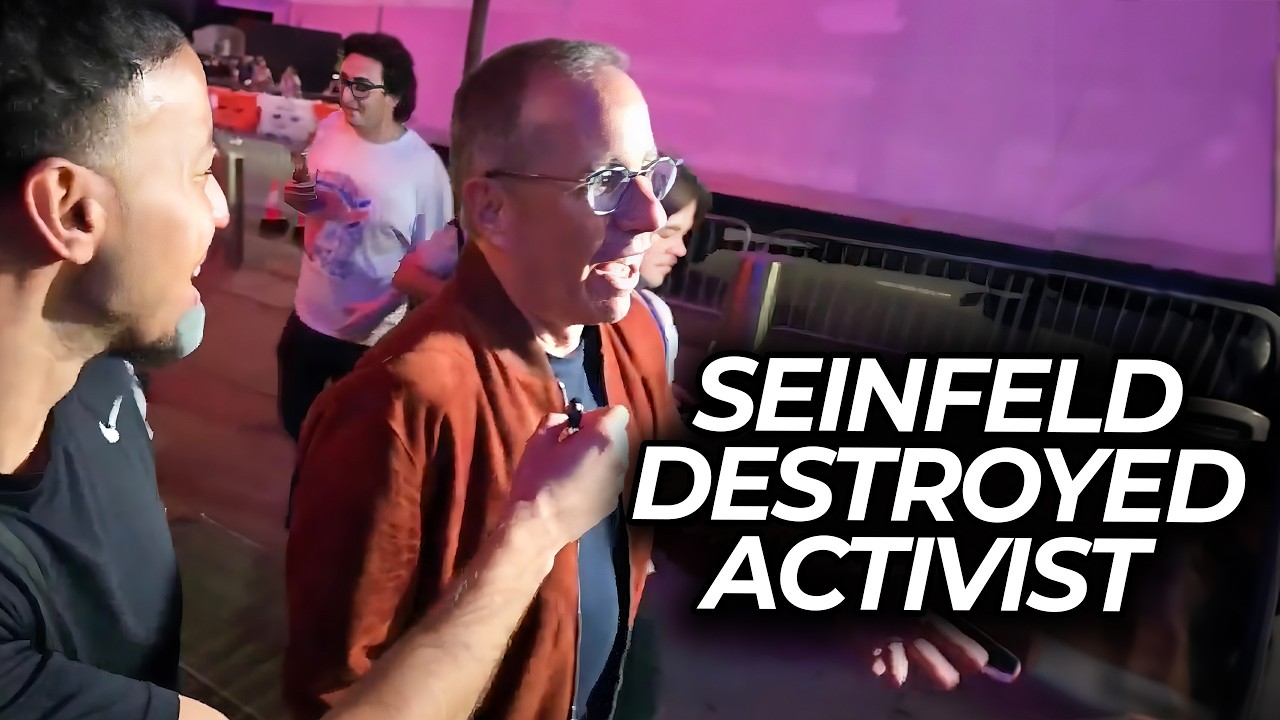
According to a report on Thursday at Israel National News, the incident unfolded on Wednesday evening outside Madison Square Garden in Manhattan following a dramatic NBA Finals contest in which the New York Knicks narrowly defeated the San Antonio Spurs by a score of 107-106. As jubilant fans streamed out of the arena after the closely contested game, Seinfeld was approached by a livestreamer who sought to engage the comedian in a politically provocative exchange.
The encounter, which was captured on video and subsequently circulated across social media platforms, quickly generated significant public attention, with many observers focusing on Seinfeld’s characteristically concise and unscripted response.
According to the information provided in the Israel National News report, the individual who approached Seinfeld was a content creator known online as “FinesseFave.” While livestreaming, the individual reportedly placed a microphone in front of the comedian and asked whether he would say, “Free Palestine.”
Rather than engage in a prolonged discussion or attempt to debate the issue, Seinfeld reportedly laughed and immediately responded, “It doesn’t exist,” before continuing on his way.
The brevity of the exchange was characteristic of the comedian whose career has been built upon sharp observational humor, quick wit, and an ability to deliver memorable punchlines in just a few words.
Within hours, clips of the encounter spread widely across social media platforms, generating extensive commentary from supporters and critics alike. Israel National News noted that the video quickly became a subject of discussion among commentators examining the increasingly frequent intersection of politics, celebrity culture, and social media activism.
As Israel National News has frequently reported, Seinfeld has never hidden his support for Israel. Over the years, the comedian has publicly expressed his connection to the Jewish state and has maintained relationships with Israeli cultural and charitable organizations.
Unlike many public figures who seek to avoid controversial political discussions, Seinfeld has often appeared willing to state his views openly despite the likelihood of criticism. His position has become particularly visible in the aftermath of the October 7 attacks and the subsequent conflict that has generated intense debate throughout the entertainment industry.
Many celebrities have faced pressure from activists, advocacy organizations, and social media campaigns to publicly endorse one side or another in the conflict. Some have chosen silence, while others have become vocal advocates for various causes. Seinfeld belongs to a category of public figures who have consistently maintained their support for Israel despite criticism and occasional public confrontations.
According to Israel National News, the latest incident is far from the first time Seinfeld has been confronted in public because of his views. Over the past several years, activists and demonstrators have occasionally targeted celebrities whose positions on Middle Eastern issues differ from their own. In Seinfeld’s case, such encounters have frequently generated media attention because of the comedian’s ability to respond with humor rather than outrage.
Israel National News recalled a previous incident in which an individual approached Seinfeld under the pretense of requesting a photograph. After posing for a selfie, the individual reportedly made a political statement in support of the Palestinian cause. Rather than becoming embroiled in a lengthy confrontation, Seinfeld responded directly and bluntly, generating another viral moment that was widely discussed across both traditional and social media platforms.
Such episodes have contributed to a growing public perception that the comedian is unlikely to be intimidated by attempts to publicly pressure him regarding his political views.
The exchange comes at a time when political activism increasingly intersects with entertainment culture. According to observers cited in discussions surrounding the incident, public figures today face an environment in which political questions often emerge unexpectedly during interviews, public appearances, sporting events, and even casual encounters.
The rise of livestreaming and social media content creation has further intensified this phenomenon. Individuals with smartphones and internet audiences frequently seek interactions with celebrities in hopes of generating viral content. These encounters are often designed to provoke reactions that can later be shared online.
In many cases, public figures choose to ignore such approaches altogether. Others respond defensively. Seinfeld’s reaction stood out precisely because of its combination of brevity, confidence, and humor. Supporters argued that his response demonstrated an unwillingness to be drawn into a confrontation staged for social media consumption.
Throughout his decades-long career, Seinfeld has cultivated a reputation for intellectual independence and candor. Best known as the co-creator and star of the enormously successful sitcom *Seinfeld*, he remains one of the most influential figures in American comedy. His observations on culture, politics, entertainment, and public life have often attracted attention precisely because he tends to express himself without the careful scripting that characterizes many modern celebrity statements.
According to commentators discussing the latest incident, Seinfeld’s response reflected a broader tendency to reject what he perceives as performative activism or public pressure campaigns. Rather than issue carefully crafted public relations language, he often responds spontaneously and directly. That approach has earned both admiration and criticism, but it has also reinforced his reputation as a public figure who rarely modifies his views in response to external pressure.
As the video circulated online, reactions were sharply divided. Supporters praised Seinfeld for standing by his convictions and refusing to be pressured into making a political statement that did not reflect his views. Others criticized the remark and argued that public figures should exercise greater caution when discussing highly sensitive geopolitical issues. The polarized reactions reflected the broader divisions that have characterized public discourse surrounding the Israeli-Palestinian conflict.
The Israel National News report noted that the exchange quickly became another example of how even brief interactions involving prominent public figures can become significant cultural moments in an era dominated by social media.
The incident underscores the extent to which discussions regarding Israel and the broader Middle East continue to permeate popular culture, sports, entertainment, and public life. For celebrities such as Seinfeld, whose views on these issues are already well known, unexpected confrontations have become an increasingly common feature of public appearances.
Whether viewed as a humorous exchange, a political statement, or simply another viral social media moment, the encounter highlighted the ongoing tensions surrounding public discussions of Israel and the willingness of some public figures to address those issues directly.
As Israel National News reported, Seinfeld’s latest response was delivered in only a few words. Yet those few words generated widespread attention, demonstrating once again how celebrity, politics, and social media continue to intersect in unpredictable and often highly visible ways.
For Jerry Seinfeld, the episode represented another chapter in a growing series of public encounters in which he has declined to retreat from his stated views. For supporters and critics alike, the exchange served as a reminder that even the briefest remarks from a globally recognized entertainer can reverberate far beyond the moment in which they are spoken.



