



|
Getting your Trinity Audio player ready...
|
By: Jerome Brookshire – Jewish Voice News
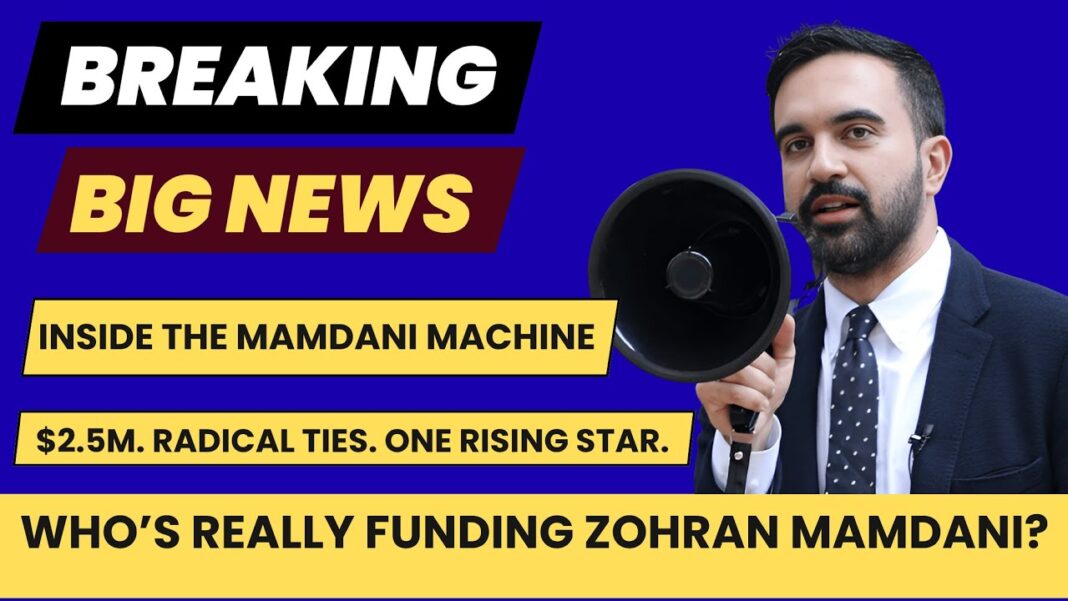
In the final days before New York’s mayoral election, the campaign of Democratic Socialist frontrunner Zohran Mamdani has entered a paradoxical phase—one that even his most ardent supporters can no longer ignore. While the 34-year-old Assemblyman from Queens continues to rail against billionaires, the corporate elite, and “capitalist control of politics,” a growing body of evidence—reported by The Daily Mail of the UK on Tuesday—reveals that some of the most powerful figures in Democratic politics and global finance are quietly bankrolling his rise.
At a raucous rally on Sunday night at Forest Hills Stadium, a visibly impassioned Senator Bernie Sanders delivered what was meant to be a moment of triumph for the Mamdani campaign. “Do everything you can to work with Zohran,” Sanders implored the roaring crowd, “to make him and his administration the best in the history of New York.” Yet his next words carried an unintended chill. “He’s not going to have all the answers.”
As The Daily Mail report noted, it was an oddly unsteady endorsement—one tinged with both urgency and forewarning. To many observers, it sounded less like a victory speech and more like a plea: a tacit admission that the youngest and least experienced candidate in modern memory to seek New York’s highest office is walking into a role for which charisma and ideological zeal alone will not suffice.
For all his magnetic appeal and “everyman” authenticity, Mamdani’s record as a legislator in Albany has been modest at best. Out of twenty bills he introduced, only three passed, a figure that The Daily Mail report described as “a performance that would normally disqualify a candidate from serious contention.” Yet Mamdani’s ascent has been propelled by something rarer than legislative success—a mythology of purity.
To his fervent supporters, he represents the “unbought, unbossed” future of politics—a sharp rebuke to the money-soaked cynicism of the political class. But as The Daily Mail revealed in its exposé, Mamdani’s anti-billionaire narrative is increasingly undermined by the astonishing network of powerful donors, strategists, and former Obama aides who now orbit his campaign.
The revelation that George Soros, the 95-year-old financier once dubbed “the man who broke the Bank of England,” has been quietly underwriting the political ecosystem surrounding Mamdani sent shockwaves through both the city’s Jewish community and the broader political establishment. Soros’s $25 billion Open Society Foundations (OSF), The Daily Mail reported, has “indirectly funneled” at least $37 million to organizations that have either endorsed or materially supported Mamdani’s mayoral campaign—including the Working Families Party and several smaller progressive action groups.
This funding network, operating through an intricate web of non-profit entities, represents the very form of institutional power that Mamdani publicly decries. Yet its beneficiaries appear to have been indispensable to his success.
As The Daily Mail report further detailed, Mamdani’s ties to Soros’s philanthropic empire are not recent—and not merely political. They are personal and intergenerational.
In 2004, Mamdani’s mother, Mira Nair, the Oscar-nominated filmmaker best known for Monsoon Wedding, founded the Maisha Film Lab in Uganda to train young African filmmakers. On its own website, the school acknowledges funding from Soros’s Open Society Foundations.
Meanwhile, Mamdani’s father, Mahmood Mamdani, a Marxist historian and director of the Makerere Institute of Social Research in Kampala, has also received Soros-linked grants for academic projects. Between 2020 and 2023, The Daily Mail found that the Open Society Foundations contributed $620,000 to Makerere University, including a $450,000 grant for a project described as “the decolonization of knowledge in Africa.”
The ideological harmony between Soros’s globalist philanthropy and Mamdani’s anti-capitalist worldview has made their association politically potent—and, to critics, deeply hypocritical. As New York Mayor Eric Adams put it, “While Zohran Mamdani attacks job creators and rails against wealth, the truth is he’s benefiting from millions in support from billionaires and the very non-profit network he pretends to stand apart from.”
Republican candidate Curtis Sliwa, meanwhile, was blunter: “He wants to get rid of the billionaires—except the ones who bankroll his radical agenda.”
Perhaps the most striking revelations in The Daily Mail’s report on Tuesday concern the Obama-era political machine now repurposed to guide Mamdani’s campaign.
At the center of that nexus stands Patrick Gaspard, the former U.S. Ambassador to South Africa, ex-president of the Open Society Foundations, and before that, President Obama’s political director. For three years, Gaspard oversaw OSF’s vast philanthropic network, earning over $1 million in 2020 alone, before stepping down to reenter the political arena.
Today, Gaspard is one of Mamdani’s closest informal advisers, quietly shaping strategy and outreach. His presence, The Daily Mail report noted, “cements the perception that Mamdani’s campaign, while publicly anti-establishment, is in fact deeply enmeshed in the Democratic Party’s most elite networks.”
But Gaspard is far from alone. According to The Daily Mail’s investigation, a constellation of Obama loyalists—including David Axelrod, Dan Pfeiffer, and Jon Favreau—have all established communication with Mamdani’s inner circle in recent months.
Axelrod, Obama’s longtime strategist, even visited Mamdani’s campaign headquarters this summer. “He has a spirit I haven’t seen in a while—an upbeat idealism,” Axelrod told reporters afterward. “You may not agree with every answer he gives, but he’s asking the right questions.”
That endorsement, subtle but unmistakable, mirrors the sentiment of Barack Obama himself, who reportedly made a “lengthy congratulatory call” to Mamdani after his stunning primary victory over Andrew Cuomo. As The Daily Mail and The New York Times both confirmed, Obama “offered advice about governing and the importance of giving people hope in a dark time.”
The symbolism was powerful. But for Mamdani’s supporters—many of whom consider Obama a symbol of establishment compromise—the embrace was an uneasy one.
While Mamdani publicly disavows big money in politics, his campaign has relied heavily on high-priced consultants and media firms linked to the Democratic elite.
The Daily Mail report revealed that the Debra Schommer Media Group, a Los Angeles-based consultancy that previously handled advertising for Obama’s campaigns, has been paid more than $3 million for Mamdani’s television and digital media buys. The firm’s founder, Debra Schommer, once led media planning for Axe Media, the agency co-founded by David Axelrod and David Plouffe—Obama’s two closest political architects.
To progressive idealists who believed Mamdani represented a clean break from the old order, these revelations cut deep. “The same operatives who made Obama a brand are now rebranding socialism for a new generation,” one longtime Democratic strategist told The Daily Mail. “It’s less a revolution than a reboot.”
At Sunday’s “New York Is Not for Sale” rally, Bernie Sanders’s thinly veiled hesitation reflected a growing concern within the far-left movement. As The Daily Mail report observed, the Vermont senator’s appeal for unity sounded more like a plea for oversight—a reminder that even among progressives, Mamdani’s alliances raise eyebrows.
“Ordinary people get one vote,” Sanders told the cheering stadium crowd. “Meanwhile, billionaires get the opportunity to spend as much as they want to elect the candidates they want.” The irony was hard to miss: among the most influential billionaires shaping this election is George Soros himself, whose philanthropic empire has become the quiet engine behind Mamdani’s political ascent.
For a candidate who rails daily against “the billionaire class,” it is a contradiction of Shakespearean proportions.
The Daily Mail report described Mamdani as “a product of the very elite he claims to despise.” Born to an acclaimed filmmaker and an Ivy League-educated scholar, educated at Bowdoin College, and now courted by former presidents and billionaires, Mamdani’s biography defies the populist mythos that surrounds him.
Yet, it is precisely this paradox that has made him such a compelling—and divisive—figure in American politics. To his supporters, Mamdani’s cosmopolitan pedigree only enhances his credibility as a reformer who “understands privilege from the inside.” To his critics, it proves he is “a socialist in rhetoric but an insider in reality,” as The Daily Mail succinctly put it.
As Election Day looms, Mamdani’s path forward appears both paved and perilous. His campaign has become a convergence point for every faction of the Democratic Party: from the Sanders-AOC left, hungry for ideological purity, to the Obama establishment, eager to mold him into a palatable progressive for the national stage.
But for all the soaring rhetoric about equity, justice, and “New York for the many,” Mamdani’s movement has already been touched by the same forces it claims to oppose. The Soros donations, the Obama alumni network, the million-dollar consultants—each reveals a campaign less revolutionary than transactional, less insurgent than carefully stage-managed.
As The Daily Mail report observed, “Mamdani’s candidacy has become a mirror of the Democratic Party’s internal struggle—a party that cannot decide whether to tear down the establishment or simply rename it.”
For New Yorkers heading to the polls, the choice may seem clear-cut: reform versus continuity, socialism versus centrism. But behind the slogans and the rallies, the 2025 mayoral election has exposed something more fundamental—a collision between idealism and influence, between the purity of a movement and the machinery that sustains it.
And as Bernie Sanders himself warned, “Zohran Mamdani is not going to have all the answers.”
It is, perhaps, the one line in this long, strange campaign that no one—supporter or critic—can disagree with.
