



|
Getting your Trinity Audio player ready...
|
By: Fern Sidman
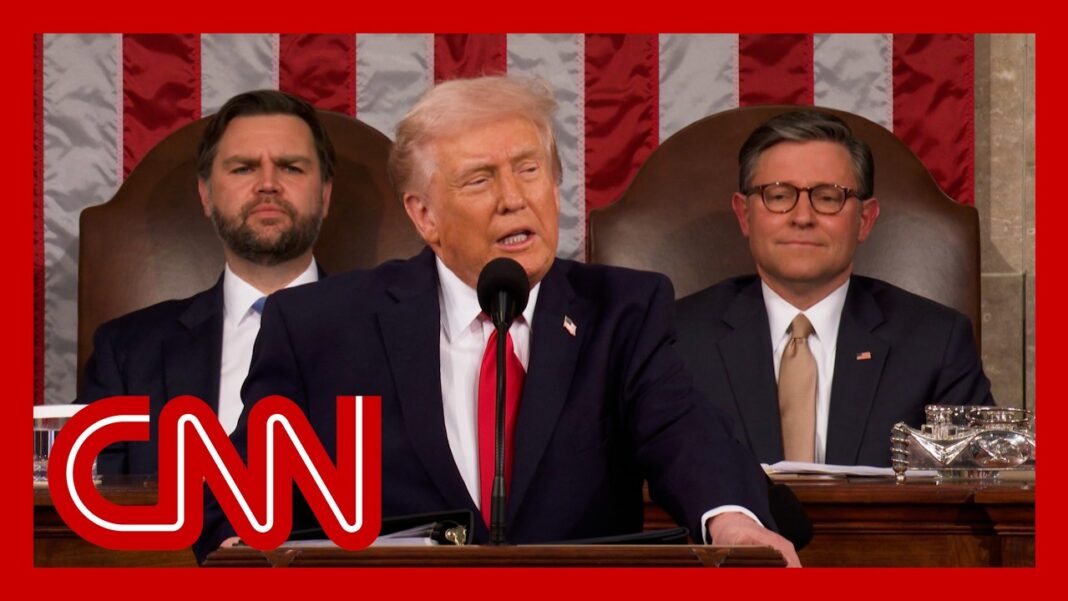
In a State of the Union address that blended triumphalism with warning, economic narrative with geopolitical brinkmanship, President Donald Trump on Tuesday night set out to persuade Congress and the country that the United States is in the midst of what he termed “a turnaround for the ages.” Delivering an address that lasted one hour and 48 minutes before a joint session of lawmakers, the president depicted a nation rebounding from what he characterized as a year of inherited crisis into a posture of renewed vigor at home and reasserted deterrence abroad.
Newsmax described the speech as one of the most assertive declarations of policy direction of Trump’s second term, designed to crystallize a governing philosophy that fuses domestic economic populism with an unapologetically muscular foreign policy.
“When I last spoke in this chamber 12 months ago, I had just inherited a nation in crisis,” Trump told lawmakers, invoking a tableau of stagnation and disorder: a faltering economy, inflation that had hollowed out household budgets, a porous southern border, depleted morale within the ranks of law enforcement and the military, and a world convulsed by war and instability. The president returned repeatedly to this portrait of national malaise as a rhetorical foil against which to stage what he presented as a dramatic reversal.
According to the information provided in the Newsmax report, the White House had framed the address as a kind of ledger of accomplishments, intended to demonstrate that decisive leadership and pro-growth policies had delivered tangible results in just one year.
Trump’s economic narrative was anchored in the language of restoration. He told the chamber that the border was now secure, the nation’s “spirit” renewed, and inflation decisively tamed. He pointed to deregulation, tax relief, and the aggressive expansion of domestic energy production as the mechanisms by which his administration had relieved pressure on family budgets. The Newsmax report highlighted the president’s emphasis on affordability, an issue that had become politically combustible during the preceding period of high inflation. Trump claimed that core inflation had fallen to levels not seen in more than five years, with the final months of 2025 registering a rate of 1.7 percent.
He offered the price of gasoline as a visible barometer of change, recounting his recent visit to Iowa, where he said he had seen pump prices dip below $2 a gallon. Mortgage rates, he added, had declined to their lowest point in four years, shaving thousands of dollars off the annual cost of a typical home loan.
The president’s invocation of market performance served as a capstone to his domestic case. He boasted that the stock market had notched more than fifty record highs since the election, a statistic the Newsmax report cited as emblematic of Trump’s effort to reassure investors and voters alike that the economic “roar” he described was not merely rhetorical flourish but measurable reality.
The US Men’s Hockey Team receives thunderous applause tonight at the State of the Union address. pic.twitter.com/rjAUdDLk12
— The Jewish Voice (@TJVNEWS) February 25, 2026
Throughout the address, Trump framed his first year back in office as a comprehensive reversal of decline, restoring energy independence, revitalizing manufacturing, and reasserting what he called American confidence. “We’re not going back,” he declared, as both a policy promise and a political warning to his opponents.
Yet the address was not confined to domestic economics. Trump’s foreign policy section was infused with the doctrine of peace through strength. He reiterated that while he would “make peace wherever I can,” he would “never hesitate to confront threats to America.” The centerpiece of this section was his reference to last year’s U.S. military strike on Iran’s nuclear facilities, which he described as a “breakthrough operation” that had obliterated Tehran’s weapons program.
The operation, known as Midnight Hammer, was presented as the enforcement of a long-standing American red line: that Iran must never be permitted to acquire a nuclear weapon. Trump’s language was unambiguous. He portrayed Iran’s regime as expansionist and dangerous, warning that Tehran had already developed missiles capable of threatening Europe and U.S. bases abroad, and was working toward systems that could one day reach American soil.
The Newsmax report noted that Trump accused Iran of attempting to rebuild its nuclear capabilities despite warnings. “We wiped it out and they want to start all over again,” he said, a formulation that cast the strike as decisive but not definitive. Even as he brandished the specter of force, Trump revealed that negotiations with Tehran were underway through intermediaries in the Middle East and Europe.
His preference, he said, was to resolve the standoff diplomatically, but he underscored that the United States would never accept a nuclear-armed Iran. The juxtaposition of diplomacy and deterrence was central to Trump’s message, and Newsmax reported that administration officials have sought to frame the current talks as an effort to extract explicit, verifiable guarantees that Iran would abandon uranium enrichment at weapons-grade levels in exchange for sanctions relief.
Trump Confronts Nancy Pelosi on Insider Trading during his SOTU address @realDonaldTrump @SpeakerPelosi #InsiderTrading pic.twitter.com/rD6L9RufgU
— The Jewish Voice (@TJVNEWS) February 25, 2026
The address also touched on what Trump characterized as diplomatic achievements in other theaters. He applauded his administration’s role in brokering a fragile ceasefire in Gaza and in securing the release of hostages taken by Hamas terrorists on October 7, 2023 hen 1200 Israelis and others were brutally massacred by the Iranian-backed terror proxy.
He pointed to the capture of Venezuela’s autocratic leader Nicolás Maduro and to efforts to pressure NATO allies to increase defense spending as further evidence of a foreign policy that seeks to recalibrate alliances and confront adversaries with equal parts coercion and negotiation.
If Trump’s vision of national revival was expansive, his denunciation of domestic political opposition was pointed. The president sharply criticized Democrats for blocking funding for the Department of Homeland Security and for opposing measures aimed at tightening border enforcement and requiring photo identification for voting.
Newsmax reported that Trump accused Democratic lawmakers of precipitating another government shutdown, one that had already inflicted economic costs and hamstrung agencies responsible for protecting Americans from terrorism and violent crime. The partial shutdown of DHS, which affected FEMA, the Coast Guard, the Secret Service, and the Transportation Security Administration, became emblematic of what he described as a dereliction of the government’s first duty: to protect its citizens.
“The first duty of the American government is to protect American citizens, not illegal aliens,” he said, inviting lawmakers to stand in affirmation. When Democrats remained seated, Trump castigated them for moral abdication.
The emotional tenor of the evening was underscored by the presence of Hanan Lischinsky, the brother of Yaron Lischinsky, an Israeli Embassy staffer murdered in Washington, D.C., in a recent antisemitic attack. The Jewish News Syndicate reported that Lischinsky attended the address as a guest of House Speaker Mike Johnson.
Trump’s remarks about the tragedy framed it as a reminder of the global stakes of extremism and hatred, and Johnson’s comments underscored the personal toll of political violence. The gesture lent a somber human dimension to an address otherwise dominated by declarations of strength and resurgence.
In the aftermath of the speech, Newsmax’s coverage emphasized the performative and strategic dimensions of Trump’s address. Supporters hailed it as a clarion call for national confidence, a declaration that the country had turned a corner after years of turbulence. Critics, meanwhile, questioned the metrics and interpretations underpinning the president’s claims. Yet even detractors acknowledged the coherence of the narrative Trump sought to construct: a story of a nation reclaimed from crisis through assertive leadership, disciplined economic policy, and an unflinching posture toward adversaries.
What distinguished this State of the Union, as the Newsmax report observed, was not merely the enumeration of policies but the insistence on a civilizational inflection point. Trump did not frame his agenda as incremental adjustment but as epochal reversal, a “turnaround for the ages” that would redefine the trajectory of the republic.
The rhetorical force of that claim lies less in its empirical verifiability than in its capacity to mobilize political will. In casting the present moment as a hinge in history, Trump sought to bind his supporters to a narrative of restoration and to challenge his opponents to contest not merely policies but the meaning of national revival itself.
