



|
Getting your Trinity Audio player ready...
|
By: Fern Sidman
In an emotional convergence of human relief and geopolitical theater, Israel marked an extraordinary day on Monday — one defined by tears of reunion, solemn remembrance, and the glimmer of diplomatic transformation. After 737 days in captivity, 20 Israeli hostages were released by Hamas and handed to the International Committee of the Red Cross (ICRC) under the terms of a breakthrough ceasefire deal aimed at ending the two-year war in Gaza.
Simultaneously, President Donald Trump arrived in Israel aboard Air Force One for a tightly choreographed, one-day mission that included meetings with Israeli leaders and participation in a broader Middle East peace summit in Sharm el-Sheikh, Egypt. The juxtaposition — of freed captives and a visiting U.S. president hailed as a peace broker — lent the day both gravity and spectacle, one that many Israelis are calling “a turning point in history.”
Red Cross receives second group of released hostages. Their names are: Guy Gilboa-Dalal, Eitan Mor, Gali and Ziv Berman, Alon Ohel, Matan Angrest and Omri Miran. https://t.co/eZWwExiXrg pic.twitter.com/Jxthd6hns0
— The Jewish Voice (@TJVNEWS) October 13, 2025
The seven freed hostages — Alon Ohel, Matan Angrest, brothers Gali and Ziv Berman, Eitan Mor, Omri Miren, and Guy Gilboa-Dalal — were seized on October 7, 2023, during the Hamas terror onslaught that left more than 1,200 Israelis dead and 253 others kidnapped into Gaza. Their return, facilitated at the Re’im Base near the Gaza border, brought both national catharsis and private heartbreak.
The IDF confirmed shortly before 11 a.m. that all seven had crossed back into Israeli territory, escorted by security forces and medical personnel. “The commanders and soldiers of the IDF salute and embrace the returning hostages as they make their way home,” the military said in an official statement. “They will undergo initial medical evaluations and reunite with their families in southern Israel.”
For the families waiting at Re’im — many of whom had endured sleepless nights for nearly two years — the moment was indescribable. A military official described the scene as “a flood of tears and applause,” where “hope and grief intertwined like never before.”
Among the returnees was 22-year-old Guy Gilboa-Dalal, kidnapped from the Nova music festival, where Hamas gunmen massacred hundreds of young people. Months earlier, a freed hostage reported seeing Guy alive, describing the “inhuman conditions” in which the captives were held — conditions that included malnutrition, confinement in underground tunnels, and psychological torment.
Omri Miren, abducted from Kibbutz Nahal Oz, became an emblem of endurance during the long months of waiting. His wife, Lishay, had posted a now-viral photograph the previous night showing their daughters, Roni (4) and Alma (2), standing beside packed pink suitcases with the caption: “Prepared and ready for Daddy Omri.”
Alon Ohel, a university student, was seized at the Nova festival. His mother, Dana Ohel, emerged as one of the leading voices in the Hostages and Missing Families Forum, organizing vigils, marches, and international campaigns that kept the plight of the captives in public view. “It was her voice,” said one activist, “that refused to let the world forget.”
Matan Angrest, another festivalgoer, was known as a volunteer medic and music lover. His parents led dozens of rallies urging government action, their faces now etched in the national consciousness.
The Berman brothers, Gali and Ziv, were captured together from southern Israel and spent every day of captivity side by side — their joint release offering a symbolic echo of resilience. “For their parents, it was the one mercy they prayed for,” said an IDF official at Re’im.
Eitan Mor, 23, from Kibbutz Re’im, was one of the last captives confirmed alive. His family, in a haunting act of faith, kept his room untouched for nearly two years — the bed made, his favorite books stacked neatly, the air thick with absence.
One of the most historic and emotional moments in the history of Israel 🇮🇱
Hostages are welcomed home by thousands of Israelis after two painful years in Hamas captivity 🎗 pic.twitter.com/h0hqRQ1JyA
— REAL JEW (@THEREALJEW613) October 13, 2025
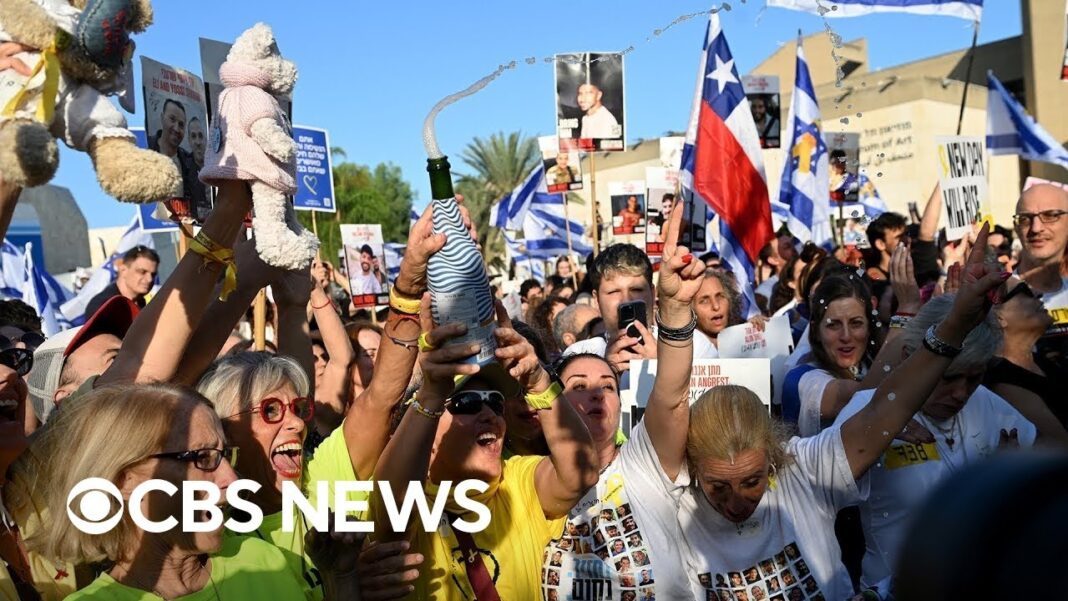
Across Israel, scenes of spontaneous jubilation erupted as the names of the released hostages were broadcast live on television. In Tel Aviv’s Hostages Square, a crowd of thousands — many carrying Israeli flags adorned with yellow ribbons — burst into applause and chants of “Bring them home now!”
Parents clutched their children. Some sang Hatikvah. Others wept in silence. For those whose loved ones remain in Gaza — including the families of 20 other living hostages slated for release later this week, and the 28 believed to be dead — the emotion was bittersweet.
“I just can’t trust Hamas to bring them all alive,” said Gil Dickmann, whose cousin Carmel Gat was murdered in captivity after being abducted from Kibbutz Be’eri. “Carmel was hours away from release when the ceasefire collapsed two months ago. We’ve been through too many false hopes.”
The International Committee of the Red Cross confirmed it had launched a “multi-phase operation” to coordinate the exchange of hostages and prisoners under the ceasefire framework. “We are facilitating the transfer of released hostages to Israeli authorities and the repatriation of prisoners to the Gaza Strip and the West Bank,” said an ICRC spokesperson. “We will also oversee the transfer of remains so families can bury their loved ones with dignity.”
The Israeli military urged restraint and respect for privacy. “We ask the public to act responsibly and rely only on official information,” the IDF Spokesperson’s Unit said.
As the hostages crossed back into Israel, Air Force One descended onto the tarmac at Ben Gurion Airport at precisely 9:20 a.m., bearing President Donald Trump for a whirlwind diplomatic tour. The visit, lasting less than five hours, was timed to coincide with the hostage release — a symbolic alignment that underscored Washington’s deep involvement in brokering the ceasefire.
Gali Berman is Free! https://t.co/Dros8JJC85
— The Jewish Voice (@TJVNEWS) October 13, 2025
Trump was greeted by President Isaac Herzog and Prime Minister Benjamin Netanyahu in a brief ceremony under tight security, which had shut down sections of the Tel Aviv–Jerusalem highway for the presidential motorcade.
Prior to addressing a Knesset plenum, Netanyahu met privately with the families of the hostages in a closed door meeting, to offer his continued support and to hear the plaudits they offered for Trump’s Herculean efforts to secure the release of their loved ones.
By 11:00 a.m., Trump delivered his remarks at the Knesset in which he praised Israel’s resilience and called for “a new era of peace built on strength, courage, and faith.”
“Today,” Trump declared, “we witness not only the return of Israel’s sons, but the reaffirmation of a people who never give up. The hostages’ freedom reminds the world that terror will never defeat determination.”
Hamas video called the families of several hostages who are set to be released later this morning, allowing them to speak with their loved ones for the first time in two years. #Hamas #hostagesreturn pic.twitter.com/sSP6vSva0L
— The Jewish Voice (@TJVNEWS) October 13, 2025
Following his address, Trump departed for Sharm el-Sheikh, Egypt, where the Summit for Peace convened under the joint chairmanship of President Trump and Egyptian President Abdel Fattah el-Sisi. The high-level gathering — which also includes leaders from Turkey, Jordan, Britain, Germany, France, Italy, the United Nations, and the European Union — aims to consolidate the fragile Gaza ceasefire and launch a regional framework for reconstruction and political normalization.
The Egyptian presidency announced that Trump will be awarded The Order of the Nile, Egypt’s highest honor, in recognition of his “distinguished contributions to peace efforts, defusing conflicts, and his pivotal role in ending the Gaza war.”
Meanwhile, the Israeli President’s Office confirmed that Trump will also receive the Israeli Presidential Medal of Honor, the nation’s highest civilian decoration. In a statement, President Herzog praised Trump for his “unwavering commitment to Israel’s security and to the return of our hostages.”
“History will remember those who stood with Israel in our darkest hour,” Herzog said. “President Trump’s leadership helped turn despair into deliverance.”
Despite the jubilation, officials and families alike remain cautious. The war that began on October 7, 2023, has left Gaza in ruins, displaced more than 1.8 million Palestinians, and exacted heavy casualties on both sides. The two-year conflict redefined the region’s political fault lines and strained Israel’s relations with key international partners.
The ceasefire — painstakingly negotiated through Qatari, Egyptian, and American intermediaries — may yet prove fragile. Israeli officials confirmed that Hamas continues to hold dozens of captives, including several dual nationals.
Still, for many Israelis, Monday’s events offered the first tangible relief in years. “For the first time, we can breathe,” said one soldier stationed near Re’im Base. “It’s not peace yet, but it feels like the beginning of something we almost forgot existed — hope.”
At sunset, as the freed hostages underwent medical evaluations and prepared to reunite with their families, Tel Aviv’s Hostages Square remained crowded. Volunteers distributed candles, yellow ribbons, and small flags that read simply: “Welcome Home.”
Nearby, the massive LED screen that had displayed the faces of the captives for 24 months went briefly dark — then illuminated again with seven words that summed up a nation’s emotion:
“They’re home. But the mission continues.”
