
































|
Getting your Trinity Audio player ready...
|
UAVs need to be flying robots and not just flying cameras, HevenDrones CEO tells JNS.
By: Yaakov Lappin
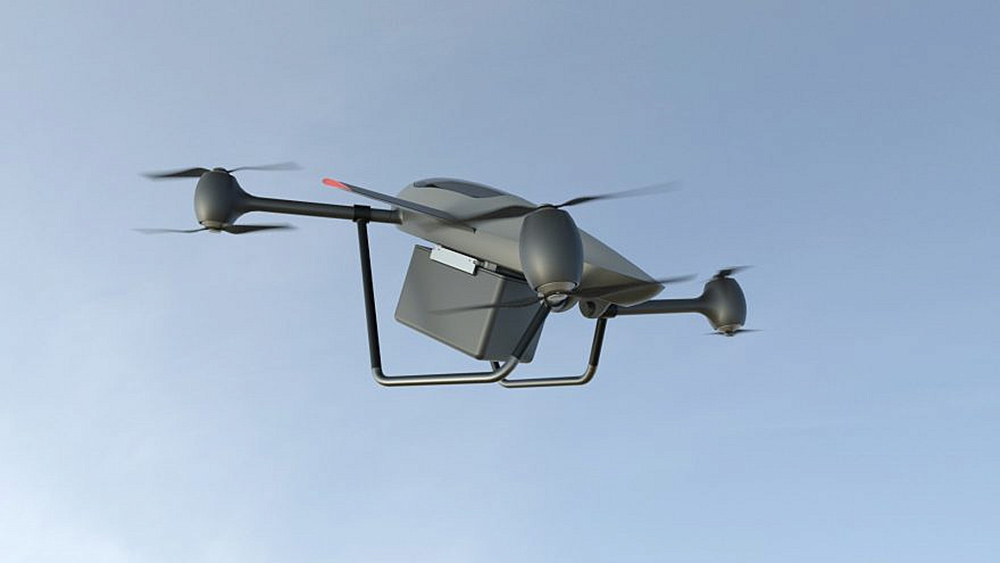
A new drone made by Israeli company HevenDrones could revolutionize defense and commercial drone uses.
The firm’s hydrogen-powered H2D55 Drone is five times more energy efficient than traditional lithium battery-powered drones and can fly for 100 minutes with a payload of seven kilograms (15 pounds), according to the company.
The drone, which was unveiled in February at Abu Dhabi’s IDEX (International Defence Exhibition and Conference), can be used for a wide range of defense and commercial applications, from emergency responses to last-mile delivery and intelligence-gathering missions.
Bentzion Levinson, founder and CEO of HevenDrones, told JNS the company was founded three-and-a-half years ago, based on the concept of seeing drones not merely as flying cameras but also as flying robots.
The vast majority of drones currently act as flying cameras, he said, identifying problems, gathering information over a battlefield or spotting hazards like fires—all highly important functions.
“The problem is limiting drones to being flying sensors. We wanted to develop flying robots that can do things from the sky, like lifting larger payloads over larger distances,” he said. “We asked, how can relatively small drones carry significant payloads for longer?”
The answer, Levinson and his team found, was in the battery.
With drones already starting to play greater functions, such as Amazon’s delivery project, Levinson’s company identified a key bottleneck: limited flight time.
“We saw two problems. The first is the range, usually capped at around 10 kilometers and sometimes shorter. The second is the need to get multiple drones to work as a swarm. That creates value and takes the person out of the loop. If you have to come back to change batteries every 30 to 40 minutes, that has less value,” he said.
The company gathered energy experts and concluded that hydrogen is the best power source for UAV fuel cells.
‘Five times the flight speed and 10 times the range’
Heven Drones works with the Israeli Defense Ministry and has become its supplier of hydrogen-powered drones after demonstrating proof of concept for the ministry in November.
The H2D55 Drone is the company’s first product line. It is planning two additional models that can take heavier payloads greater distances.
Levinson described the technology as a game-changer.
“The hydrogen allows for much longer flights, for massive increases in hovering and maneuvering. We achieved five times the flight speed and 10 times the range,” he said.
The drones can take any kind of payload, for example, universal containers and logistic packages.
The promise of hydrogen fuel has been talked about by various industries for the past 20 years, so far with few tangible results. There are some hydrogen-powered cars on the market but they have yet to make major inroads.
Levinson said issues of easy access to hydrogen fuel have until now formed a main challenge.
To overcome this, HevenDrones teamed up with supply chain partners, including American energy company Plug Power, which creates lightweight hydrogen fuel cells.
“Drones have the ability to lead the hydrogen revolution. The main challenge goes back to the supply chain,” said Levinson. “Customers need 24/7 resupply.”
To overcome this challenge, the company offers three options: resupplying the customer directly with fuel tanks, a portable technology in which the tanks are pressurized by clients such as hospitals, and an option in which clients create their own hydrogen using nothing more than running water and electricity—a solution Levinson described as a “real breakthrough.”
“Any army base or offshore energy rig can use electricity and running water to create energy out of thin air,” he said.
This enables automated refueling systems to come online. “This technology is here. The final stages of it are being commercialized,” said Levinson.
The environmental benefits of this power source are clear, he added.
The company is working with a number of clients worldwide. Levinson said the journey ahead is exciting.
“As regulation and capabilities grow, more and more problems will be solved by these flying robots,” he said.
In other defense related news, JNS.org also reported that on April 10, the country’s Defense Ministry revealed that the “Ofek 13” spy satellite, launched on March 28, had successfully transmitted its first images.
The development was a milestone on the way to the satellite becoming a fully operational Israeli intelligence asset.
The “Ofek 13’s” key feature is its synthetic-aperture radar (SAR) on-board sensor. The SAR payload grants the craft advanced observation capability, which is not limited by many of the constraints that apply to space-based cameras, being able to capture highly detailed images even through cloud cover, or at night.
The satellite “will drastically improve Israel’s intelligence capabilities from space for years to come,” said the head of the Israeli Defense Ministry’s Space and Satellite Administration, Avi Berger, following the launch.
Israel’s “Ofek 10” and “Ofek 8” satellites were also equipped with SAR capability.
According to Israeli Defense Minister Yoav Gallant, Israel is one of very few countries to possess such capabilities. Earlier this month, he praised Israeli engineers’ “creativity, talent and consistency in addition to the hard work of outstanding professionals that took part in this operation,” vowing to “continue to prove that even the sky isn’t the limit for the Israeli defense establishment.”
A key figure in this project is Brig. Gen. (res.) Daniel Gold, head of the Defense Directorate for Research and Development. Gold described the SAR satellite as being at “the peak of global technology,” adding that the March 28 launch establishes Israel’s “superiority in the field of space yet again. It also constitutes a leap forward in operational and technological abilities for the preservation and improvement of Israel’s standing in space for the coming decades.”
The keys to the satellite are now in the hands of the IDF’s Military intelligence 9900 Unit, which will begin receiving around-the-clock images from it, and building a full operational intelligence picture.
In July 2020, in the middle of the coronavirus global pandemic, Israel launched its “Ofek 16” observation satellite into orbit from central Israel. “Ofek 16” carries an on-board camera that provides higher-resolution images than ever before.
While no additional information was offered regarding the Ofek 16, it’s worth noting that Elbit Systems’ sophisticated camera system known as “Jupiter” had been put on earlier Israeli satellites.
The camera allows for inspections of “extremely high-value targets,” and it produces higher clarity photographs of small and discrete vehicles, objects, and structures, according to Elbit’s website. In order to examine the harm done to adversary targets, it can also be utilized for “more advanced battle damage assessment” and “more detailed operational planning.”
Other Israeli satellites in orbit include the “Ofek 5,” which was launched in 2002 and is still in use today, according to Defense Ministry officials.
The series kicked off in 1988 with the launch of the “Ofek 1” (“Horizon 1”).
Israel Aerospace Industries is the prime contractor in the development of the “Ofek 13” satellite, launcher and ground monitoring system. Rafael Advanced Defense Systems developed the launch engines, together with Tomer, a government-owned firm.
(JNS.org)



