



|
Getting your Trinity Audio player ready...
|
By: Fern Sidman
A sweeping new strategic study is calling on Israel’s security and technology establishment to fundamentally rethink its national posture in the aftermath of October 7, 2023, urging a transformation that would embed the Jewish state at the core of America’s regional and global security architecture. The report, published by the Henry Jackson Society and titled “Israel 2048: A Blueprint for a Rising Asymmetric Geopolitical Power,” envisions a dramatic recalibration of the U.S.–Israel partnership—one centered less on traditional military aid and more on joint technological supremacy.
According to a report on Thursday at Fox News Digital, which extensively covered the report’s release and its broader implications, the study argues that the next quarter century presents Israel with a historic opportunity to reposition itself not merely as a resilient regional actor but as an indispensable deep-tech and defense innovation hub anchoring Western strategic interests across continents.
Barak M. Seener, co-author of the report, told Fox News Digital that the United States requires Israel not simply as a military ally but as a structural pillar of its regional and global security design. “America requires Israel for its security architecture in the region via the Abraham Accords and, more broadly, will be a force multiplier regarding the technological edge against China,” Seener said.
That framing reflects a shift in emphasis. Rather than viewing Israel primarily through the prism of deterrence against hostile neighbors, the study urges policymakers to recognize Israel as a dynamic node within a networked geopolitical order shaped by artificial intelligence, quantum computing, cyber warfare and advanced semiconductor supply chains. The Fox News Digital report noted that the report positions Israel’s technological ecosystem as a strategic asset capable of reinforcing U.S. power in an era of intensifying great-power competition.
The study’s authors—Seener and David Wurmser—contend that the U.S.–Israel alliance must evolve from one defined by American military assistance to one characterized by joint research and development, co-investment and integrated innovation platforms. They advocate reframing the bilateral relationship “around technology,” emphasizing shared development in defense-tech, AI, quantum computing and next-generation warfare capabilities.
Fox News Digital reported that this proposed transformation comes at a moment of profound strategic reassessment. During President Trump’s first term, the Abraham Accords normalized diplomatic relations between Israel and several Sunni Arab states, including Bahrain, the United Arab Emirates, Morocco and Sudan. Those agreements reshaped the Middle East’s diplomatic map, creating a framework for regional cooperation that transcended traditional fault lines.
Seener told Fox News Digital that the Abraham Accords provide a platform for embedding Israel within a broader security architecture that connects trade routes, digital infrastructure and defense innovation. “Israel is not only achieving regional dominance but international power by connecting trade routes and digital connectivity,” he said. “Israel simply cannot remain in a purely defensive posture and hunker down and react to threats on its borders.”
That observation underscores a central thesis of the report: Israel must transition from reactive defense to proactive technological statecraft. According to the information provided in the Fox News Digital report, the study urges Israel to leverage its competitive advantages to shape global supply chains in artificial intelligence, semiconductors, missile defense and cyber capabilities. By doing so, Israel would not only secure its own future but reinforce Western resilience against authoritarian rivals.
The Pentagon’s recently released National Defense Strategy, cited by Seener in his remarks to Fox News Digital, for the first time explicitly described Israel as a strategic military partner. Seener emphasized the novelty of that designation. “That has never happened before,” he said. In the study’s interpretation, such language signals an opening for deeper structural integration between American and Israeli defense ecosystems.
The report also situates its recommendations within the context of recent military developments. Following Israel’s successful air campaign against the Islamic Republic of Iran in June 2025, Seener argued to Fox News Digital that Israel demonstrated a level of intelligence coordination and operational capability that altered Washington’s calculus. “America now wants to be part of this success story,” he said.
Seener asserted that President Trump’s decision to join Israel in prosecuting military action reflected recognition of Israel’s intelligence acumen and battlefield effectiveness. “For the first time, America joined Israel in the prosecution of a war,” he said, suggesting that this precedent could pave the way for deeper operational collaboration.
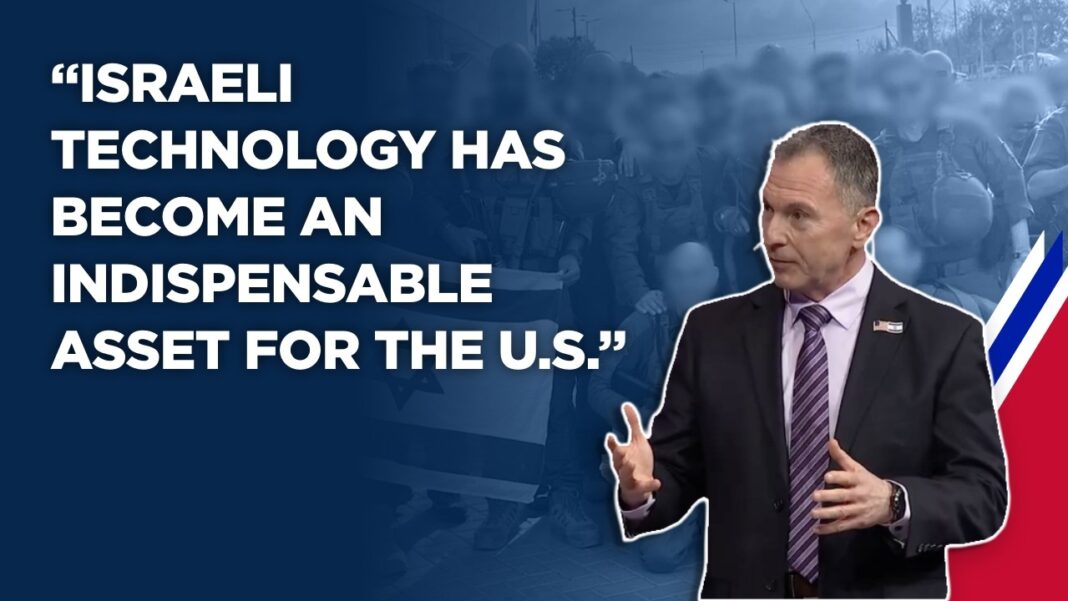
The study contends that Israel’s defense technology ecosystem—ranging from missile defense systems to cyber innovation—renders it indispensable to a growing number of nations. Fox News Digital highlighted the report’s call to embed Israel as a “defense-tech and deep-tech power that is indispensable to Western security and global technological competition.” That indispensability, the authors argue, should be leveraged to anchor alliances and shape supply chains critical to AI and semiconductor production.
Yet the blueprint is not solely outward-looking. It also urges Israel to reduce vulnerabilities arising from external political pressures. The report recommends accelerating domestic production lines for critical military systems, munitions and energy infrastructure to insulate Israel from fluctuations in foreign political climates.
The authors point to Europe’s growing ambivalence as a cautionary example. Britain’s left-leaning government reportedly denied U.S. forces access to British bases for strikes against Iran earlier this month, illustrating the unpredictability of allied cooperation. Such episodes, the report suggests, underscore the importance of self-sufficiency in core defense capabilities.
Seener told Fox News Digital that Israel’s technological prowess can also serve as a diplomatic instrument. By offering cutting-edge defense-tech and AI partnerships, Israel can deepen alliances not only in the Gulf but across Europe and Asia. “Israel is not a superpower,” he said, “but a geopolitical power that gives nations a force multiplier, and they benefit from Israel as a tech defense nation.”
The report’s emphasis on preventing technological leakage to China reflects acute awareness of global competition. The authors argue that Israel must prioritize passing negotiated regulations to prevent AI and quantum technology transfer that could undermine Western strategic advantages. Safeguarding intellectual property and dual-use technologies is central to maintaining Israel’s value proposition within the Western alliance.
Critically, the blueprint envisions Israel’s centennial year in 2048 as a milestone not only of national endurance but of strategic elevation. By then, the study posits, Israel could stand not merely as a regional military power but as a linchpin of Western technological architecture. Such a transformation would require sustained investment in joint R&D, expanded integration of Israeli firms into American defense supply chains, and institutional mechanisms that elevate collaboration beyond episodic procurement contracts.
The report arrives at a time when the Middle East remains volatile, and the global order is increasingly defined by technological competition. The authors argue that aligning Israeli innovation with American strategic objectives creates a synergistic dynamic that strengthens both nations while reinforcing regional stability through economic and digital connectivity.
Ultimately, “Israel 2048: A Blueprint for a Rising Asymmetric Geopolitical Power” is less a forecast than a call to action. It urges Israeli policymakers to move beyond a paradigm of dependence toward one of co-equal technological partnership. For Washington, it offers a vision of Israel not as a beneficiary of aid but as a co-architect of strategic resilience in an era marked by geopolitical fragmentation and rapid technological change.
As Fox News Digital reported, Seener’s formulation captures the study’s essence: Israel’s defense technology makes it indispensable. In the authors’ view, harnessing that indispensability—through structured collaboration, regulatory safeguards and forward-looking investment—could redefine the U.S.–Israel alliance for the next quarter century.
Whether policymakers embrace this blueprint remains to be seen. Yet the study’s central message resonates clearly: in a world increasingly shaped by code, connectivity and competition, the strategic partnership between Washington and Jerusalem must evolve accordingly—or risk obsolescence in the face of accelerating global change.
