



|
Getting your Trinity Audio player ready...
|
Trump Orders Naval Blockade of Strait of Hormuz as Diplomacy with Iran Collapses
By: Fern Sidman
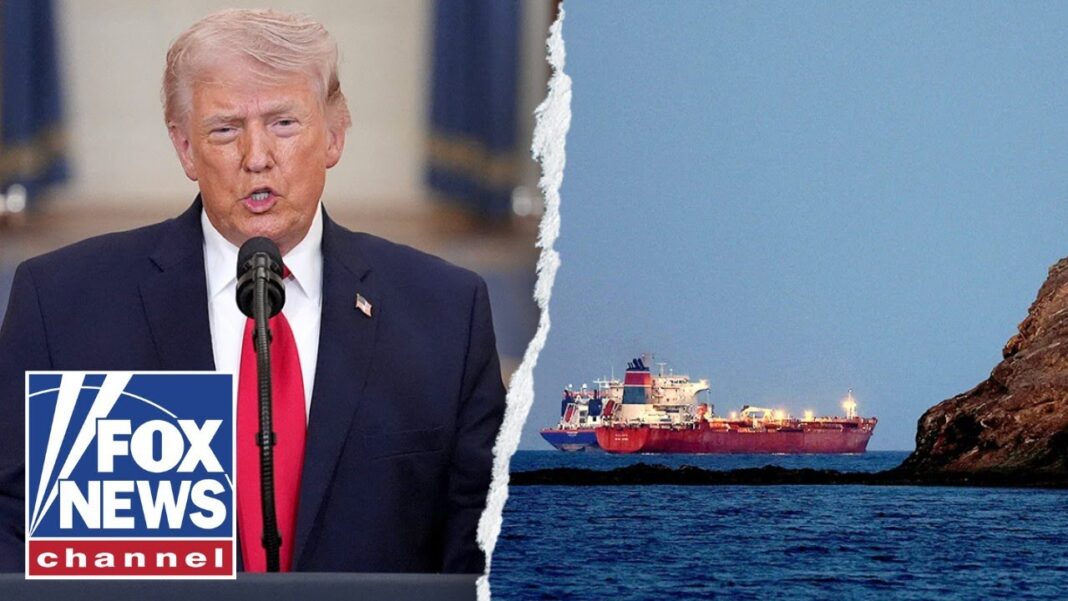
In a moment of extraordinary geopolitical consequence, President Donald Trump has ordered a sweeping naval blockade of the Strait of Hormuz, signaling a decisive escalation in the already volatile confrontation between the United States and Iran. The announcement, delivered through a forceful and expansive statement on the president’s Truth Social platform, came mere hours after the collapse of marathon negotiations in Pakistan—talks that had been widely viewed as a final opportunity to avert a broader and potentially catastrophic conflict.
As detailed extensively in a report on Sunday morning by Israel National News, the decision marks a pivotal turning point in the crisis, transforming a tense standoff into an overt assertion of maritime dominance in one of the world’s most strategically vital waterways. The ramifications of this move—economic, military, and diplomatic—are poised to reverberate across continents.
The Strait of Hormuz, a narrow maritime corridor connecting the Persian Gulf to the Arabian Sea, serves as a critical artery for global energy supplies. A significant percentage of the world’s oil shipments traverse its waters daily, making its stability indispensable to the functioning of the international economy.
By imposing a naval blockade, the United States has effectively asserted control over this chokepoint, seeking to prevent Iran from leveraging its geographic advantage as a tool of economic coercion. According to the Israel National News report, the move was precipitated by mounting concerns that Iran had not only failed to honor commitments to ensure free passage but had also introduced new uncertainties by allegedly deploying naval mines and imposing unauthorized transit fees.
President Trump’s rhetoric was unambiguous. “This is world extortion,” he declared, framing Iran’s actions as a direct affront to international norms and a threat to global stability. His language underscored a broader strategic narrative: that the United States would not tolerate the weaponization of international waterways.
The decision to initiate a blockade followed the abrupt termination of a grueling 21-hour negotiation session in Islamabad, Pakistan. The talks, attended by senior representatives from both nations, had raised cautious hopes of a diplomatic breakthrough. Instead, they concluded in stalemate.
Vice President J.D. Vance, who led the American delegation, described the discussions as “substantive” but ultimately unproductive. Speaking at a press conference in Islamabad, he emphasized that the failure to reach an agreement was “bad news for Iran much more than it is for the United States.”
The central sticking point, as reported by Israel National News, was Iran’s refusal to provide a definitive and enduring commitment to abandon its nuclear ambitions. While progress was reportedly made on peripheral issues, the core demand—ensuring that Iran would neither develop nor retain the capacity to produce nuclear weapons—remained unmet.
Vance articulated the American position with clarity: “We need to see an affirmative commitment that they will not seek a nuclear weapon… not just now, but for the long term.” The absence of such a guarantee rendered any broader agreement untenable.
President Trump’s response to the diplomatic impasse was swift and uncompromising. In his statement, he announced that the United States Navy would immediately begin the process of intercepting all vessels entering or exiting the Strait of Hormuz. Furthermore, any ship found to have paid what he described as “illegal tolls” to Iran would be subject to interdiction.
This directive represents a significant expansion of U.S. naval operations in the region. It not only seeks to neutralize Iran’s economic leverage but also introduces the possibility of direct confrontations at sea. The president’s warning—that any Iranian attempt to engage U.S. forces or civilian vessels would be met with overwhelming retaliation—adds a stark dimension to the unfolding scenario.
According to the information provided in the Israel National News report, the blockade will also involve efforts to locate and neutralize naval mines allegedly deployed by Iran. Such operations are inherently perilous, requiring precision and vigilance to avoid unintended escalation.
At the heart of the crisis lies the enduring question of Iran’s nuclear program. President Trump has consistently framed this issue as non-negotiable, reiterating his longstanding assertion that Iran must never be allowed to acquire nuclear weapons.
In his statement, he emphasized that while the negotiations had yielded agreements on several points, none of them mattered in the absence of a resolution on the nuclear issue. “The only point that really mattered… was not agreed to,” he wrote, highlighting the centrality of this concern to American policy.
This position reflects a broader strategic calculus: that the risks associated with a nuclear-armed Iran—both in terms of regional stability and global security—far outweigh the costs of continued confrontation.
The blockade is not expected to be a unilateral endeavor. President Trump indicated that other nations would participate in the operation, suggesting the formation of a multinational coalition aimed at ensuring freedom of navigation.
Such a coalition would lend legitimacy to the initiative while distributing the operational burden. However, it also raises complex questions about alliance dynamics and the willingness of other countries to align themselves with a policy that carries significant risks.
As noted in the Israel National News report, the involvement of international partners could serve as both a force multiplier and a stabilizing influence, provided that coordination remains effective and objectives are clearly defined.
Iranian officials, for their part, have attributed the breakdown in negotiations to what they describe as excessive American demands. Reports from Iranian media outlets suggest that Tehran views its nuclear program as a sovereign right, one that it is unwilling to relinquish under external pressure.
This divergence in fundamental objectives has long been a source of friction between the two nations. The events in Islamabad have merely brought this tension into sharper relief.
The question now is whether Iran will respond to the blockade with restraint or escalation. The presence of naval mines, if confirmed, introduces an additional layer of complexity, as it could lead to unintended incidents with far-reaching consequences.
The immediate impact of the blockade is likely to be felt in global energy markets. Any disruption to the flow of oil through the Strait of Hormuz has the potential to trigger price volatility, with cascading effects on economies worldwide.
Investors and policymakers alike are closely monitoring the situation, aware that even a temporary interruption could have significant implications for supply chains and inflation.
The broader economic stakes underscore the interconnected nature of the crisis. What begins as a regional dispute has the capacity to influence global financial stability.
The decision to impose a naval blockade represents a bold and consequential step, one that carries both strategic advantages and inherent risks. It signals a willingness to confront Iran directly while attempting to safeguard vital international interests.
Yet it also narrows the space for diplomatic maneuvering, raising the specter of further escalation. The coming days and weeks will be critical in determining whether this strategy yields the desired outcomes or leads to unintended consequences.
As the Israel National News report highlighted, the situation remains fluid, with multiple variables at play. The interplay between military action, diplomatic efforts, and international reactions will shape the trajectory of the crisis.
The blockade of the Strait of Hormuz marks a defining moment in the ongoing confrontation between the United States and Iran. It is a manifestation of a broader struggle over power, security, and the rules governing international conduct.
For President Trump, the move represents a culmination of his administration’s approach: a blend of assertive diplomacy and decisive military action aimed at achieving strategic objectives.
For the international community, it presents a complex challenge—balancing the imperative of maintaining open waterways with the need to prevent further escalation.
As the world watches, the stakes could scarcely be higher. The decisions made in the shadow of this blockade will not only shape the immediate future of the region but also leave an enduring imprint on the global order.
