



|
Getting your Trinity Audio player ready...
|
By: Justin Winograd
In remarks that reverberated across Israel’s political and security establishment, Israeli Finance Minister Bezalel Smotrich offered a stark and uncompromising assessment of the Islamic Republic of Iran, portraying its ruling system not merely as a strategic adversary but as an existential menace whose continued existence constitutes, in his words, an “intolerable reality” for the Jewish state. Speaking to Israel National News on Monday, Smotrich framed the confrontation with Tehran as one of historic gravity, one that admits no comfortable middle ground and no illusions about the nature of the regime that has, for decades, declared Israel’s destruction as a central plank of its ideological identity.
Israel National News reported Smotrich’s assertion that the Iranian leadership functions as a terror regime in the fullest sense of the term, one that couples incendiary rhetoric about annihilating Israel with methodical efforts to acquire both conventional and unconventional military capabilities. In his telling, Iran’s nuclear ambitions cannot be disentangled from its broader strategy of encirclement: the cultivation, arming, and financing of proxy forces across the Middle East, from Lebanon and Syria to Gaza and beyond, forming what Israeli officials often describe as a tightening ring of fire around the Jewish state. This, Smotrich warned, is not a theoretical danger or a distant contingency but an ongoing process unfolding in real time.
The finance minister’s language was unambiguous. So long as the current regime in Tehran remains intact, he suggested, Israel is forced to live under the shadow of a power that openly contemplates its eradication. The grim dichotomy he articulated—“Either they destroy us, or we bring about their downfall”—was not presented as rhetorical flourish but as a sober appraisal of the structural logic of the confrontation. In this framing, coexistence with a regime ideologically committed to Israel’s elimination is a contradiction in terms.
Yet Smotrich’s remarks were not limited to denunciation. He situated Israel’s posture toward Iran within the context of its relationship with the United States, acknowledging that Jerusalem and Washington may not always share identical tactical preferences even when they converge on strategic objectives. The Israel National News report highlighted his emphasis on what he described as an unusually close alignment between Israel’s current government and the American administration. Such closeness, Smotrich suggested, is not merely diplomatic nicety but a potential lever for forging “clear understandings” on how to confront the Iranian challenge. His words hinted at a desire for deeper coordination that goes beyond declarative policy, touching on the realm of concrete commitments and shared red lines.
This emphasis on coordination carries particular resonance against the backdrop of ongoing international debates over Iran’s nuclear program and the possibility of renewed or revised diplomatic arrangements. Smotrich’s stance, as reported by Israel National News, was categorical in rejecting any agreement that does not fundamentally transform Iran’s strategic posture. He dismissed the notion of a limited or partial deal as not merely inadequate but dangerous, arguing that any accord must impose sweeping constraints on Tehran’s ballistic missile development and compel a cessation of its support for terrorist organizations and proxy militias throughout the region. In his view, agreements that focus narrowly on nuclear enrichment while leaving intact Iran’s regional war machinery amount to a flawed bargain, one that postpones rather than resolves the underlying threat.
Pressed on whether military action remains an option, Smotrich declined to enter into operational specifics, invoking the longstanding Israeli doctrine that sensitive security deliberations are not conducted in public view. Yet his insistence that “every option remains available” was itself a carefully calibrated signal, underscoring Israel’s determination to preserve freedom of action in the face of what it perceives as an existential peril. The Israel National News report noted that this refusal to foreclose any avenue reflects a broader strategic culture in Israel, one shaped by historical experience and by the conviction that survival cannot be entrusted solely to diplomatic assurances.
While Smotrich’s comments on Iran dominated attention, his interview with Israel National News also ventured into the domain of domestic politics, revealing the interplay between Israel’s external challenges and its internal debates. As leader of the Religious Zionist Party and a central figure in the current coalition, Smotrich addressed mounting tensions with haredi factions over the state budget. He criticized what he characterized as the instrumentalization of fiscal negotiations as political leverage, arguing that such tactics are irresponsible in a time of war and economic strain. The finance minister presented himself as committed to a reformist economic agenda, one that prioritizes tax reductions, enhanced competition in the banking sector, lower credit costs for consumers, and the dismantling of entrenched monopolies.
These goals, he suggested, are integral to strengthening Israel’s social and economic resilience, which in turn undergirds its capacity to confront external threats.
The Israel National News report underscored the irony Smotrich himself acknowledged: that his party’s electoral fortunes have not necessarily reflected its prominence in shaping wartime and economic policy. Drawing on a remark by the late minister Uri Orbach, Smotrich quipped that “we succeeded too much,” a paradoxical formulation meant to capture the phenomenon whereby the national-religious public’s integration into Israel’s broader social and political fabric has diluted the appeal of a party perceived as sectoral. He rejected that characterization, insisting that his movement does not represent a narrow constituency but seeks to embed the values of the people, the land, and the Torah at the heart of Israel’s mainstream political life.
Khamenei: Drive The Enemy to Despair
As tensions across the Middle East deepen amid an expanding American military footprint in the Gulf, Iran’s Supreme Leader, Ayatollah Ali Khamenei, has sought to rally his nation around a familiar theme: unity in the face of what he casts as an implacable foreign adversary. His words, delivered in the measured yet incendiary cadence that has long characterized the Islamic Republic’s revolutionary rhetoric, arrive at a moment of heightened geopolitical anxiety—one in which Israel, the United States, and their allies appear to be recalibrating their posture toward Tehran. The Jewish News Syndicate (JNS) reported on Monday that these parallel currents of resolve and apprehension are converging as Israeli leaders contemplate what some describe as a historic crossroads in the decades-long struggle to contain Iran’s strategic ambitions.
In a public message disseminated on Monday, Khamenei exhorted Iranians to demonstrate unity and fortitude, arguing that national power derives not merely from armaments but from the collective will of the people. JNS has closely followed how Tehran’s leadership frames external pressure as an existential contest between revolutionary perseverance and foreign designs to undo the Islamic Republic. Khamenei’s insistence that “the enemy must be driven to despair” through steadfastness reflects a narrative deeply embedded in the regime’s political theology, one that traces contemporary challenges back to the 1979 revolution that toppled Iran’s monarchy and installed clerical rule.
The timing of Khamenei’s call to unity was conspicuous. The Islamic Republic is marking the 47th anniversary of the revolution that reshaped Iran’s domestic and foreign policy, and the Supreme Leader’s rhetoric was infused with a sense of historical siege. He portrayed foreign powers as perpetually scheming to restore the ancient régime, invoking the exiled Crown Prince Reza Pahlavi as a symbol of those efforts. According to the information provided in the JNS report, Khamenei sought to reframe the current moment not as a narrow confrontation over military deployments or nuclear enrichment, but as another chapter in a protracted struggle between Iran’s revolutionary identity and what he characterizes as hostile external forces intent on reversing it.
Yet even as Tehran projects defiance, Israel’s political leadership is framing the moment in terms of opportunity as well as danger. JNS reports that Blue and White Party leader Benny Gantz, a former Israel Defense Forces chief of staff and defense minister, has publicly articulated hope that Prime Minister Benjamin Netanyahu can persuade President Trump to undertake what he described as a historic decision—one that would fundamentally alter Iran’s role as a strategic threat in the region. Gantz’s remarks situate the Iranian challenge not solely within Israel’s national security calculus but within a broader global framework, underscoring his contention that Tehran’s ambitions pose risks that extend far beyond the Middle East.
Talks Between Tehran & Washington
In the arid diplomatic landscape between Tehran and Washington, the latest round of indirect nuclear negotiations in Oman has offered more theater than traction — a discussion of process rather than decisive progress. As both sides probe one another’s red lines and capabilities, the regional context has become increasingly combustible, underscored by a massive buildup of American forces in the Gulf and increasing Israeli pressure for a more comprehensive approach to Iran’s strategic capabilities. The New York Times reported on Friday that although the Muscat talks did not collapse into antagonism or immediate crisis, they also failed to deliver the kind of breakthrough that might avert future conflagration.
When the delegations adjourned after their first full session in Muscat on Friday, the public statements were notable for their cautious optimism rather than substance. Iranian Foreign Minister Abbas Araghchi described the discussion as a “good start” and said both sides agreed to consult with their respective capitals about how to proceed toward a framework for future negotiations. President Trump echoed that sentiment, telling reporters that the talks were “very good” and emphasizing that he was “in no rush” to conclude a deal.
But beneath this bland veneer of progress lies a stark reality: the fundamental positions of the two governments are, in many respects, as distant as they have ever been. According to reports, Tehran insists that negotiations remain tightly focused on its nuclear program and that its right to enrich uranium on its own soil must be acknowledged — a stance the United States and its allies reject. Even more contentious issues, such as Iran’s ballistic missile development and its support for regional proxy forces like Hezbollah, Hamas, and the Houthis, were explicitly excluded by Iranian negotiators from the Muscat agenda.
The New York Times report noted that this narrowing of focus frustrates American and allied expectations that any serious diplomatic effort must address not only fissile material production but also the broader architecture of Iranian militarization. Ballistic missile capabilities — which Tehran has described as “non-negotiable” — constitute a strategic worry for both the United States and Israel, as these systems have the range and precision to threaten American bases and allies across the region.
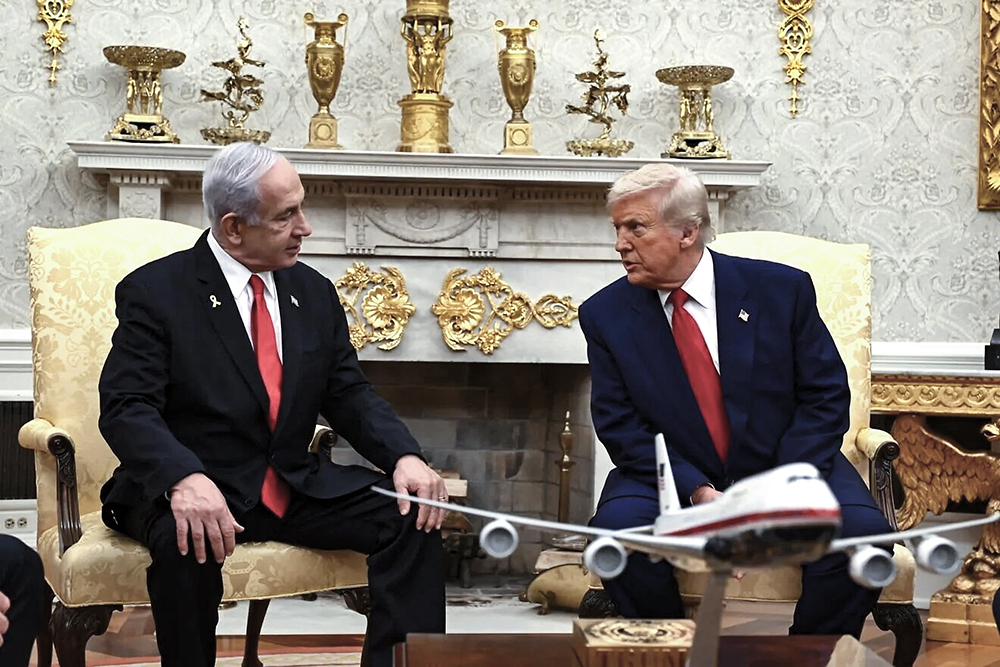
Amid this impasse, Israeli Prime Minister Benjamin Netanyahu has chosen to accelerate his upcoming diplomatic engagement with the United States. According to The Jerusalem Post, Netanyahu will travel to Washington earlier than originally scheduled to meet with President Trump and senior members of the administration. Israeli officials characterize the meeting as a “strategy-shaping session,” one that will extend beyond the immediate contours of the U.S.–Iran negotiations to explore potential pathways should those talks fail. Significantly, the discussions are expected to include scenarios involving a possible U.S. military strike.
Netanyahu’s decision to bring key security aides — including his military secretary and the acting national security council director — reflects Jerusalem’s desire to ensure that its strategic concerns are woven into the broader diplomatic calculus. Foremost among these concerns is the question of ballistic missiles, which remain outside the scope of the Muscat dialogue despite Israel’s insistence that any comprehensive agreement with Tehran address them. The Jerusalem Post report noted that Israeli officials are increasingly concerned that the U.S. negotiation process, as currently framed, risks yielding a deal that curtails aspects of the nuclear program while leaving missile capabilities and regional proxy networks intact — a scenario that many in Jerusalem regard as insufficient to neutralize Iran’s strategic threat.
This posture accords with a broader Israeli insistence that diplomatic efforts must be calibrated against the totality of the challenge. For Netanyahu and his advisors, a settlement that focuses narrowly on enriched uranium without addressing the means by which Tehran projects power across the region will simply defer the problem rather than resolve it. Indeed, senior Israeli officials have signaled that Israel may consider unilateral options if a comprehensive deal fails to materialize — an acknowledgment of both the urgency and the complexity of the Iranian quandary.
