



|
Getting your Trinity Audio player ready...
|
By: Fern Sidman
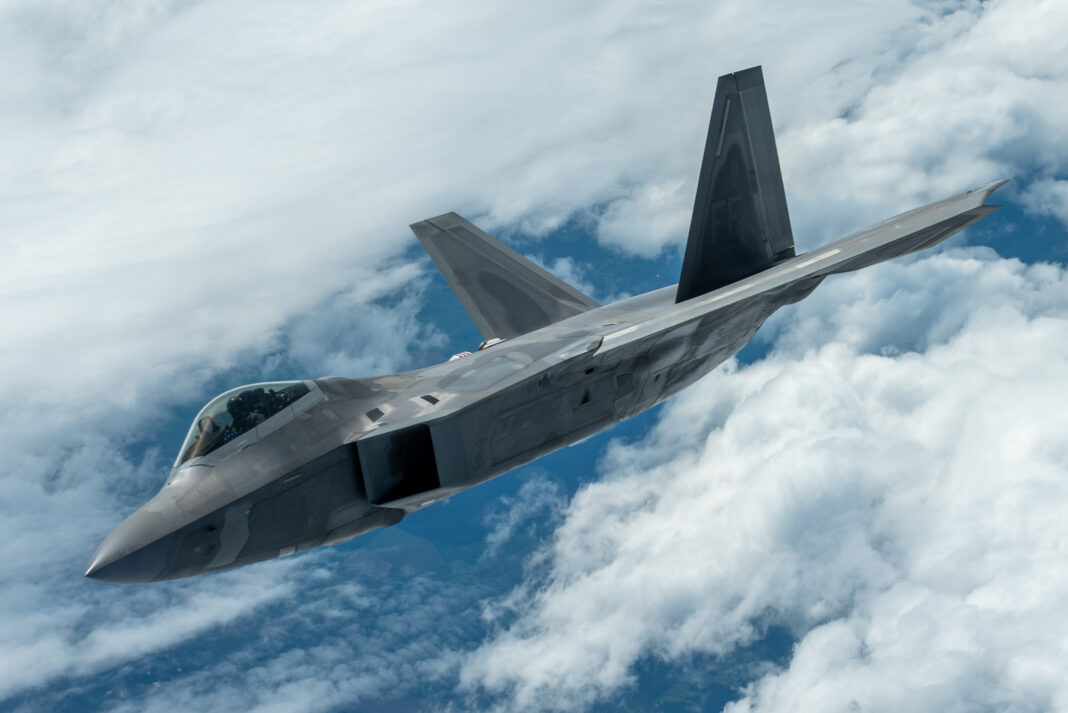
The arrival of a squadron of U.S. Air Force F-22 Raptor stealth fighters at Ovda Airbase in Israel’s Negev Desert has sent a tremor through diplomatic and military circles across the Middle East. World Israel News, citing confirmation from a senior U.S. Central Command official, reported on Tuesday that the deployment unfolded quietly but deliberately, with the aircraft transiting from RAF Lakenheath in the United Kingdom under the protective choreography of American aerial refueling tankers.
Eleven of the world’s most advanced air superiority fighters touched down on Israeli tarmac, an unprecedented presence that analysts describe not as routine cooperation, nor as symbolic reassurance, but as a strategically charged signal in a region braced for potential escalation with Iran.
The World Israel News report emphasized that stationing American combat aircraft on Israeli soil is an infrequent occurrence, and the presence of the F-22—a fifth-generation stealth fighter that the United States has never exported to any ally—imbues the move with particular gravity. Unlike multilateral exercises or temporary rotational deployments seen in previous years, this forward basing appears intimately tethered to operational contingencies rather than training protocols.
Even during periods of heightened regional turmoil—during the campaign against ISIS, joint air exercises such as Blue Flag, or even amid Operation Midnight Hammer in June 2025—F-22s had not been based in Israel for combat-oriented missions. The current deployment therefore stands apart, a departure from precedent that has not gone unnoticed in defense circles or among regional actors parsing every signal emanating from Washington.
The logistical choreography of the deployment underscores its seriousness. World Israel News reported that the Raptors flew thousands of miles from RAF Lakenheath, supported by KC-46 Pegasus and KC-135 Stratotanker refueling aircraft. One jet reportedly turned back with a suspected fuel leak, but the remainder completed the journey and are now stationed at Ovda, a remote but strategically situated airbase well suited for discreet high-end operations.
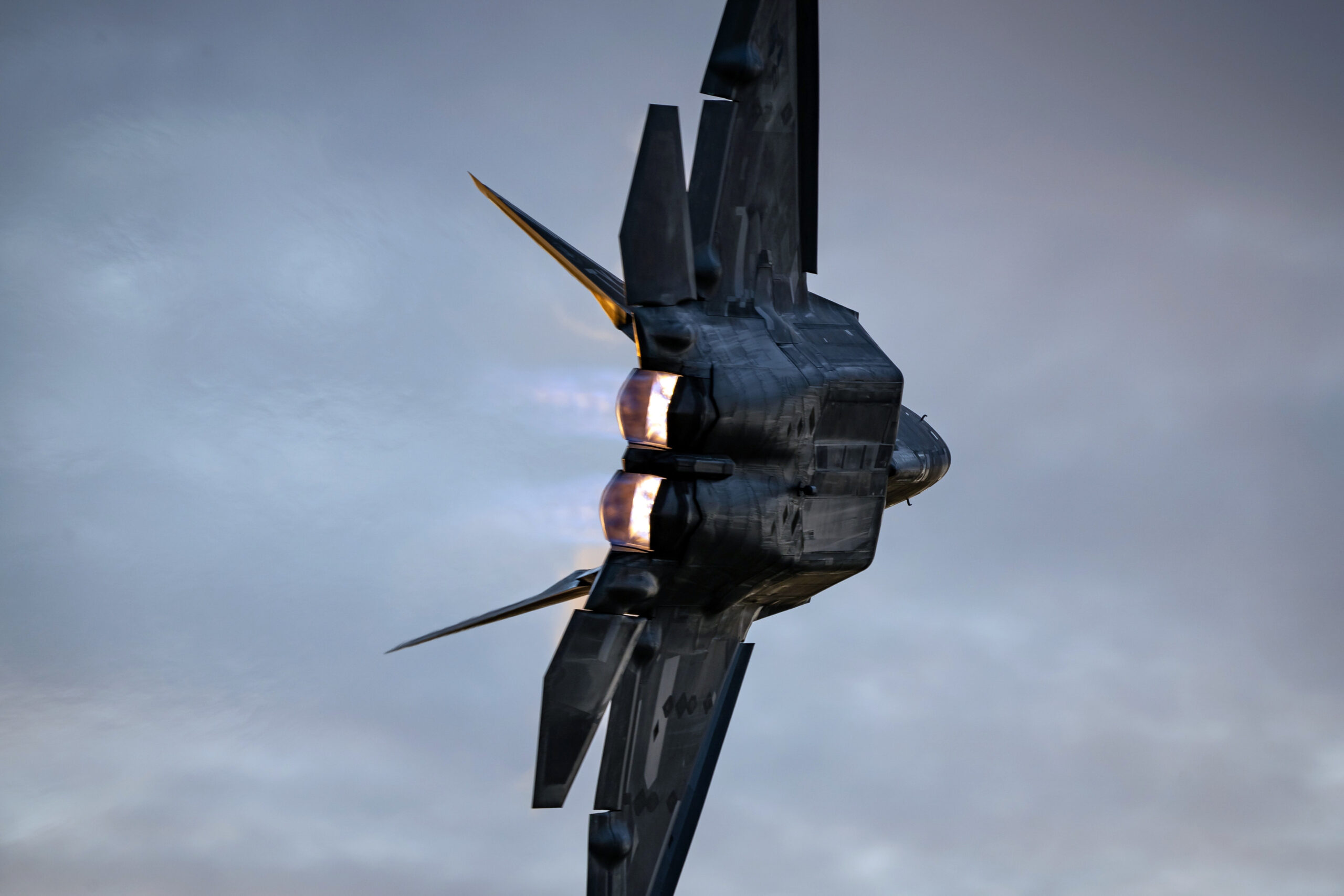
(Courtesy photo)
In committing roughly six percent of its operational F-22 fleet to a single forward location, the United States has signaled that this is not mere posturing. Only 195 F-22s were ever built, with approximately 180 believed to remain operational. These aircraft are irreplaceable in the near term, their production line shuttered and their capabilities unmatched in the current inventory of any air force in the world.
World Israel News has repeatedly cautioned that the F-22’s role in any prospective conflict is often misunderstood by the public. The aircraft is not a bomber; it does not carry bunker-busting munitions designed to collapse hardened underground facilities. Its purpose is more elemental and, in some respects, more ominous.
The F-22 is engineered to dominate contested airspace, to blind and dismantle enemy air defenses in the opening phases of an air campaign. In the lexicon of modern warfare, it is a Suppression of Enemy Air Defenses platform, a hunter of radar arrays and surface-to-air missile batteries. Its task is to clear the sky so that other aircraft—the bombers and strike fighters carrying the ordnance capable of penetrating fortified targets—can operate with reduced risk.
In the context of Iran’s layered air defense architecture, this capability assumes profound significance. Tehran has spent decades constructing a dense lattice of radar systems and missile batteries around key nuclear sites such as Fordow, Natanz, and Isfahan. These defenses represent the principal obstacle between American B-2 Spirit bombers, armed with 30,000-pound GBU-57 bunker busters, and the centrifuge halls buried deep beneath granite and reinforced concrete.
The F-22’s stealth, sensor fusion, and kinetic reach are designed to carve corridors through precisely such defenses, to degrade and neutralize the protective envelope that shields high-value targets. In the blunt assessment of several analysts quoted by World Israel News, the Raptors are not the punch; they are the hand that pushes aside the shield.
The deployment unfolds amid a sweeping American military buildup across the Middle East. The World Israel News report catalogued the accumulation of force: multiple carrier strike groups with more than 150 aircraft between them, hundreds of additional combat aircraft staged at regional bases, vast quantities of munitions airlifted by C-17 transporters, and a constellation of aerial refueling tankers enabling sustained operations over extended distances.
Airborne warning and control systems patrol the skies, while maritime patrol aircraft map the strategic arteries of the region, including the Strait of Hormuz. The region’s logistical infrastructure is being subtly but decisively reshaped, with evacuations reported from certain facilities and contingency planning visible in the posture of allied embassies.
Diplomacy has not been abandoned, at least formally. A third round of talks between American and Iranian negotiators is scheduled in Geneva, with intermediaries seeking to salvage some form of nuclear accommodation. Officials in Washington privately acknowledge that the window for diplomacy is narrowing. The juxtaposition of negotiations with the forward deployment of high-end combat assets creates a dual narrative: the language of dialogue coexisting uneasily with the mechanics of preparation.
For Tehran, the message is ambiguous but unmistakable. The presence of F-22s on Israeli soil, combined with carrier strike groups in the region, conveys a readiness that transcends deterrent signaling.
There is a sequence to modern air campaigns that military planners know intimately, and World Israel News has drawn attention to how the current posture aligns with that choreography. Strike aircraft are positioned. Munitions are staged. Tankers are deployed to sustain operations. Airborne command and control assets are in place. Reconnaissance platforms map potential corridors of ingress and egress.
The arrival of the F-22s corresponds to the next phase in that sequence: the deployment of assets specifically designed to suppress enemy air defenses along those corridors. Such sequencing, veterans of previous campaigns from Desert Storm onward observe, is not coincidental. It is procedural, a methodical progression toward operational readiness.
Regional responses further underscore the sense that a decision point may be approaching. World Israel News has reported advisories issued by several governments urging their citizens to prepare for airspace closures or to depart high-risk areas. Embassies have adjusted staffing levels.
Iranian leadership is reportedly dispersing senior figures, a precautionary measure historically associated with periods of anticipated confrontation. Tehran has conducted exercises simulating disruptions to shipping in the Strait of Hormuz, a reminder of the economic leverage it could wield in the event of hostilities. Across capitals and command centers, contingency planning appears to be converging on the same unspoken possibility.
For Israel, the presence of American F-22s is both a reassurance and a portent. The U.S.–Israel strategic relationship has long encompassed intelligence sharing, joint exercises, and coordinated contingency planning. Yet the forward basing of America’s most advanced air superiority fighter on Israeli soil represents a qualitative escalation in visible cooperation. It suggests that any prospective operation involving Iran’s nuclear infrastructure would likely unfold in close coordination between Washington and Jerusalem, even if the formal chain of command remains American.
The symbolism of the Raptors parked on Israeli tarmac resonates domestically as a testament to the depth of the alliance, while regionally it amplifies perceptions that Israel is not isolated but embedded within a broader Western military architecture.
Critics caution against interpreting the deployment as an irrevocable prelude to war. World Israel News has acknowledged that military postures can serve as instruments of coercive diplomacy, intended to concentrate the minds of negotiators rather than to herald immediate action. Yet the scale and specificity of the assets deployed complicate that interpretation. Forward-deploying a significant fraction of an irreplaceable fleet of stealth fighters is not costless. It consumes readiness, exposes assets to risk, and signals a seriousness that extends beyond rhetorical pressure. In this light, the Raptors at Ovda appear less like chess pieces arranged for effect and more like instruments positioned for use.
The broader geopolitical context further heightens the stakes. Iran’s nuclear program has been the subject of intermittent negotiations, sanctions, and covert actions for decades, but the convergence of American and Israeli red lines has grown more explicit in recent years. World Israel News has documented how successive warnings that Tehran must not cross certain thresholds have been accompanied by incremental escalations in military preparedness. The current posture suggests that those thresholds are being tested, if not already breached.
For decision-makers in Washington and Jerusalem, the calculus is fraught: to act risks regional conflagration; to refrain risks entrenching a nuclear-armed adversary whose strategic posture is openly hostile.
In the final analysis, the F-22s now resting on the tarmac at Ovda Airbase embody more than metal and avionics. As the World Israel News report observed, they represent the crystallization of a strategic moment in which diplomacy and deterrence are entwined in uneasy proximity.
The Raptors are designed to clear the sky, to render invisible threats visible and neutralizable. One clears the sky, however, only when something is intended to fly through it. Whether that intention will translate into action remains uncertain, but the choreography of preparation has rarely been so overt. The region, and indeed the world, watches as the skies above the Negev grow crowded with the instruments of decisions yet to be made.
