



|
Getting your Trinity Audio player ready...
|
By: Andrew Carlson
In a development that underscores the accelerating convergence of artificial intelligence, robotics, and modern warfare, the Israeli defense-technology startup XTEND has unveiled plans to enter the public markets through a merger with a United States-based firm, marking one of the most consequential cross-border defense technology transactions of recent years. As The Times of Israel reported on Tuesday, XTEND, an Israeli developer of a human-guided AI drone operating system, has agreed to combine with Florida-based JFB Construction Holdings in a transaction that would value the joint enterprise at approximately $1.5 billion and pave the way for a Nasdaq listing under the name XTEND AI Robotics.
The announcement reflects not merely a financial maneuver but a strategic repositioning of an Israeli innovation that has already left an indelible mark on contemporary combat doctrine. Founded in 2018 by brothers Aviv and Matteo Shapira, alongside Rubi Liani, a pioneer of the Israeli Drone Racing League, and defense and unmanned aerial vehicle specialist Adir Tubi, XTEND emerged from the crucible of Israel’s security challenges. The Times of Israel has chronicled how the technological foundations of XTEND’s operating system were first refined along Israel’s southern border, where Israeli forces sought novel methods to intercept incendiary balloons launched from Gaza.
From those early iterations, a sophisticated human-guided autonomous platform was born—one capable of allowing operators, even those with no prior flight experience, to maneuver drones and robotic systems with precision in environments hostile to GPS and rife with physical danger.
The company’s journey from tactical improvisation to global defense supplier encapsulates a broader narrative of Israeli technological entrepreneurship. The Shapira brothers were no strangers to transformative exits; their earlier venture, Replay Technologies, was acquired by Intel in 2016 for $175 million, an episode frequently cited by The Times of Israel as emblematic of Israel’s role as a crucible for cutting-edge innovation.
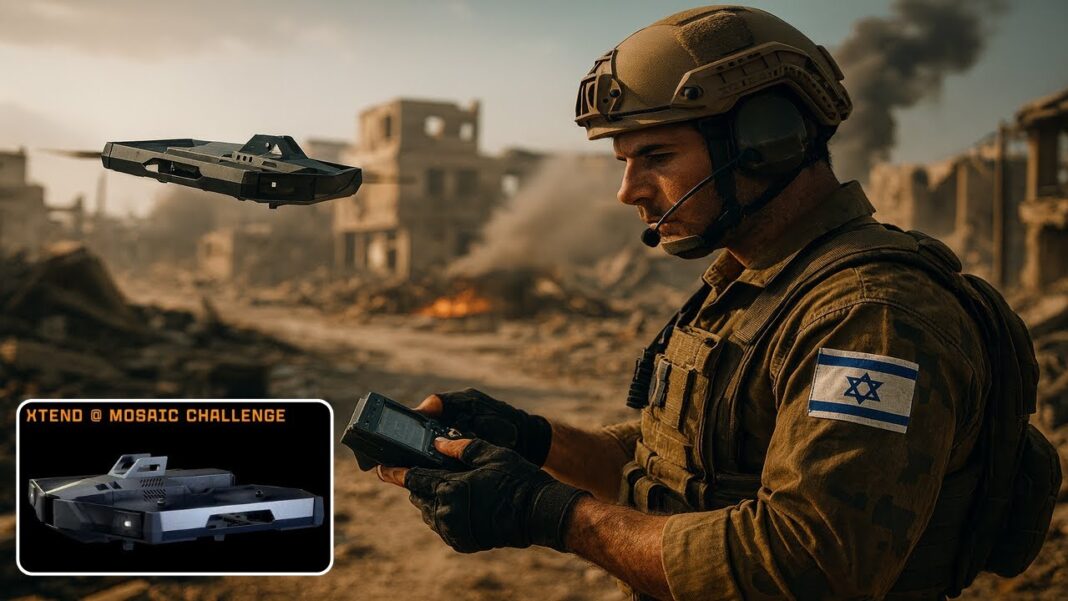
With XTEND, however, the stakes are more expansive, and the implications more geopolitical. The firm’s human-guided AI operating system, which integrates a portable virtual reality headset with gesture-based controls, has been deployed in hundreds of units by the Israel Defense Forces during the war against the Hamas terror organization in Gaza. The Times of Israel has noted that the technology has enabled Israeli soldiers to survey tunnels, scan buildings for explosives or militants, and conduct high-risk operations from a position of relative safety, effectively extending human presence into lethal environments without the concomitant exposure to mortal peril.
Yet XTEND’s ambitions have never been confined to the Israeli theater. Prior to the eruption of the current conflict with Hamas, the startup’s largest client was the US Department of Defense, a testament to the transatlantic appeal of technologies that promise to reconfigure the calculus of battlefield risk. In this sense, the merger with JFB Construction Holdings is less a departure from XTEND’s trajectory than a consolidation of its American footprint.
As The Times of Israel reported, the transaction is supported by $152 million in backing from a consortium of strategic investors, including Eric Trump, Israel’s Protego Ventures, Florida-based drone manufacturer Unusual Machines, Texas real estate developer American Ventures, and Miami-based Aliya Capital. This eclectic coalition of investors underscores the breadth of interest in defense robotics, spanning political networks, venture capital, industrial manufacturing, and real estate.
Upon completion of the all-stock merger—anticipated in mid-2026—the newly christened XTEND AI Robotics will be headquartered in Tampa, Florida, and will trade on Nasdaq under the ticker symbol “XTND.” The relocation of corporate headquarters to the United States is emblematic of a broader trend that The Times of Israel has observed: Israeli defense startups increasingly seek proximity to American capital markets, regulatory frameworks, and procurement ecosystems.
The establishment of a US-based production facility is central to this strategy. By situating manufacturing within American territory, XTEND aims not only to scale its production capacity but also to embed itself more deeply within the procurement pipelines of the US military and its NATO allies, as well as emerging security customers in Asia.
Aviv Shapira, one of the company’s co-founders, has articulated the strategic logic underpinning the merger in language that resonates with the current geopolitical moment. As quoted by The Times of Israel, Shapira observed that demand for systems designed to keep human operators out of harm’s way is surging as the global security environment grows more volatile.
This volatility is not abstract. From Eastern Europe to the Middle East, conflicts have illuminated the vulnerabilities of traditional military doctrine and accelerated the adoption of unmanned and semi-autonomous systems. XTEND’s technology occupies a distinctive niche within this landscape: it does not aspire to full autonomy divorced from human oversight, but rather to a form of human-guided autonomy that marries algorithmic assistance with intuitive human control.
This hybrid paradigm speaks to enduring ethical and operational debates about the role of artificial intelligence in warfare. The Times of Israel has frequently reported on concerns within Israeli defense circles regarding the delegation of lethal decision-making to machines. XTEND’s platform, by contrast, preserves a central role for human agency while leveraging AI to enhance situational awareness, precision, and speed. Operators wearing virtual reality headsets can inhabit the perspective of the drone, navigating labyrinthine interiors or subterranean tunnels with a level of immersion that traditional remote controls cannot approximate. Gesture-based interfaces further collapse the distance between human intention and robotic action, transforming complex maneuvers into intuitive movements.
The implications of this technology extend beyond combat scenarios. While XTEND’s primary markets are defense and security, the underlying operating system has potential applications in disaster response, industrial inspection, and hazardous environment exploration. Israeli drone technologies have often found dual-use pathways, migrating from military applications to civilian contexts such as search-and-rescue operations or infrastructure maintenance. In the wake of natural disasters, for instance, drones equipped with human-guided AI systems could navigate collapsed buildings to locate survivors, minimizing risk to first responders. The planned expansion of XTEND’s manufacturing capacity in the United States may thus catalyze a broader diffusion of its technology into non-military domains.
Nevertheless, the company’s impending Nasdaq debut is inseparable from the militarized origins of its innovation. The Israeli defense establishment’s embrace of XTEND’s systems during the Gaza war has imbued the company with a degree of battlefield validation that few startups can claim. The Times of Israel report detailed how the IDF’s adoption of these drones has been driven by a grim calculus: in densely built urban environments, the cost of sending soldiers into tunnels or booby-trapped structures can be catastrophic. By externalizing that risk onto unmanned systems, XTEND’s technology has altered the operational geometry of urban warfare. Critics, however, caution that the proliferation of such systems may lower the threshold for military engagement by reducing the perceived human cost, a concern that echoes broader debates about the moral hazard of automation in conflict.
The merger with JFB Construction Holdings introduces another layer of complexity. JFB, a Florida-based real estate development and construction company, is not an obvious partner for a high-technology defense firm. Such reverse mergers are increasingly utilized as vehicles for bringing innovative startups to public markets without the protracted uncertainties of traditional initial public offerings. For XTEND, the partnership with JFB provides not only a pathway to Nasdaq but also access to American industrial infrastructure and regulatory familiarity, assets that are indispensable for scaling operations in the US defense market.
The participation of Eric Trump as a strategic investor has drawn particular attention. While The Times of Israel has reported this fact with characteristic restraint, the association inevitably invites scrutiny regarding the intersection of defense technology, capital markets, and political networks. In an era when defense procurement is entangled with domestic politics and international alliances, the presence of politically connected investors may shape perceptions of XTEND’s trajectory in Washington and beyond. Yet the company’s leadership has emphasized that the merger is driven by pragmatic considerations of scale, manufacturing capacity, and market access, rather than political signaling.
As XTEND prepares for its transformation into XTEND AI Robotics, the company stands at the intersection of multiple tectonic shifts: the ascent of AI-guided robotics in warfare, the globalization of defense technology markets, and the deepening entanglement of Israeli innovation with American industrial and financial ecosystems. The Times of Israel has long documented Israel’s evolution into a hub of defense-related entrepreneurship, and XTEND’s Nasdaq ambitions may come to symbolize a new phase in that evolution—one in which Israeli startups do not merely supply technology to global partners but become publicly traded entities integrated into the architecture of Western defense industries.
In the coming months, regulatory approvals, shareholder votes, and market conditions will determine whether the merger proceeds as planned. Yet irrespective of the transaction’s ultimate outcome, XTEND’s ascent from a borderland innovation to a prospective Nasdaq-listed company encapsulates the paradoxes of contemporary defense technology: born of conflict, propelled by capital, and poised to reshape the contours of both warfare and industrial innovation.
