














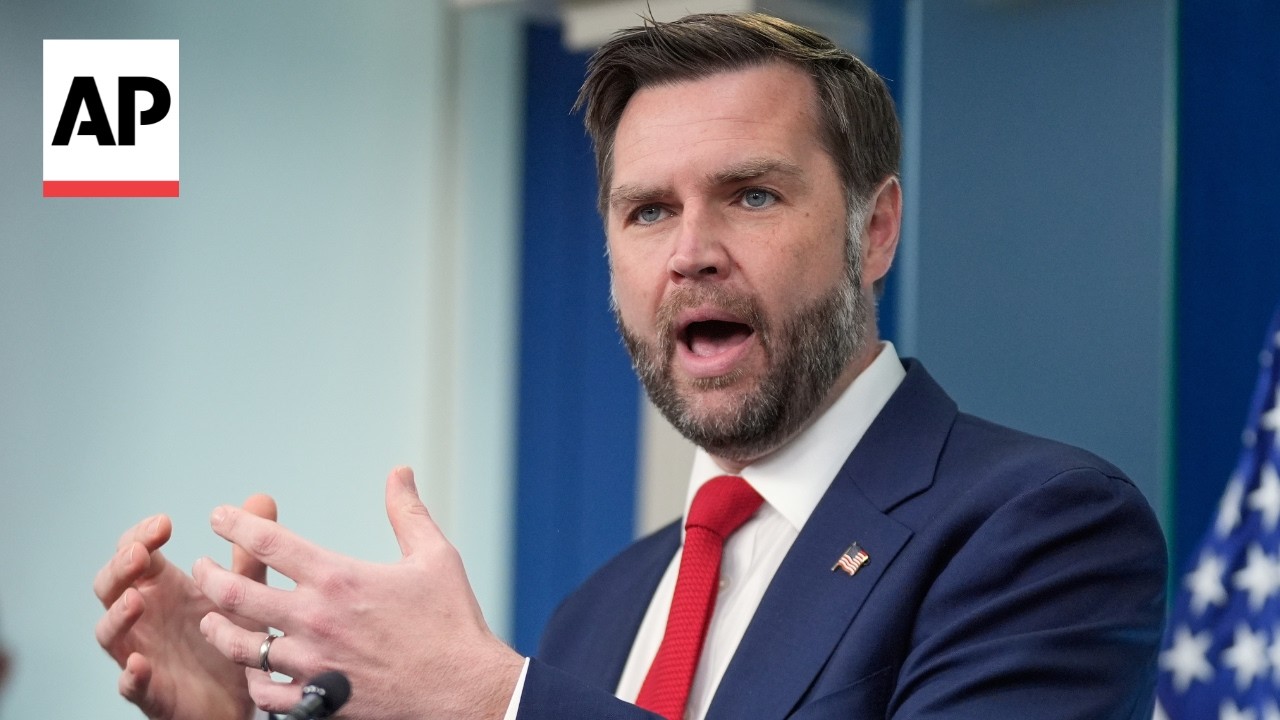
The latest remarks on Thursday at the White House by Vice President JD Vance regarding Israeli criticism of the U.S.-Iran Memorandum of Understanding have exposed a troubling misunderstanding of the nature of the U.S.-Israel alliance and, more importantly, of Israel’s unique security predicament.
According to a report by Israel National News, Vance sharply rebuked members of Prime Minister Benjamin Netanyahu’s government who expressed concern about the emerging agreement with Iran, suggesting that Israeli officials should refrain from criticizing President Donald Trump because he is, in Vance’s words, “the only head of state in the entire world who is sympathetic to the nation of Israel at this moment in time.”
That statement may have been intended as a defense of President Trump and his diplomatic initiative. Instead, it risks sending an unfortunate message: that Israel should mute its concerns about a matter of existential national security because the United States is doing it a favor.
Such a view fundamentally misunderstands both the alliance and the stakes involved.
According to the Israel National News report, Vance stated, “If I was in the cabinet of the Israeli government, I might not be attacking the only powerful ally that I have in the entire world.” The implication is unmistakable. Israeli leaders, in this formulation, should exercise restraint not because the agreement is necessarily sound, but because America has been supportive.
Yet alliances are not built upon silence. They are built upon honesty.
Indeed, one of the defining strengths of the U.S.-Israel relationship throughout its history has been the willingness of leaders on both sides to speak candidly when they disagree. Israeli officials are not questioning America’s friendship. They are questioning whether a particular agreement adequately protects Israeli security. There is a profound difference.
According to the Israel National News report, Vance defended the agreement’s provisions by arguing that no new benefits are being granted to Iran. “What is the benefit that the Iranians get that they didn’t have before? The answer is nothing,” he said.
That assertion is likely to be disputed by many critics of the agreement. Skeptics point out that even if certain economic activities existed before, formalizing arrangements, reducing restrictions, restoring commercial activity, and providing greater diplomatic legitimacy can all constitute meaningful strategic gains.
Reasonable people can disagree about the magnitude of those benefits. What is unreasonable is suggesting that Israeli officials should not raise such questions. No nation has monitored Iran’s nuclear activities more closely than Israel. No nation has spent decades warning the international community about the risks posed by Iran’s enrichment activities, ballistic missile programs, and regional proxy network. And no nation would face more immediate consequences if those concerns prove justified. That reality gives Israeli leaders not only the right but arguably the obligation to scrutinize any agreement involving Tehran.
Israel National News reported that Vance urged critics to “have a little bit of faith in President Trump.” Faith, however, is not a substitute for verification.
Diplomatic agreements are not judged by intentions alone. They are judged by their terms, enforcement mechanisms, compliance provisions, and long-term consequences.
Even the strongest supporters of President Trump should recognize that rigorous scrutiny strengthens agreements rather than weakens them. If a deal is truly sound, it should be able to withstand serious questions. If concerns are unfounded, they can be answered. If concerns are valid, they should be addressed. That is how responsible policymaking works.
The broader issue extends beyond the particulars of the memorandum itself. Vance’s remarks risk creating the impression that Israel should approach its security concerns with a degree of deference that no sovereign nation could reasonably be expected to adopt.
Imagine asking the United States to remain silent about a major international agreement affecting American national security simply because a friendly foreign government supported it. No American administration would accept such a proposition. Nor should Israel.
The reality is that Israeli skepticism regarding Iran did not emerge from ideology alone. It emerged from decades of confrontation, intelligence assessments, regional conflicts, and repeated disputes over nuclear transparency. Supporters of the agreement may sincerely believe it advances stability. Opponents may sincerely believe it creates new risks. Both positions deserve to be debated openly.
What should not happen is the suggestion that criticism itself is somehow improper. According to the Israel National News report, Vance emphasized that the administration retains leverage should Iran fail to comply. That assurance is undoubtedly intended to reassure skeptics. Yet history demonstrates why many remain cautious.
Questions about compliance, verification, and enforcement have accompanied nearly every major diplomatic engagement with Iran for decades. Those questions will not disappear simply because officials ask critics to trust the process. Trust is important. Verification is indispensable.
The alliance between the United States and Israel is among the most durable strategic partnerships in modern history precisely because it has survived disagreements. American presidents and Israeli prime ministers have often differed on tactics, negotiations, settlements, military operations, and diplomacy. Yet the alliance endured because both sides understood that genuine friendship permits honest disagreement. In that sense, criticism of a policy proposal should never be confused with hostility toward an ally.
Israeli officials who express concern about the memorandum are not attacking the United States. They are doing what leaders are expected to do: evaluating whether a proposed arrangement adequately protects their nation’s interests. One may agree or disagree with their conclusions. But questioning their right to raise those concerns is another matter entirely.
Israel National News’ reporting highlights a debate that ultimately extends far beyond one agreement. It touches upon fundamental questions of sovereignty, alliance management, and national security. Can allies disagree publicly? Should concerns be muted for the sake of appearances? Does friendship require silence? The answer to all three questions should be no.
Strong alliances are not weakened by honest debate. They are strengthened by it. President Trump has long portrayed himself as a friend of Israel, and many Israelis acknowledge actions taken during his presidency that they view favorably. Precisely because the relationship is strong, Israeli leaders should feel free to speak candidly when they believe their country’s security is at stake. That is not ingratitude. It is responsibility.
And when the subject involves Iran, nuclear issues, regional security, and the future balance of power in the Middle East, responsibility demands nothing less.



