










The White House, the Octagon, and the Age of Spectacle: How a UFC Mega-Event Came to Define the Trump Era
By: Jason Ostedder
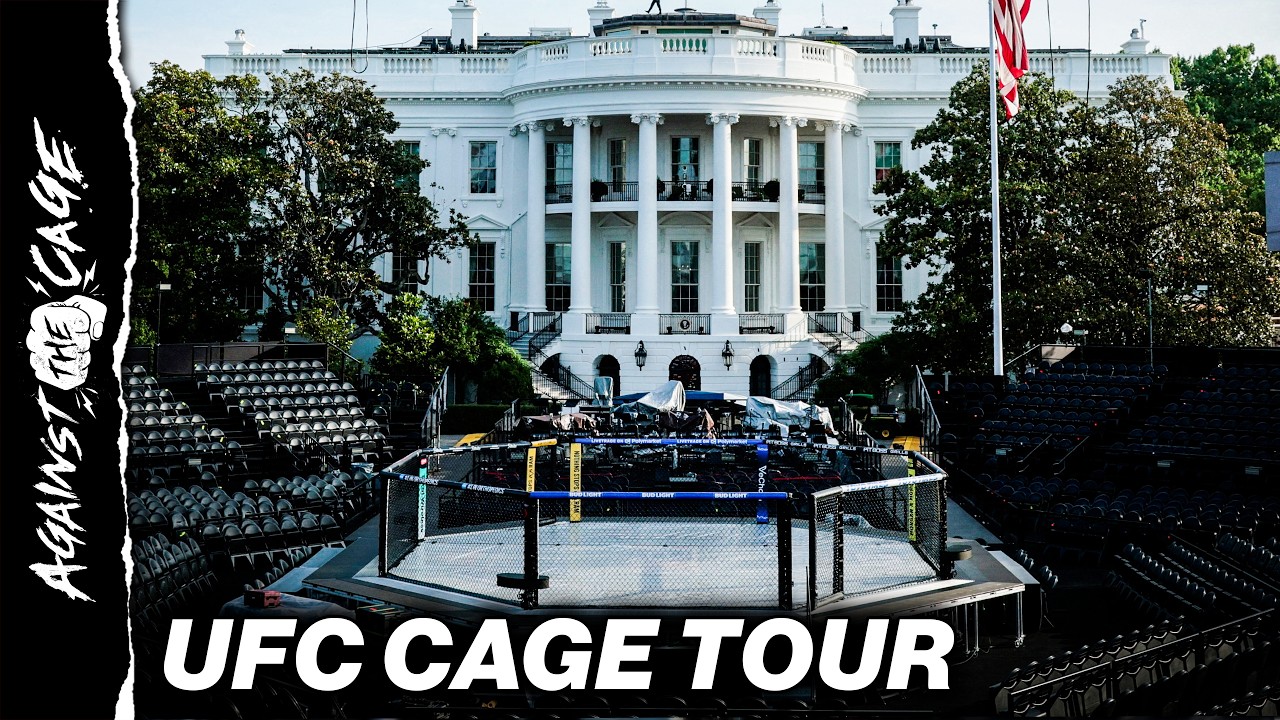
On the South Lawn of the White House, beneath the gaze of one of the most recognizable residences in the world, a colossal steel superstructure now rises above the historic grounds like something transplanted from a futuristic sports arena or a Las Vegas entertainment complex.
Known simply as “The Claw,” the towering arena that will host UFC Freedom 250 on June 14 has become one of the most talked-about structures in America. Scheduled to coincide with President Donald Trump’s 80th birthday, Flag Day, and the broader America 250 commemorations, the event has already secured a place in presidential history before a single punch has been thrown. According to a report on Friday in The New York Times, journalists, influencers, political operatives, sports personalities, and foreign correspondents were invited onto the South Lawn this week to inspect the unprecedented venue and witness firsthand a spectacle unlike anything previously staged at the Executive Mansion.
The event itself is no longer merely a political curiosity. It is rapidly emerging as a defining cultural moment that encapsulates many of the themes that have characterized the Trump era: celebrity, entertainment, branding, political theater, media saturation, and the deliberate fusion of government symbolism with mass-market spectacle.
The New York Times described scenes of reporters wandering through the massive structure in visible amazement as crews worked feverishly to complete preparations for what is expected to be one of the most watched sporting events of the year. The publication reported that the enormous steel framework dominates the White House grounds and towers above much of the surrounding landscape.
By every measure, the undertaking is extraordinary.
According to numerous published reports, UFC Freedom 250 will be staged on the South Lawn before an audience expected to exceed 4,000 invited guests, while millions more are anticipated to watch through broadcast and streaming platforms. Reuters has reported that the event represents the culmination of a longstanding relationship between President Trump and the Ultimate Fighting Championship, whose president, Dana White, has become one of Trump’s closest allies in the sports and entertainment world.
For decades, presidents have utilized the White House as a stage for diplomacy, ceremonial events, state dinners, and historic announcements. Yet presidential historians interviewed by The New York Times indicated that there is no direct precedent for transforming the South Lawn into a fully operational mixed martial arts arena.
The newspaper quoted historian Douglas Brinkley as contrasting the event with the carefully choreographed political stagecraft of previous administrations. According to The New York Times report, Brinkley suggested that even the most visually ambitious presidential presentations of the modern era pale in comparison to the current undertaking.
That comparison underscores the uniqueness of the moment.
Throughout American history, presidents have embraced emerging technologies and communications mediums. Franklin Roosevelt mastered radio. John Kennedy understood television. Ronald Reagan brought cinematic instincts to politics. Barack Obama leveraged social media.
Trump, however, has often operated within a different cultural framework altogether — one shaped not merely by politics but by entertainment, branding, reality television, professional wrestling, combat sports, and the tabloid ecosystem that helped elevate him into a national celebrity long before he entered politics.
The New York Times report observed that standing beneath The Claw evokes associations less with traditional Washington symbolism and more with commercial entertainment complexes, sports mega-events, and large-scale promotional spectacles.
That impression is hardly accidental. The president’s affinity for combat sports has been well documented. Trump has attended numerous UFC events, frequently receiving enthusiastic receptions from crowds. His relationship with Dana White stretches back years and predates his political career. Reuters has reported that White and Trump forged a close friendship through the UFC’s formative years, when Trump provided venues and support during periods when the organization struggled for mainstream acceptance.
Now that relationship has produced what may be the most visually ambitious sporting event ever staged at a presidential residence.
The physical dimensions alone are staggering. Various reports indicate that the temporary arena structure rises above portions of the White House itself and can be seen from considerable distances throughout Washington. The New York Times described massive lighting arrays affixed to the structure’s curved appendages, with individual lights capable of independent movement and dramatic nighttime effects.
The visual presentation is expected to transform the White House grounds into something resembling a championship sporting venue rather than a traditional government setting.
Large video screens, elaborate lighting systems, sponsor displays, broadcast infrastructure, hospitality facilities, and extensive seating arrangements have fundamentally altered the appearance of the South Lawn.
According to Reuters and other published accounts, the UFC is financing much of the massive production effort, which reportedly carries costs measured in tens of millions of dollars.
The symbolism of the event is generating nearly as much discussion as the fights themselves.
Supporters view the UFC showcase as an innovative celebration of American culture and athletic excellence during the nation’s 250th anniversary observances. Critics view it as an example of the growing merger between politics, entertainment, and personal branding.
The New York Times report noted that while visitors touring the arena expressed amazement at its scale and ambition, others questioned whether the spectacle was appropriate amid ongoing international crises and domestic political challenges.
That debate has intensified in recent days. According to Reuters, public opinion regarding the event remains sharply divided. Critics have argued that the White House should remain distinct from commercial entertainment ventures, while supporters contend that the presidency has always evolved alongside American culture and public interests.
What is indisputable is that the event has attracted extraordinary international attention. Sports journalists have traveled from around the world to cover the proceedings.
The New York Times report described foreign correspondents walking through the partially completed venue in visible disbelief as they attempted to absorb the scale of the undertaking. One Australian reporter quoted by the newspaper reportedly described the scene as both “incredible” and “unbelievable.”
Such reactions reflect the reality that few people expected to see a UFC championship card staged against the backdrop of the White House. Yet for many observers, the event feels remarkably consistent with Trump’s political persona.
Long before entering politics, Trump cultivated a public image built around excess, entertainment, promotion, and spectacle. His business ventures included casinos, beauty pageants, television programs, sporting events, and celebrity-driven enterprises. His political career has frequently incorporated many of the same instincts.
The White House UFC event may therefore represent not a departure from Trumpism but its ultimate expression. According to The New York Times report, the juxtaposition between the historic White House grounds and the massive entertainment infrastructure creates an atmosphere that feels simultaneously surreal and strangely inevitable.
The publication suggested that the event serves as a culmination of decades of American celebrity culture, sports entertainment, political branding, and media evolution. The visual contrast is especially striking.
The arena rises amid trees planted by previous presidents and overlooks one of the most historically significant buildings in the United States. According to The New York Times report, spectators seated in the highest sections will have sightlines comparable to the level of the White House’s Truman Balcony.
Such imagery captures the unusual collision of history and spectacle now unfolding in Washington. Meanwhile, preparations continue at a relentless pace.
Construction crews, security personnel, broadcast technicians, military musicians, UFC officials, Secret Service agents, and event organizers have spent weeks transforming the South Lawn into a temporary sporting complex. Reuters reported that legal challenges seeking to halt the event have thus far failed, allowing preparations to continue uninterrupted ahead of fight night.
Organizers anticipate enormous global audiences. Dana White has repeatedly suggested that viewership could rival some of the largest sporting broadcasts in recent memory, while media organizations worldwide have devoted extensive coverage to the event.
For Washington itself, the weekend represents a remarkable moment. The city has hosted inaugurations, military parades, diplomatic summits, state funerals, and historic protests.
It has witnessed some of the most consequential moments in American political history. Yet even longtime observers struggle to identify anything quite comparable to what will unfold on the South Lawn.
As The New York Times reported, the atmosphere surrounding the arena tour resembled a mixture of political convention, sporting event, entertainment showcase, and media spectacle. That combination may ultimately explain why the event has captured such intense attention.
Whether viewed as innovative, controversial, excessive, entertaining, historic, or all of those things simultaneously, UFC Freedom 250 has already succeeded in becoming far more than a sporting event. It has become a cultural statement. It has become a political symbol.
And perhaps most significantly, it has become a reflection of a presidency that has consistently blurred traditional boundaries between governance, media, celebrity, and entertainment.
On Sunday night, beneath the towering steel arcs of The Claw, fighters will enter the octagon and compete before a global audience. Yet regardless of who wins or loses inside the cage, the larger story may already have been written. The White House has long served as a symbol of American power. For one extraordinary evening, it will also serve as the backdrop for one of the most ambitious sporting spectacles ever staged on government property — a moment that many observers believe will be remembered as one of the most visually striking and culturally revealing events of the Trump presidency.
And as millions watch from around the world, the image of a giant UFC arena rising above the South Lawn may become one of the defining visual symbols of America in 2026.



