













Tense NBC “Meet The Press” Clash Ends Abruptly as Trump Cuts Short Interview Following Dispute Over Election Claims
By: Tzirel Rosenblatt
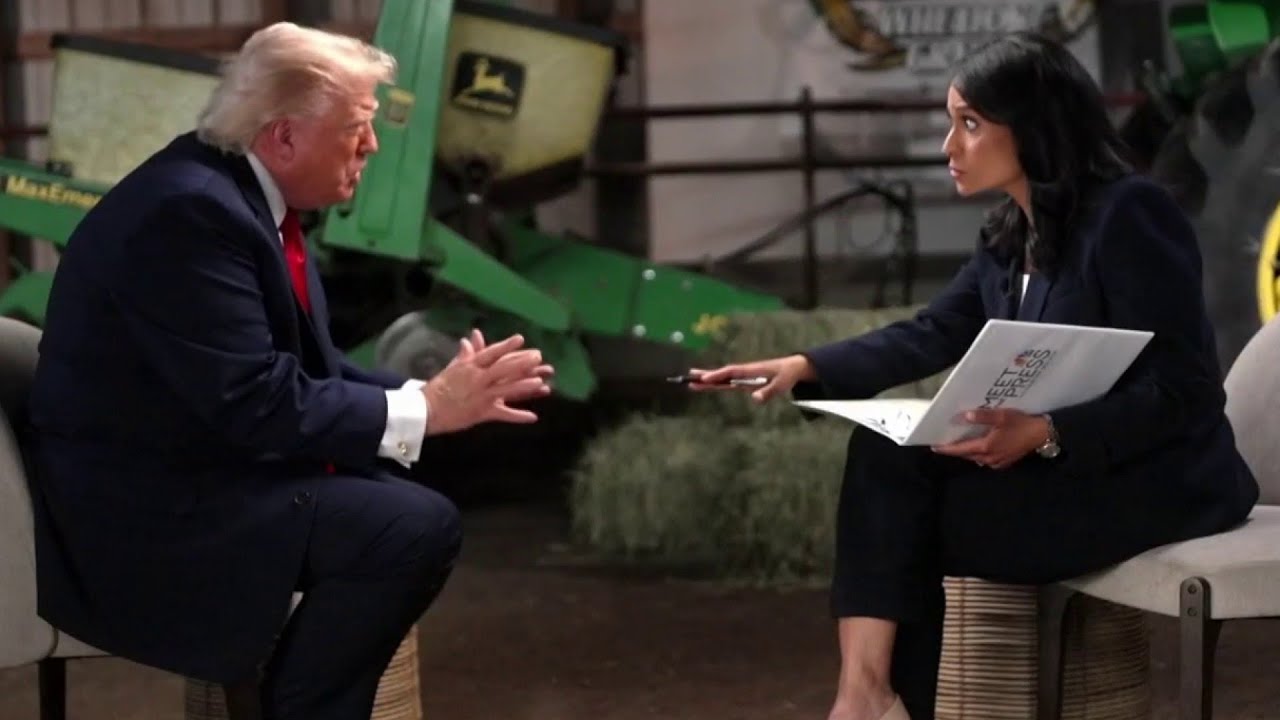
A televised interview between President Donald Trump and NBC moderator Kristen Welker came to an abrupt and dramatic conclusion on Sunday after an increasingly contentious exchange over Trump’s allegations regarding election irregularities, highlighting once again the often adversarial relationship between the president and major American news organizations.
According to a report on Sunday at VIN News, the interview, which initially encompassed a broad array of domestic and international issues, gradually evolved into a heated confrontation as Welker pressed the president on claims he has made concerning election administration and alleged voting problems in California.
What began as a policy-focused discussion ultimately transformed into a pointed debate over evidence, media credibility, and the role of journalists in scrutinizing statements made by public officials.
The exchange quickly attracted widespread national attention, with clips circulating extensively across social media platforms and generating intense discussion among political observers, journalists, supporters of the president, and his critics.
VIN News reported that tensions escalated when Welker sought additional clarification regarding Trump’s assertions about election-related concerns. As the questioning continued, the discussion became increasingly combative, with both participants firmly defending their respective positions.
Trump reportedly maintained that his concerns regarding election administration warranted public attention, while Welker continued pressing him for supporting evidence related to the specific claims under discussion. The disagreement reflected a broader dynamic that has characterized much of Trump’s public engagement with the national press throughout his political career.
For years, the president has frequently argued that major media institutions fail to treat him fairly and often approach his statements and policies with preconceived bias. Journalists and news organizations, meanwhile, have maintained that rigorous questioning and requests for evidence represent essential elements of responsible reporting and democratic accountability.
The confrontation described by VIN News appeared to encapsulate that long-running conflict in a particularly visible and dramatic fashion.
As the discussion intensified, Trump reportedly shifted his criticism beyond the immediate subject matter and began directing broader complaints toward several major news organizations. According to the VIN News report, the president accused prominent media outlets of engaging in unfair coverage and displaying persistent bias in their reporting. Such criticisms have become a recurring feature of Trump’s interactions with journalists.
Throughout multiple campaigns and presidential terms, he has repeatedly challenged the credibility, motivations, and editorial judgments of various national media institutions. Supporters often argue that his criticisms expose perceived ideological bias within the press, while opponents contend that his attacks undermine public trust in independent journalism.
The interview’s increasingly confrontational tone eventually reached a breaking point. VIN News reported that Trump ultimately indicated he no longer wished to continue the conversation and moved to bring the interview to an end. The decision effectively terminated the exchange before additional topics could be fully explored.
As the president prepared to leave, Welker reportedly attempted to continue asking questions. However, according to VIN News, Trump declined to remain for further discussion and ended his participation. The abrupt conclusion immediately became the defining moment of the interview.
Television interviews involving presidents are typically carefully structured affairs designed to facilitate extensive discussion of public policy and current events. While disagreements between journalists and political leaders are hardly unusual, interviews ending prematurely often attract substantial public attention because they underscore the tensions that can emerge when political messaging collides with journalistic scrutiny.
The White House did not immediately issue a public statement regarding the exchange, according to the information cited by VIN News. The absence of an official response only heightened public interest as commentators and analysts sought to interpret the significance of the encounter.
The interview itself covered a range of major issues before the confrontation overshadowed the broader discussion. VIN News reported that Trump addressed subjects involving the American economy, foreign policy concerns, and escalating tensions related to Iran. Those issues remain among the most consequential matters facing the administration and continue to dominate national political debate.
However, as often occurs in modern media environments, the dramatic conclusion ultimately attracted greater public attention than many of the substantive policy discussions that preceded it. Political communications experts frequently observe that moments of conflict tend to generate significantly more engagement than routine policy exchanges. As a result, memorable confrontations often shape public perceptions of an interview more profoundly than detailed discussions of legislation, economics, or international affairs.
That phenomenon appeared evident in the aftermath of this encounter. VIN News noted that video clips of the exchange spread rapidly online following the broadcast. Supporters of the president generally viewed the episode as another example of Trump forcefully pushing back against what they perceive as hostile media treatment.
Many argued that the questioning reflected a broader pattern in which journalists devote disproportionate attention to challenging the president while applying different standards to political figures from other ideological perspectives.
Critics, by contrast, viewed the confrontation differently. Some argued that Welker’s questions fell squarely within the responsibilities of professional journalism and that requests for evidence regarding significant public claims are both appropriate and necessary. Others contended that the president’s decision to terminate the interview prematurely prevented a fuller examination of issues that warranted public discussion.
The sharply divergent reactions underscored the extent to which perceptions of media performance have become deeply intertwined with broader political identities. Indeed, the exchange highlighted a central feature of contemporary American politics: the increasingly polarized relationship between elected leaders, news organizations, and their respective audiences.
VIN News has frequently reported on developments involving the intersection of politics and media, noting how public confidence in news institutions has become a major topic of debate in recent years. Surveys have repeatedly shown significant differences in media trust levels among various political constituencies, with many Americans expressing skepticism regarding the objectivity of national news coverage.
Against that backdrop, confrontations such as the one involving Trump and Welker often resonate far beyond the immediate details of the discussion itself. They become symbolic contests over credibility, authority, and the competing roles of political leaders and journalists in shaping public understanding.
For Trump, media confrontations have long represented a defining element of his political identity. From his earliest presidential campaign through his subsequent years in office, he has frequently portrayed himself as challenging entrenched institutions, including major media organizations.
Supporters often view these confrontations as evidence of his willingness to engage directly with adversarial questioning and resist what they see as unfair treatment. Meanwhile, journalists have generally maintained that vigorous questioning of public officials is essential regardless of party affiliation or political ideology.
News organizations argue that their responsibility is to seek clarification, verify claims, and provide the public with information necessary to evaluate government actions and statements. The collision between those perspectives has produced numerous memorable encounters over the years, and the interview described by VIN News appears destined to join that list.
Beyond the immediate political implications, the episode also illustrates the evolving nature of modern media consumption. Within minutes of the broadcast, excerpts of the exchange were circulating across digital platforms, reaching audiences far larger than those who watched the interview in its entirety. Short video clips, isolated quotes, and commentary from public figures quickly transformed a single interview segment into a nationwide conversation.
This rapid dissemination ensures that moments of tension can take on lives of their own, often becoming political events independent of the broader context in which they occurred. As a result, the confrontation between Trump and Welker has become more than simply a disagreement during a television interview.
According to the account reported by VIN News, it has evolved into another chapter in the long-running struggle between a president who frequently accuses major news organizations of bias and journalists who insist upon their responsibility to challenge public officials and examine controversial claims.
Whether viewed as a principled defense against perceived media hostility or as an unwillingness to continue answering difficult questions, the episode is likely to remain part of the broader national debate regarding politics, journalism, and public trust.
As reactions continue to emerge from across the political spectrum, the exchange serves as a vivid reminder that in the contemporary media landscape, the relationship between elected leaders and the press remains one of the most consequential and closely scrutinized dynamics in American public life.



