

























NYU Student Charged With Hate Crimes After Swastika Flag Incident During Graduation Week
Arrest Sparks Renewed Debate Over Antisemitism, Campus Activism, and Escalating Tensions at American Universities
By: Fern Sidman
A fourth-year student at New York University has been arrested and charged with multiple hate crimes after authorities alleged that he raised a swastika-emblazoned flag atop a university building during graduation-week events last month, an incident that drew widespread condemnation from university officials, Jewish advocacy organizations, and law enforcement authorities.
According to a report on Thursday in The Algemeiner, Alexander Stepnowsky, 23, of Fairfield, Connecticut, was taken into custody in Manhattan’s Lower East Side on Tuesday and charged with burglary as a hate crime, criminal trespass as a hate crime, and two counts of aggravated harassment.
The arrest represents one of the most significant hate-crime prosecutions to emerge from a university campus this year and has intensified ongoing national discussions about antisemitism, anti-Zionist activism, and the increasingly volatile atmosphere surrounding the Israel-Hamas conflict at colleges and universities across the United States.
Authorities allege that Stepnowsky was responsible for placing a flag featuring swastikas on a campus building during a period when thousands of students, faculty members, family members, and guests were participating in commencement-related celebrations. The display immediately generated outrage and concern, particularly because of the symbolism employed and the timing of the incident.
According to The Algemeiner report, law enforcement officials said surveillance footage played a central role in identifying the suspect. Investigators reportedly determined that Stepnowsky accessed the building by using a keycard, an action that allegedly generated electronic records capable of assisting investigators in reconstructing his movements.
Authorities further stated that surveillance cameras captured an individual entering the building before the offensive display appeared on the rooftop.
CBS News reported, according to information cited by The Algemeiner, that police sources claimed Stepnowsky expressed frustration regarding what he described as New York University’s involvement with issues related to Israel.
However, the defendant has denied criminal wrongdoing. At his arraignment on Wednesday, Stepnowsky entered a plea of not guilty. The court subsequently released him without bail, and he is scheduled to return to court in August as legal proceedings continue. The charges remain allegations, and prosecutors must prove them in court.
New York University moved quickly to condemn the incident following the arrest. Wiley Norvell, a senior university communications official, issued a statement emphasizing the seriousness with which the institution views the matter. “The symbols that were represented are antisemitic and hateful to every person of conscience,” Norvell said. “This appalling act violated our sense of community and solidarity.” Norvell also made clear that the university’s response would not be limited to criminal proceedings. “In addition to criminal proceedings, we will immediately pursue our disciplinary procedures, which carry the most severe consequences,” he stated.
The university’s response reflects growing concern among higher education institutions regarding incidents involving antisemitism and hate-based intimidation. Many universities have faced criticism from lawmakers, donors, alumni, and Jewish organizations regarding their handling of antisemitic incidents since the outbreak of the Israel-Hamas war.
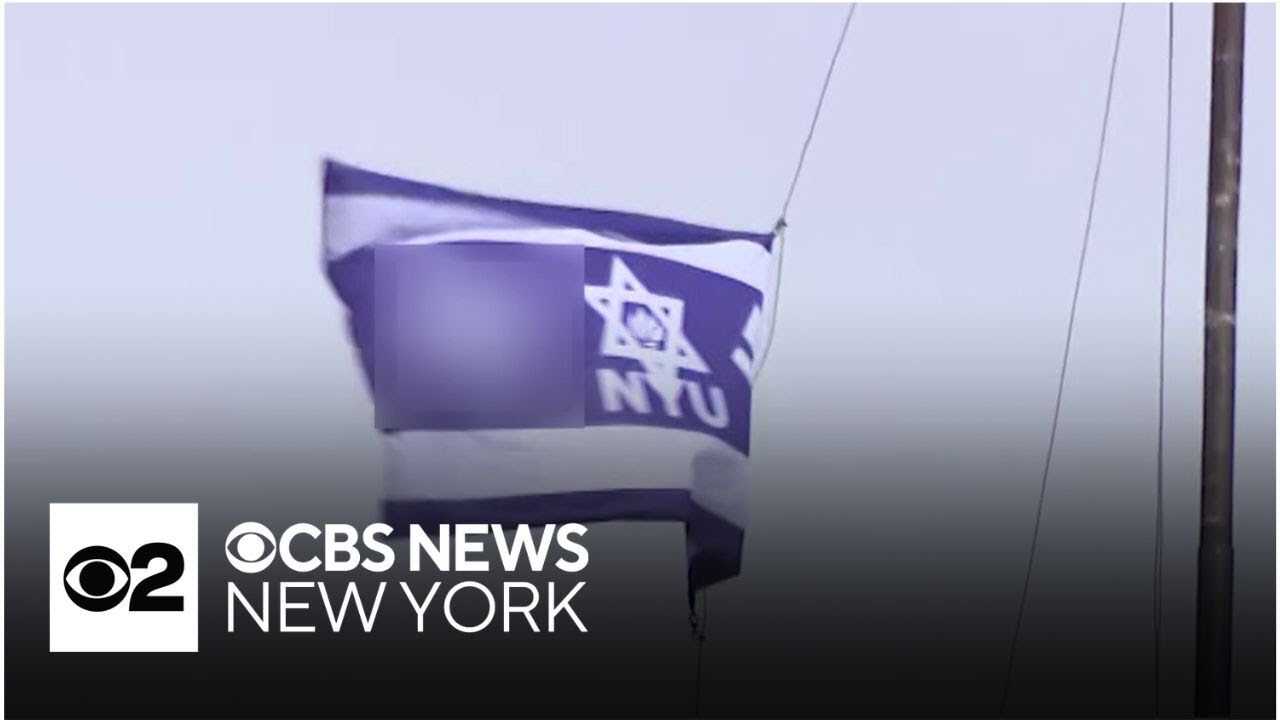
According to The Algemeiner report, the flag was reportedly designed to resemble New York University’s recognizable purple-and-white branding while incorporating symbols with deeply controversial historical and political associations. The display allegedly featured two swastikas positioned alongside a Star of David rendered in blue and white colors associated with the State of Israel. Observers noted that the juxtaposition of those symbols carried particularly disturbing implications.
Historically, combinations of Nazi imagery and Jewish symbols have frequently been used to advance conspiracy theories regarding Jewish influence or control. Jewish organizations argued that the display could not reasonably be interpreted as accidental or benign. Instead, they maintained that the symbolism appeared specifically designed to provoke fear and hostility.
The incident comes amid broader debates concerning antisemitism and anti-Zionism on college campuses, where disagreements over Israel have increasingly become flashpoints for controversy.
Among the strongest reactions came from StopAntisemitism, a Jewish civil rights advocacy organization. Liora Rez, the group’s chief executive officer, argued that the display represented far more than political expression. “This was not a prank, political statement, or act of free expression,” Rez said. “Swastikas are among the most universally recognized symbols of antisemitic hatred and genocide, and displaying them alongside Jewish symbols was a deliberate act intended to intimidate and target Jews.” Rez urged prosecutors to pursue the matter aggressively. “Alexander Stepnowsky should be prosecuted to the fullest extent of the law,” she stated.
Her remarks echoed broader concerns among Jewish advocacy organizations that antisemitic incidents on campuses are becoming increasingly overt and aggressive.
As The Algemeiner noted in its reporting, commencement events have increasingly become venues for political demonstrations and controversies related to the Middle East conflict. Universities across the country have struggled to balance free expression with maintaining celebratory academic ceremonies.
The NYU incident follows a series of commencement-related disputes over the past two years. Last year, New York University became embroiled in controversy after a student speaker allegedly deviated from approved remarks during a graduation ceremony. According to university officials cited by The Algemeiner, the student concealed the true content of a commencement speech that included accusations against Israel. University administrators publicly criticized the speaker and withheld his diploma pending review.
The controversy became one of several high-profile incidents illustrating the growing politicization of commencement ceremonies.
The Algemeiner reported that comparable incidents have occurred at other universities. At George Washington University, student speaker Cecilia Culver delivered remarks that drew national attention after making statements regarding Israel and the university’s role in global affairs. University officials later stated that she had been dishonest about the content of her planned speech. The institution subsequently barred her from campus and revoked certain academic distinctions. Culver later filed a lawsuit challenging those actions.
The dispute generated widespread debate concerning free speech, academic governance, and institutional authority. The controversy underscored the challenges universities face when political activism intersects with official academic ceremonies.
Students have not been the only participants in these controversies. Faculty members have also become involved. According to the information provided in The Algemeiner report, a commencement speech delivered by a University of Michigan professor last month sparked criticism after remarks praising pro-Hamas activists drew objections from university leadership. University President Domenico Grasso later stated that portions of the speech had deviated from material previously submitted for review.
The incident prompted renewed discussion regarding institutional neutrality and the role of faculty members in politically sensitive debates. As universities continue navigating these disputes, administrators increasingly find themselves under pressure from multiple constituencies demanding stronger action.
Despite the visibility of recent controversies, The Algemeiner reported that some observers believe anti-Zionist student activism may be losing momentum compared with its peak during the previous academic year. Several attempts to organize major demonstrations reportedly failed to generate the same level of participation that characterized earlier protests.
At Occidental College in Los Angeles, Students for Justice in Palestine dismantled an encampment after administrators intervened and initiated disciplinary measures. At Smith College, activists ended an unauthorized encampment following discussions with university officials.
These developments have led some observers to suggest that the political energy that fueled large-scale campus demonstrations may be waning. Nevertheless, incidents such as the NYU swastika flag controversy demonstrate that tensions surrounding Israel, antisemitism, and campus activism remain highly volatile.
The arrest of Stepnowsky arrives during a period of heightened scrutiny of universities nationwide. Federal investigations, congressional hearings, donor pressure campaigns, and public criticism have all focused attention on how institutions respond to allegations of antisemitism.
For many Jewish students and organizations, the appearance of Nazi imagery on a university building during graduation celebrations represents an especially troubling development. For university administrators, the incident serves as another reminder of the challenges involved in maintaining campus environments that balance free expression with safety and inclusion.
As criminal proceedings move forward and university disciplinary processes unfold, the case is likely to remain closely watched by educational leaders, civil rights advocates, and policymakers alike. Whatever the outcome in court, the controversy has already become another significant chapter in the ongoing national debate over antisemitism, political activism, and the future of campus discourse in the United States.



