



|
Getting your Trinity Audio player ready...
|
By: Fern Sidman
The Olympic Games have long been imagined as a rare sanctuary from the rancor of geopolitics, a global arena in which athletic excellence is meant to eclipse the divisions of nation and ideology. Yet, as Israel National News reported on Tuesday, that fragile ideal was once again placed under severe strain when a Swiss public broadcaster removed a controversial segment of commentary after one of its journalists used the platform of a bobsleigh race to launch a sustained political attack on an Israeli athlete.
View this post on Instagram
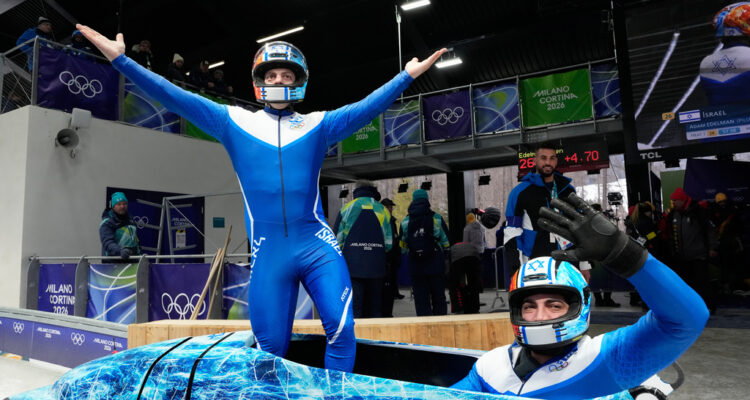
According to reports carried by Reuters and amplified by Israel National News, Radio Television Suisse (RTS) acknowledged that it had taken down from its website a portion of commentary delivered during the two-man bobsleigh event at the Olympic Games in Cortina. The broadcast accompanied a run by Israeli athletes Adam Edelman and Chen Menachem. Instead of confining his remarks to the technical or competitive dimensions of the race, the commentator, Stefan Renna, devoted a significant portion of the airtime to questioning Edelman’s very presence at the Games, citing the athlete’s political views regarding Israel’s war against Hamas in Gaza.
The incident has sparked a broader debate about the boundaries between sports journalism and political advocacy, the application of International Olympic Committee regulations on political expression, and the vulnerability of Israeli athletes to politicized scrutiny in international sporting arenas. Israel National News reported that Renna asserted Edelman’s public identification as a Zionist and his social media statements in support of Israel’s military actions placed him in potential violation of IOC rules concerning political statements by athletes. The commentator went further, accusing Edelman of endorsing what he characterized as “genocide” in Gaza and of mocking “Free Palestine” graffiti encountered during a World Cup race.
In a moment that many observers deemed an extraordinary breach of journalistic propriety, Renna concluded on-air that “one can therefore question his presence in Cortina during these Games,” invoking IOC rules that limit the participation of athletes with active military connections or overt political advocacy. The Israel National News report called attention to the gravity of this assertion: a broadcaster effectively placing an athlete’s legitimacy at the Olympics under suspicion, not for any breach of sporting conduct, but for his political identity and expressions.
RTS, confronted with an immediate backlash, issued a statement defending the journalist’s intent while conceding the inappropriateness of the execution. “Our journalist wished to question the IOC’s policy regarding the statements made by the athlete concerned,” the broadcaster said, as quoted by Israel National News. “However, although factual, such information may have appeared inappropriate due to its length within the context of a sports commentary. For this reason, we removed the segment from our website last night.” The phrasing of this response, acknowledging that the material may have been “inappropriate” because of its length rather than its substance, has itself drawn criticism for appearing to minimize the ethical concerns raised by the broadcast.
Notably, while RTS removed the commentary from its official website, recordings of the segment continued to circulate on social media, ensuring that the controversy did not dissipate with the broadcaster’s partial retraction. The International Olympic Committee, when asked to comment, deflected responsibility, stating that any questions regarding the remarks of broadcasters should be addressed to the media outlets themselves. The International Bobsleigh and Skeleton Federation, the sport’s governing body, has thus far remained silent on the episode.
The athlete at the center of the controversy, Adam Edelman, responded publicly with a mixture of defiance and dignity. Born in the United States and representing Israel, Edelman described the broadcast as a “diatribe” and rejected the premise that his political identity could negate the legitimacy of his athletic achievement. In a social media post cited in the Israel National News report, Edelman wrote that he and his teammates constituted “a team of six proud Israelis who’ve made it to the Olympic stage. No coach with us. No big program. Just a dream, grit, and an unyielding pride in who we represent.” He added pointedly that he did not believe it was possible to witness such a journey and still give credence to the commentator’s denunciation.
The broader implications of the incident extend beyond the immediate affront to Edelman and his team. The Israel National News report contextualized the controversy within a pattern of heightened scrutiny and politicization directed at Israeli athletes and cultural figures in international forums since the outbreak of the war with Hamas. The Olympic movement’s insistence on political neutrality has long been aspirational rather than absolute; the Games have historically been entangled with boycotts, protests, and ideological disputes. Yet the targeting of individual athletes for their national or political identities represents a particularly corrosive development, eroding the premise that the Olympic stage is a space of equal dignity for all competitors.
Renna’s invocation of IOC rules raises complex questions about the interpretation and application of those guidelines. The IOC has regulations that restrict overt political demonstrations by athletes within Olympic venues, intended to preserve the neutrality of the competition. However, these rules are typically applied to actions taken within the Olympic context itself, such as podium protests or symbolic gestures during events, rather than to athletes’ personal political views expressed outside the arena. By extrapolating from Edelman’s social media activity to question his eligibility to compete, the commentator appeared to conflate personal expression with institutional policy, a conflation that many legal and ethical experts would regard as untenable.
The language employed in the broadcast further exacerbated the controversy. Accusations of “genocide” and references to graffiti mocking are not neutral descriptors; they are politically charged assertions that presuppose a moral judgment about a complex and deeply contested conflict. Such claims, delivered in the context of a live sports broadcast, transformed a moment of athletic performance into an involuntary forum for geopolitical condemnation. The effect, critics argue, is to conscript athletes into political debates they did not initiate, subjecting them to scrutiny and censure simply for representing their country.
RTS’s decision to remove the segment reflects an acknowledgment, however belated, of the impropriety of the broadcast. Yet the broadcaster’s framing of the issue as one of contextual length rather than ethical overreach has left lingering questions about institutional accountability. The network’s statement did not explicitly apologize to Edelman or his team, nor did it articulate a clear commitment to preventing similar incidents in the future. This omission has fueled skepticism about whether the retraction represents a substantive correction or a tactical response to public pressure.
The IOC’s deflection of responsibility, directing inquiries back to media outlets, underscores the fragmented nature of accountability in the Olympic ecosystem. Broadcasters operate with editorial independence, yet their coverage shapes the public perception of the Games and the athletes who compete in them. When commentary crosses into targeted political denunciation, the absence of a clear mechanism for redress leaves athletes exposed and audiences uncertain about the standards governing Olympic coverage.
For Edelman and Menachem, the episode has added an unwelcome layer of controversy to an already arduous Olympic journey. As Israel National News reported, the Israeli bobsleigh team operates without the institutional support enjoyed by larger programs, relying instead on personal determination and national pride to reach the sport’s highest stage. To have that achievement overshadowed by a commentator’s political critique underscores the vulnerability of smaller delegations to narratives beyond their control.
The incident also resonates within the broader discourse on antisemitism and the politicization of Jewish identity in international arenas. While Renna framed his critique in terms of Edelman’s alleged political positions, the effect of singling out an Israeli athlete for condemnation inevitably intersects with longstanding patterns in which Jewish or Israeli figures are subjected to disproportionate scrutiny. Israel National News has repeatedly documented concerns that such patterns, even when couched in the language of political critique, can contribute to a climate in which Jewish participation in global cultural and sporting life is problematized.
At stake, ultimately, is the integrity of the Olympic ideal itself. The Games are not insulated from the world’s conflicts, nor should they be. Athletes, like all citizens, hold political beliefs and inhabit national narratives. Yet the conversion of sports commentary into a platform for questioning an athlete’s moral legitimacy on the basis of his nationality or political identity threatens to erode the fragile covenant that allows competitors from adversarial nations to share the same track, rink, or ice run. The Israel National News report framed the controversy as a cautionary tale: when the finish line becomes a firing line, the promise of sport as a unifying human endeavor is placed in jeopardy.
As the Olympic spectacle continues, the reverberations of this episode will linger, prompting broadcasters, sporting bodies, and audiences alike to reconsider where the line should be drawn between contextual political awareness and targeted political condemnation. The answer to that question will shape not only the experience of Israeli athletes, but the future character of international sport in an era when the boundaries between competition and conflict grow ever more porous.
