



|
Getting your Trinity Audio player ready...
|
By: Abe Wertenheim
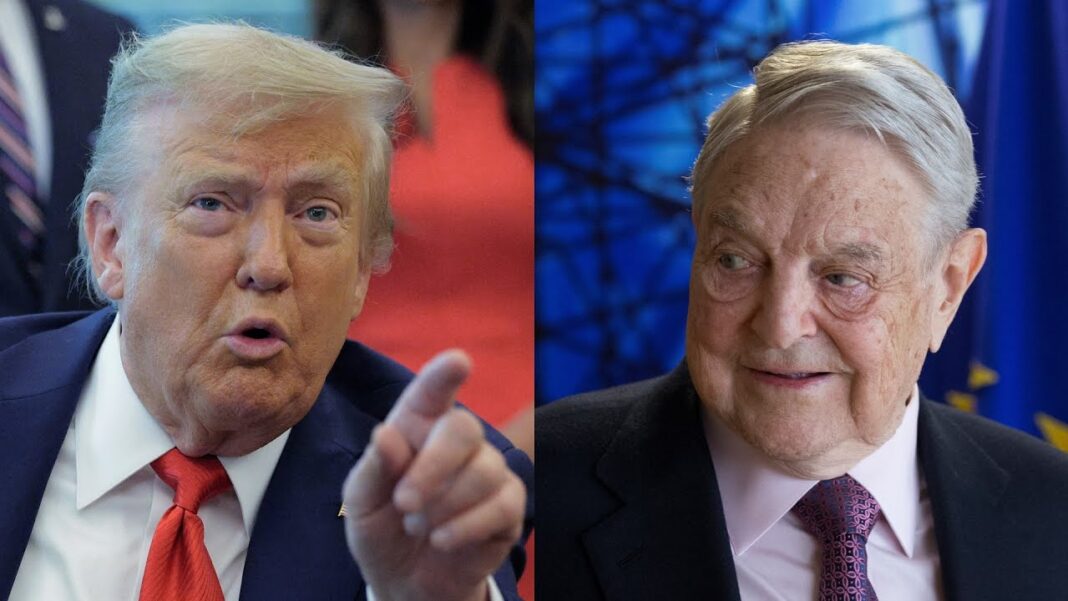
President Donald Trump has once again issued a sharp warning about the dangers posed by billionaire financier George Soros and his son, Alexander, insisting that the two should face federal racketeering charges for their role in funding and enabling violent demonstrations across the United States. His comments, delivered in a powerful social media statement on Wednesday, represent one of his clearest calls yet to confront the dangerous entanglement of money, radical activism, and anti-American ideology.
According to a report that appeared on Wednesday at Matzav.com, Trump declared: “George Soros, and his wonderful radical left son, should be charged with RICO (Racketeer Influenced and Corrupt Organizations Act) because of their support of violent protests, and much more, all throughout the United States of America.” He further accused the Soros network of systematically engineering social chaos, declaring in unmistakable terms: “Soros and his group of psychopaths have caused great damage to our country!”
The remarks focus in on what many conservatives, Jewish leaders, and pro-Israel advocates have long contended: that Soros, through his far-reaching Open Society Foundations (OSF), has actively financed initiatives that destabilize American communities and undermine U.S. allies abroad, particularly the State of Israel.
As the report at Matzav.com documented, OSF has injected billions of dollars into advocacy organizations across the globe, with a special focus on reshaping immigration laws, reimagining criminal justice policies, and fueling campus activism. Supporters of these programs argue they advance progressive values and expand civil liberties. Yet critics contend that the effects have been deeply corrosive, often encouraging lawlessness, anti-police sentiment, and hostility toward America’s traditional values.
The accusations that Trump leveled this week are not new, but they come at a moment when frustration with radical-left street protests—many of which have turned violent—remains at a boiling point. From the riots that rocked American cities in the wake of George Floyd’s death in 2020 to the more recent demonstrations that have targeted Jewish institutions and Israeli consulates, a troubling pattern has emerged.
The Matzav.com report noted that conservative watchdogs and investigative researchers have repeatedly linked Soros-backed financing to groups that either directly organized or indirectly enabled these episodes of unrest. Trump’s assertion that such conduct fits the definition of racketeering under the RICO statute reflects his belief that the pattern is too systemic to be dismissed as coincidence.
Perhaps most concerning, particularly to Jewish readers and those who track Middle East affairs, are the allegations of Soros’s connections to anti-Israel groups. As the Matzav.com report highlighted, reports from NGO Monitor show that Soros-linked money has flowed to entities openly supporting the Boycott, Divestment, and Sanctions (BDS) movement. These organizations have been criticized not only for delegitimizing Israel internationally but also for collaborating with parties that maintain open hostility toward the Jewish state.
Beyond BDS, Soros’s OSF has been connected to various NGOs operating in Judea and Samaria, many of which pursue campaigns hostile to Israel’s security interests. Some of these groups have worked to influence international tribunals, lobby European parliaments against Israel, and stage confrontational protests on the ground.
The Matzav.com report stressed that these revelations are not peripheral details but central to understanding the ideological underpinnings of Soros’s activism. For Jewish communities around the world, and particularly in Israel, Soros is viewed not as a neutral philanthropist but as a patron of forces working against the very survival of the Jewish homeland.
The influence of Soros funding is not limited to grassroots NGOs. Investigations have also pointed to significant OSF connections with J Street, the Washington-based lobbying group that presents itself as a “pro-Israel, pro-peace” organization but has long drawn criticism for pressuring Israeli governments to make dangerous concessions to Palestinian authorities.
As the Matzav.com report emphasized, J Street has become a contentious player in U.S. policy debates, often aligning with voices that seek to reduce American support for Israeli defense initiatives or to apply diplomatic pressure on Jerusalem. Critics argue that J Street provides political cover for progressive lawmakers in Washington to adopt stances that weaken Israel’s security and embolden its adversaries.
The financial and ideological synergy between OSF and J Street, then, fits into a larger pattern: one in which Soros resources are used to amplify policies that divide Jewish communities, weaken Israel’s diplomatic standing, and embolden radical activism on American soil.
Perhaps nowhere has Soros’s influence been more visible than on America’s college campuses, where student protests have increasingly adopted stridently anti-Israel and anti-American tones. Soros-backed funds have supported a constellation of organizations that, under the banner of “social justice,” have orchestrated pro-Hamas demonstrations, some of which have veered into intimidation of Jewish students and outright celebration of terrorism.
The report at Matzav.com pointed out that these student-led demonstrations frequently echo rhetoric found in extremist movements abroad, raising serious concerns about the infiltration of radical ideologies into mainstream academic life. Trump’s warning to Soros’s “crazy, West Coast friends” appears directed at these activist networks, many of which have flourished in California universities and beyond.
Trump’s Wednesday statement was not merely rhetorical bluster; it was a clear signal to his base that he intends to hold accountable those he sees as orchestrating America’s social unraveling. “Be careful, we’re watching you!” he wrote, emphasizing that citizens would no longer accept being pawns in a leftist-driven effort to destabilize the nation.
As Matzav.com reported, Trump’s tone reflects a growing determination among conservatives to challenge not only the surface-level manifestations of radical-left activism—riots, protests, and campus unrest—but also the deeper financial networks that sustain them. The former president’s invocation of RICO charges was deliberate, suggesting that Soros’s sprawling influence constitutes not random philanthropy but a coordinated, systematic effort to corrode America’s institutions.
For Trump and his supporters, Soros symbolizes more than just a billionaire donor; he epitomizes the dangers of a radical left that cloaks its intentions in the language of human rights while enabling extremism. As the Matzav.com report explained, conservatives argue that the real danger lies in how this funding has normalized hostility toward Israel, eroded respect for American law enforcement, and emboldened violent activism that jeopardizes public safety.
The radical left, critics contend, does not merely seek reform but aims to dismantle the cultural, political, and moral fabric of the United States. By bankrolling groups that operate under the guise of justice, Soros has given legitimacy and financial lifeblood to movements that thrive on division.
Trump’s decision to highlight Soros at this moment demonstrates his belief that the nation stands at a crossroads. Without accountability, he argued, the United States risks sliding further into chaos, with its democratic institutions compromised not by external enemies but by internal subversion funded by radical-left patrons.
As of publication, neither George Soros nor representatives of the Open Society Foundations have responded to Trump’s pointed accusations. This silence has been noted by many observers as striking, particularly given the seriousness of Trump’s call for RICO charges. In previous controversies, OSF has often dismissed criticism as unfounded or politically motivated, while continuing to expand its funding network at home and abroad.
The absence of a rebuttal, however, may only strengthen perceptions among Trump supporters that Soros and his allies prefer to operate in the shadows, quietly bankrolling disruptive movements rather than engaging in open debate about their intentions.
Trump’s latest remarks draw attention to what could become one of the defining political battles of the coming years: the clash between a conservative movement determined to defend national sovereignty, law and order, and pro-Israel solidarity, and a radical left sustained by the vast resources of financiers such as George Soros.
As Matzav.com has consistently reported, the stakes are not limited to partisan politics. They extend to the fundamental identity of the United States as a nation rooted in stability, freedom, and respect for its allies. Trump’s insistence that Soros be investigated under RICO reflects his view that America can no longer afford to ignore the corrosive influence of radical-left money in politics and activism.
The president’s message is clear: Americans will no longer stand idly by while powerful billionaires bankroll chaos in the streets, undermine Israel abroad, and destabilize the very fabric of American society. For Trump and his supporters, the fight against Soros is not merely about one man—it is about confronting the radical left’s attempt to remake the United States in its own image, regardless of the cost.

Agreed and agreed:
Soros was an actual participant and beneficiary in and of the Holocaust.