



|
Getting your Trinity Audio player ready...
|
Trump Accuses Comey of Assassination Threat in Controversial ‘8647’ Instagram Post, Sparks Secret Service Probe
By: Jerome Brookshire
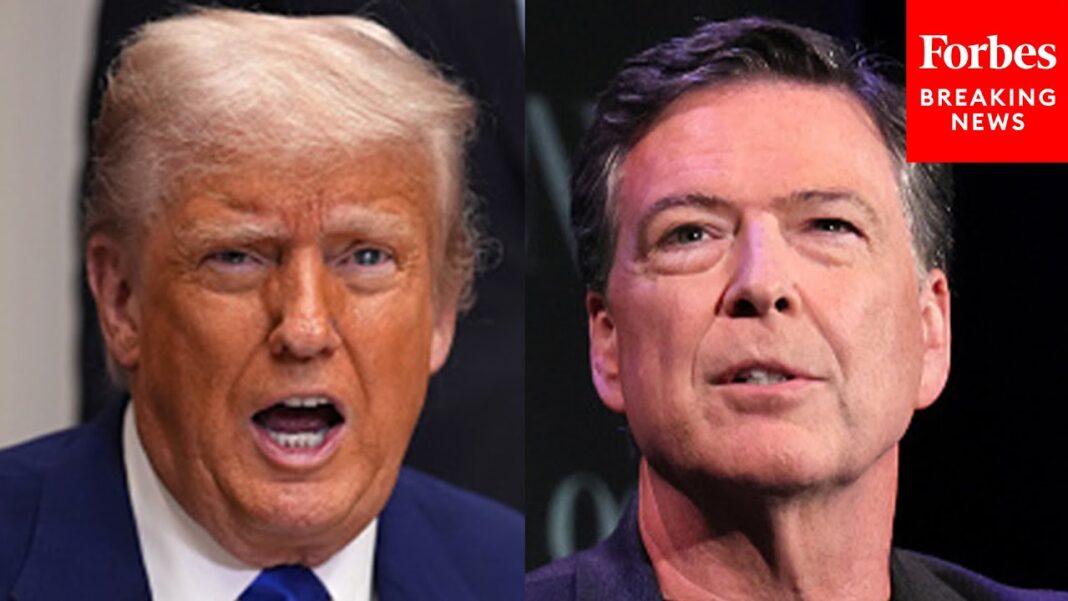
In a deeply charged escalation of political tensions, President Donald Trump has accused James Comey, the former FBI Director, of implicitly calling for his assassination through a cryptic Instagram post. As reported in The Guardian of the UK, the controversy erupted after Comey posted a photograph of seashells arranged on a beach to form the number sequence “8647” — an image he captioned innocuously as “Cool shell formation on my beach walk.”
Despite the benign caption, the image drew immediate fire from Trump’s allies and supporters, who swiftly interpreted it as a coded threat. The number “86” has long been slang for “eliminate” or “get rid of,” while “47” is now closely associated with Trump, who is vying to become the 47th president of the United States in his current re-election campaign. Together, critics claimed, the numbers spelled out an unmistakable message: “eliminate 47.”
Trump, speaking from Abu Dhabi as he concluded a Middle East diplomatic tour, told Fox News that the meaning was plain and intentional. “He knew exactly what that meant. A child knows what that meant. That meant assassination,” Trump said, as quoted by The Guardian. “And it says it loud and clear.”
The Secret Service has confirmed that it is investigating the post, emphasizing in a public statement that it treats all potential threats to the President with utmost seriousness. Anthony Guglielmi, spokesperson for the agency, acknowledged on social media that they are aware of Comey’s post and are conducting a thorough review. “We take rhetoric like this very seriously,” he wrote.
Comey, who was fired by Trump in 2017 during the investigation into Russian interference in the 2016 election, took the post down within hours. In a statement reported by The Guardian, he claimed the image had no violent intent. “I didn’t realize some folks associate those numbers with violence. It never occurred to me, but I oppose violence of any kind so I took the post down.”
Yet for many in Trump’s orbit — and beyond — the explanation didn’t ring true. Tulsi Gabbard, now serving as director of national intelligence, said the message was deliberate and dangerous. “He just issued a call to action to murder the president of the United States,” she wrote on X (formerly Twitter), adding in a Fox News appearance that the post amounted to “issuing a hit.”
Kristi Noem, Homeland Security Secretary, likewise denounced the post, calling it “a disgraceful and criminal call for violence” and confirmed that DHS and the Secret Service were investigating.
The Guardian noted that the political symbolism of “86” has surfaced in other contexts as well. Some conservative groups have used “8646” on merchandise as a call to impeach President Joe Biden — the 46th president. The use of numerical codes in modern political discourse, especially in online spaces, is not new, but it has grown increasingly fraught amid rising concerns about violent rhetoric.
The timing of Comey’s post has also raised eyebrows. As The Guardian observed, the controversy comes just as he prepares to release his third crime novel, FDR Drive, which centers on a U.S. attorney prosecuting a far-right media figure. Critics, including Gabbard and others, have accused Comey of leveraging the scandal to generate publicity for the book, arguing that the story’s themes parallel his real-life political feuds.
Comey’s defenders argue that the reaction is an overreach. He has publicly opposed violence in all forms and claims the numbers were chosen without full awareness of their political implications. However, skeptics point out his long tenure in law enforcement — including years leading the FBI’s efforts against organized crime — makes it implausible that he would be unaware of the connotations.
The Guardian carefully contextualized this latest incident within the broader climate of dangerously polarized political speech in the United States. As the paper noted, both major political figures — Trump and President Biden — have at times used combative language that critics argue can fuel extremism. Biden himself had to walk back a statement last year in which he said it was “time to put Trump in a bullseye,” just days before a failed assassination attempt on Trump.
For many observers, the Comey episode is emblematic of the increasingly blurred lines between political messaging and perceived threats. While Comey may insist his post was misunderstood, the broader public — and law enforcement — must now determine whether a former FBI chief truly failed to foresee how a simple sequence of numbers could become a national flashpoint.
As the investigation proceeds, The Guardian noted that the incident adds another volatile chapter to the long and contentious relationship between Trump and Comey. What began with a dramatic firing in 2017 has now evolved into a battle over symbols, intent, and the stakes of public discourse.
Whether or not the post will be deemed a legitimate threat remains to be seen. What’s clear, as The Guardian reported, is that the episode has already deepened America’s political fault lines and reignited a national conversation about how far political expression can — and should — go.
Comey’s Controversial Background
James Comey served as the Director of the Federal Bureau of Investigation (FBI) from 2013 until his dismissal in 2017. While his tenure was marked by significant events, it was also fraught with controversies and decisions that drew criticism from various quarters.
One of the most debated episodes of Comey’s tenure was his management of the investigation into Hillary Clinton’s use of a private email server during her time as Secretary of State. In July 2016, Comey held a press conference where he criticized Clinton’s actions but recommended no charges. Later, just days before the presidential election, he announced the reopening of the investigation due to new emails found, a move that some argue influenced the election’s outcome. The Department of Justice’s Inspector General later described Comey’s actions as “extraordinary and insubordinate,” noting that he deviated from established protocols and failed to consult with superiors.
Despite leading an investigation into Clinton’s email practices, Comey himself used a personal Gmail account for FBI business. This contradicted his own warnings to employees about the risks of using personal email for official matters. The Inspector General’s report highlighted this inconsistency, stating that Comey’s actions were “inconsistent with” Department of Justice policy.
James Comey’s tenure as FBI Director was marked by decisions that sparked significant debate and scrutiny. From his handling of high-profile investigations to personal conduct, these controversies have left a lasting impact on perceptions of his leadership and the FBI’s role in politically sensitive matters.
