



|
Getting your Trinity Audio player ready...
|
Cruz Sounds the Alarm: Senator Condemns Tucker Carlson as Dangerous Voice Fueling Rising Antisemitism
By: Fern Sidman
In a forceful and highly public rebuke that reverberated through political and media circles alike, Senator Ted Cruz sharply criticized former Fox News host Tucker Carlson on Tuesday, describing him as “the single most dangerous demagogue in the country” and warning that Carlson’s rhetoric has contributed to a troubling rise in antisemitic discourse within segments of the American right.
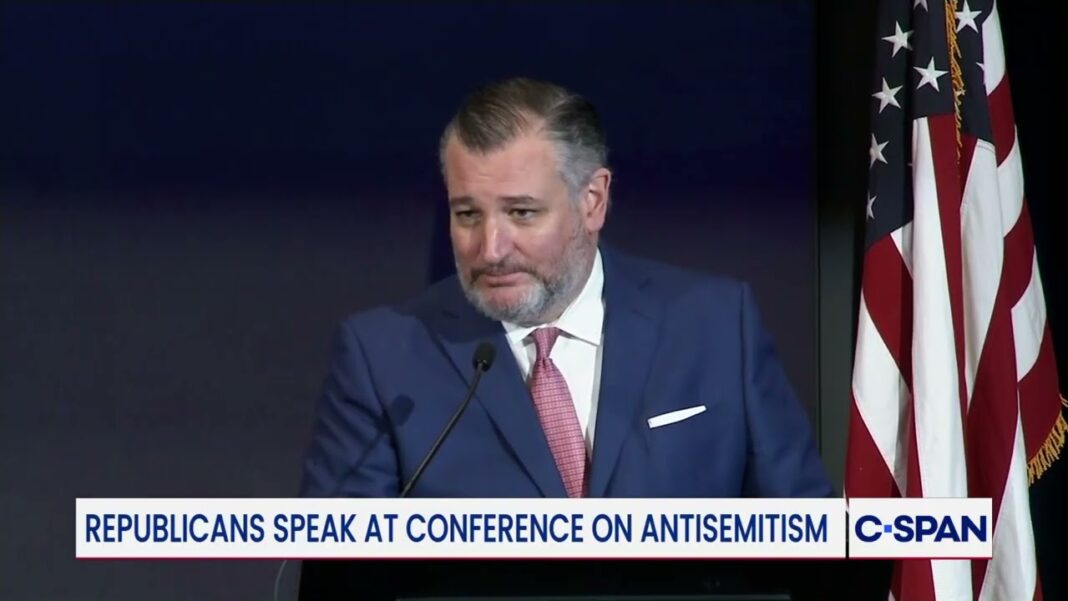
Cruz delivered the blistering assessment during remarks at a symposium on antisemitism in Washington hosted by the Republican Jewish Coalition and National Review. The event, which sought to address the alarming resurgence of antisemitic sentiment across the political spectrum, drew national attention as participants grappled with the ideological forces driving hostility toward Jewish communities.
According to a report cited by VIN News, Cruz’s remarks were among the most pointed criticisms yet directed by a leading Republican figure toward Carlson, whose influence in conservative media remains significant despite his departure from Fox News.
Speaking before an audience of policymakers, scholars, and community leaders, Cruz warned that antisemitic rhetoric has begun to appear in corners of the political right where it had previously been marginal or nonexistent. His comments spoke volumes about the urgency of confronting such views before they become normalized within mainstream political discourse.
“I have seen more antisemitism on the right in the last 18 months than at any other point in my lifetime,” Cruz declared, according to the VIN News report.
The Texas senator’s comments were particularly striking given his longstanding reputation as one of the most outspoken defenders of Israel within the Republican Party. For years, Cruz has championed a robust U.S.–Israel alliance, frequently emphasizing the strategic and moral foundations of the partnership between Washington and Jerusalem.
Yet in his remarks this week, the senator made clear that political alignment on other issues cannot excuse rhetoric that veers into antisemitic tropes or historical distortion.
Central to Cruz’s critique was Carlson’s history of featuring guests and commentators whose views on Israel and Jewish history have generated controversy.
According to reports cited by VIN News, Cruz accused Carlson of providing a platform to individuals who questioned the legitimacy of the State of Israel and advanced revisionist narratives about the Second World War—positions that many scholars and Jewish leaders have condemned as deeply troubling.
While Carlson has consistently rejected accusations of antisemitism, critics argue that some of the themes presented on his programs echo long-standing conspiracy theories and ideological currents historically associated with antisemitic movements.
Cruz suggested that the broader problem lies not merely in Carlson’s personal views but in the powerful reach of his media platform.
The former Fox News host built one of the most widely watched programs in cable news, and his online presence continues to attract millions of viewers—particularly among younger conservative audiences.
That influence, Cruz warned, gives Carlson’s rhetoric the potential to shape political attitudes in ways that extend far beyond traditional media boundaries.
“The danger is not simply what is said,” Cruz told the audience, according to reports referenced by VIN News. “The danger is how widely those ideas spread when they are presented under the banner of populism or nationalism.”
The senator’s remarks came against the backdrop of a dramatic rise in antisemitic incidents across the United States and around the world.
Jewish advocacy groups have reported a sharp increase in harassment, vandalism, and violence directed at Jewish individuals and institutions, particularly since the Hamas terrorist attacks on southern Israel on October 7, 2023.
In the months that followed those attacks, Jewish communities from New York to Los Angeles reported an unprecedented surge in threats and demonstrations targeting Jewish institutions.
As VIN News has frequently documented in its reporting, synagogues, schools, and community centers have been forced to increase security measures in response to the escalating climate of hostility.
At the symposium, several speakers emphasized that antisemitism is not confined to any single political ideology.
Rather, it has appeared in multiple forms across the political spectrum—from far-right nationalist movements to radical anti-Israel activism on the far left.
Cruz acknowledged this reality but stressed that conservatives must take responsibility for confronting antisemitism wherever it appears within their own ranks.
“If we see antisemitism on the right, we must call it out unequivocally,” he said, according to reports cited by VIN News. “Silence is not an option.”
The clash between Cruz and Carlson also reflects deeper disagreements about American foreign policy in the Middle East.
Cruz has been a vocal advocate for strong U.S. support of Israel and has consistently supported efforts to confront Iran’s nuclear ambitions.
Carlson, by contrast, has sometimes criticized what he characterizes as overly interventionist U.S. policies abroad, including Washington’s involvement in conflicts involving Israel and Iran.
These differences became particularly visible during debates over the Trump administration’s policies toward Tehran.
According to the information provided in the VIN News report, Cruz referenced these earlier disputes in his remarks, suggesting that Carlson’s critiques of U.S.–Israel cooperation have occasionally crossed into rhetoric that undermines Israel’s legitimacy.
For Cruz and many of his allies, Israel represents not only a strategic partner but also a democratic ally whose security concerns deserve unwavering American support.
Any narrative that questions Israel’s right to exist or portrays Jewish political influence in conspiratorial terms risks legitimizing deeply harmful stereotypes.
Jewish leaders attending the symposium welcomed Cruz’s willingness to address antisemitism within conservative circles. Several participants noted that confronting prejudice within one’s own ideological community requires political courage. One organizer told reporters that Cruz’s remarks reflected a broader recognition among many conservatives that antisemitism must be confronted wherever it emerges.
“As a society, we cannot allow these ideas to take root again,” the organizer said, according to the VIN News report.
Others emphasized that the fight against antisemitism must remain bipartisan.
The historical record shows that antisemitism has appeared in many ideological contexts, and effective responses require cooperation across political divides.
Despite the criticism, Carlson continues to command a large and loyal audience. Supporters argue that accusations of antisemitism have been unfairly weaponized against commentators who question aspects of U.S. foreign policy. They contend that criticism of Israel or skepticism about military intervention does not automatically constitute hostility toward Jewish people.
Yet critics counter that the line between legitimate policy debate and rhetoric that echoes antisemitic tropes can sometimes be dangerously thin.
For Cruz and others speaking at the symposium, the central issue is not disagreement over policy but the responsibility of influential voices to avoid amplifying ideas that have historically fueled hatred and violence.
As the symposium concluded, Cruz urged political leaders, journalists, and citizens alike to remain vigilant against the reemergence of antisemitic ideology.
History, he reminded the audience, offers stark lessons about the consequences of ignoring such rhetoric.
According to the VIN News report, Cruz concluded his remarks with a call for moral clarity.
“Antisemitism has no place in our politics, our media, or our society,” he said. In an era of rapidly evolving media platforms and polarized political discourse, the senator’s warning underscored the stakes involved in confronting prejudice before it gains a foothold.
Whether Cruz’s sharp condemnation of Carlson will reshape the broader debate remains to be seen. Yet the intensity of his remarks reflects a growing recognition that antisemitism—regardless of where it originates—must be challenged with unwavering resolve

Support Senator Cruz!