



|
Getting your Trinity Audio player ready...
|
By: Chaya Abecassis
The man accused of killing two young Israeli diplomats in what prosecutors have described as an anti-Israel hate crime formally pleaded not guilty on Thursday, setting the stage for what could become one of the most high-profile federal hate crime trials in recent memory.
As reported by The Algemeiner on Thursday, the defendant, Elias Rodriguez, 31, of Chicago, faces nine federal charges, including the murder of a foreign official and committing a hate crime resulting in death. Rodriguez is accused of gunning down Yaron Lischinsky, 30, and Sarah Lynn Milgrim, 26, outside the Capital Jewish Museum in Washington, D.C., on May 21. Both were employed by the Israeli Embassy and were leaving an event for young diplomats organized by the American Jewish Committee when they were fatally shot.
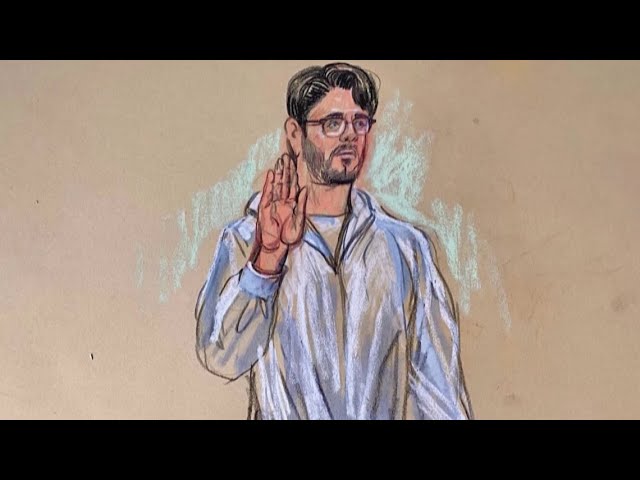
In a brief hearing before U.S. District Judge Randolph Moss, Rodriguez appeared in an orange jumpsuit and responded tersely when asked procedural questions. His attorney entered the not guilty plea on his behalf. “Yes,” he said when asked if he was satisfied with his legal representation—his only word beyond the formalities of the proceeding.
But the courtroom atmosphere was heavy with the knowledge of what prosecutors allege: that Rodriguez was driven by hatred of Israel and deliberately targeted Jewish diplomats as symbols of the state. The Algemeiner report noted that the Justice Department has emphasized the severity of the crime, not only as an attack on two individuals but as an assault on the very principle of diplomatic protection, long enshrined in international law.
The nine charges brought against Rodriguez are among the most serious in the federal code. Beyond the murder of a foreign official, they include violations that could make him eligible for the death penalty.
The indictment, as cited in The Algemeiner report, details chilling evidence. Investigators found online posts in which Rodriguez called to “vaporize every Israeli 18 and above.” Upon his arrest, he reportedly told officers, “I did it for Palestine. I did it for Gaza.” In a manifesto later uncovered, Rodriguez allegedly declared that anyone connected to Israel’s military efforts had “forfeited their humanity.”
Such explicit declarations of motive, prosecutors argue, leave little doubt that this was not a random act of violence but a calculated hate crime intended to terrorize Jewish and Israeli representatives in the United States.
The brutality of the attack shocked Washington’s diplomatic community. Lischinsky, a research assistant in the embassy’s political section, and Milgrim, a member of the administrative staff, had been in the United States only a few years. Friends and colleagues described them as deeply committed to fostering dialogue and building bridges.
As The Algemeiner report highlighted, the tragedy was compounded by the revelation that the two were on the verge of becoming engaged. Their families later confirmed that Lischinsky had been preparing to propose in the weeks following the event. The attack not only extinguished two young lives but also devastated the futures they had planned together.
The American Jewish Committee, which hosted the event, released a statement condemning the attack as “a vile act of antisemitic violence” and pledging to honor the memory of the slain diplomats by continuing their work in support of Israel and the Jewish people.
President Donald Trump’s administration has seized upon the case as emblematic of its determination to combat antisemitism at home and abroad. Administration officials have pointed to the filing of hate crime charges as a “zero-tolerance” signal against violence motivated by hatred of Jews or Israel.
As The Algemeiner reported, the White House has woven the case into its broader agenda, which includes high-profile civil rights investigations into American universities accused of tolerating antisemitism, as well as controversial efforts to deport foreign students tied to Hamas-aligned activism.
A senior administration official told reporters this week that the government views the case as “not merely a local tragedy but a national moment of accountability in the fight against antisemitism.”
The killing of Lischinsky and Milgrim is not an isolated episode but part of what Jewish organizations describe as a surge in antisemitic violence across Western capitals since the Hamas-led atrocities of October 7, 2023, which sparked an ongoing war in Gaza.
The Algemeiner has frequently documented attacks on Jewish targets in Europe, North America, and beyond—ranging from vandalism of synagogues to physical assaults on Jewish students. Yet this case marks an escalation: the targeted killing of diplomats on American soil.
For many Jewish leaders, the attack speaks volumes about the growing overlap between anti-Israel rhetoric and direct antisemitic violence, a link often downplayed in mainstream political debates. Rodriguez’s alleged statements—tying his actions directly to Gaza—highlight how narratives of “solidarity with Palestine” are being weaponized to justify outright terrorism.
Legal experts consulted by The Algemeiner suggest that the case could drag on for years, particularly if prosecutors pursue the death penalty. Death penalty cases in the federal system require extensive pretrial motions, psychiatric evaluations, and appeals.
Defense attorneys are likely to argue questions of mental health, radicalization, or entrapment, attempting to complicate what prosecutors portray as a straightforward hate crime. Given the political and diplomatic sensitivities, the trial will be closely watched not only in the United States but also in Israel and allied countries concerned about the safety of their diplomats abroad.
In the days after the attack, Israeli officials were quick to emphasize that they considered it not merely a personal tragedy but an affront to Israel’s sovereignty. The Israeli Embassy in Washington has worked closely with the State Department and the Justice Department throughout the investigation.
Israeli President Isaac Herzog sent condolences to the families, describing the killings as “an attack on Israel itself.” The foreign ministry in Jerusalem praised U.S. authorities for treating the case with the seriousness it deserves and underscored the importance of strong bilateral cooperation in safeguarding Israeli personnel worldwide.
As The Algemeiner reported, other embassies also took notice, with diplomats from allied nations expressing solidarity. The incident has prompted renewed discussions within the diplomatic corps about security at public events, especially in cities with significant political activism around the Israel-Palestinian conflict.
Ultimately, the trial of Elias Rodriguez will not be just about one man’s alleged crimes. It is poised to become a symbolic case in the broader struggle against antisemitism, testing the willingness of U.S. courts to impose the harshest penalties for violence motivated by hatred of Jews and Israel.
For the Jewish community, the murders of Lischinsky and Milgrim have already become a rallying cry. As The Algemeiner report noted, their names are being invoked in vigils and statements across the Jewish world as a reminder of the dangers of unchecked rhetoric and the urgent need to confront hate in all its forms.
The May 21 killings of Yaron Lischinsky and Sarah Lynn Milgrim cut short two lives dedicated to diplomacy and service. As Elias Rodriguez pleads not guilty and prepares to face trial, the United States must grapple with the reality that antisemitic violence is no longer confined to the shadows but has erupted into the heart of its capital.
The Algemeiner report emphasized that this case is not only about justice for two victims but also about reaffirming the principles of safety, dignity, and protection for Jews and Israelis everywhere. Whether or not Rodriguez is ultimately convicted, the tragedy serves as a stark warning: words of hate have consequences, and when left unchecked, they can turn into bullets.
