



|
Getting your Trinity Audio player ready...
|
By: Fern Sidman
By any historical measure, the sudden redeployment of a full United States carrier strike group from the western Pacific to the threshold of the Middle East is not routine. It is a declaration of seriousness — one made not with speeches or press releases, but with steel hulls, nuclear propulsion and the muted thunder of flight decks preparing for sustained operations.
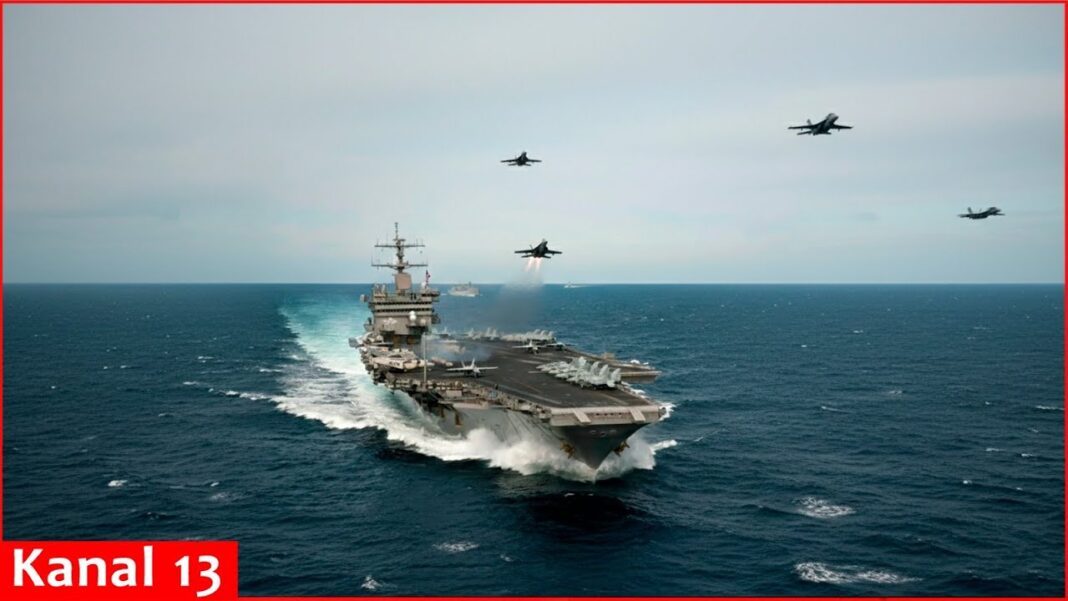
According to multiple defense sources cited in a report late Wednesday at VIN News, the Pentagon has ordered the USS Abraham Lincoln Carrier Strike Group — a Nimitz-class nuclear aircraft carrier accompanied by three Arleigh Burke-class guided-missile destroyers — to depart the South China Sea and steam westward toward the Arabian Sea, placing it within operational reach of Iran and the wider U.S. Central Command theater.
The move, which defense officials describe as deliberate rather than reactive, comes amid spiraling tensions with Tehran over its brutal suppression of nationwide protests, the closure of Iranian airspace, and intensifying concerns regarding the regime’s nuclear ambitions. At a cruising speed of roughly 20 knots, the Lincoln is expected to traverse the Indian Ocean in about a week, positioning the group off the Middle Eastern littoral by late January.
Fleet trackers reviewed by VIN News indicate that the redeployment fills a rare and strategically awkward void. At present, no U.S. carrier strike group is operating in the Middle East — an anomaly in a region where American flattops have served as floating airbases for decades, underwriting deterrence from the Strait of Hormuz to the Levant.
The Abraham Lincoln, which had been conducting F-35C flight operations and live-fire drills in the South China Sea under the aegis of the U.S. 7th Fleet, was the closest available asset capable of moving swiftly into position. Its redirection therefore marks a decisive pivot in global naval posture, transferring high-end power projection capacity from the Indo-Pacific — where tensions with China simmer — to the Persian Gulf, where Iran’s internal convulsions threaten to metastasize into regional confrontation.
“You don’t reposition a full carrier strike group from the Indo-Pacific for a one-night symbolic operation,” one defense source told VIN News on condition of anonymity. “This signals readiness for prolonged presence and follow-on capability if required.”
The Abraham Lincoln is no mere warship. Displacing more than 100,000 tons and powered by two nuclear reactors, it functions as a sovereign airfield at sea, carrying a complement of over 60 aircraft — including F-35C stealth fighters, F/A-18E/F Super Hornets, EA-18G Growler electronic warfare platforms, E-2D Hawkeye airborne command aircraft and MH-60 helicopters.
Its three Arleigh Burke-class escorts bring formidable missile defense and strike capability, armed with Aegis combat systems and vertical launch cells capable of firing Tomahawk land-attack cruise missiles, Standard Missile interceptors and anti-submarine weapons.
Together, as VIN News has detailed, the Lincoln Strike Group can establish layered air superiority, conduct deep-penetration strikes, interdict maritime traffic and provide real-time command and control for joint operations — all without reliance on regional bases.
The timing of the redeployment is inextricable from Iran’s internal unraveling. For weeks, the Islamic Republic has faced the most sustained wave of unrest since the 1979 revolution, with demonstrators openly challenging clerical rule amid collapsing living standards, currency freefall and mounting anger over repression.
As VIN News has reported, Iranian authorities have shuttered airspace, throttled internet access and unleashed security forces on protesters, while senior officials have warned that the United States and Israel will be held responsible for what they describe as “foreign-orchestrated sedition.”
Washington, for its part, has signaled that its patience is not infinite. U.S. officials have warned Tehran against executing protesters, and President Trump has publicly urged Iranians to persist in demonstrations, vowing that “help is on the way.” It is against this backdrop that the Lincoln’s westward transit must be understood.
While the carrier strike group represents the most visible symbol of American power, it is far from the only instrument available. The VIN News report noted that Tomahawk-armed destroyers already operating in the Persian Gulf and long-range B-2 Spirit bombers stationed on the U.S. mainland could enable initial precision strikes well before the Lincoln reaches station — much as they did during the June 2025 attacks on Iranian nuclear infrastructure.
Those operations, conducted without a carrier on hand, demonstrated Washington’s ability to project force rapidly across intercontinental distances. But analysts emphasize that sustained campaigns — whether coercive or protective — require the persistent air presence and logistical depth that only a carrier strike group can provide.
Pentagon officials have thus far refrained from issuing a formal confirmation of the redeployment, characterizing the Lincoln’s previous activities as routine and declining to comment on its destination. But defense analysts told VIN News that such silence is itself a form of signaling — a deliberate ambiguity designed to keep Tehran guessing.
To move a carrier is to speak in a language Iran understands viscerally. In the Iranian strategic lexicon, the arrival of a U.S. flattop offshore is synonymous with vulnerability — the unmistakable prelude to surveillance flights, freedom-of-navigation operations and, potentially, punitive strikes.
Yet the calculus is not solely Iranian. Regional actors — from Saudi Arabia and the United Arab Emirates to Israel and Qatar — are also parsing the Lincoln’s movement as a measure of American resolve. In capitals where doubts about U.S. commitment have simmered since the Afghanistan withdrawal, the redeployment is read as reassurance that Washington’s military backbone remains intact.
The decision does not come without cost. By extracting the Lincoln from the South China Sea, the Pentagon temporarily thins its carrier presence in waters where Chinese naval activity continues to expand. Beijing has spent the past decade normalizing the deployment of aircraft carriers, missile destroyers and maritime militias across the Indo-Pacific.
Nevertheless, sources quoted in the VIN News report suggest the administration concluded that the Iranian crisis presents the more immediate strategic risk — one capable of detonating into regional war, disrupting global energy markets and imperiling U.S. allies in ways that incremental Chinese assertiveness does not yet match.
As the Lincoln cuts through the Indian Ocean, its trajectory will be watched not only by satellites and naval intelligence services, but by millions whose lives are tethered to the Middle East’s fragile equilibrium.
Iran’s leadership will weigh whether the carrier’s approach represents a bluff or a prelude. Protesters inside the Islamic Republic will wonder whether the world’s most powerful navy is finally aligning with their defiance. And American allies will calibrate their own postures in response.
For now, what is clear is that Washington has chosen movement over rhetoric. The order to steam westward is a strategic sentence written in steel, and once issued, it cannot be retracted quietly.
When the USS Abraham Lincoln arrives off the Arabian Sea in the coming days, it will do so not merely as a warship, but as the embodiment of a question now echoing from Tehran to Tel Aviv: is this the moment when pressure turns into action?
