



|
Getting your Trinity Audio player ready...
|
Jared Evan
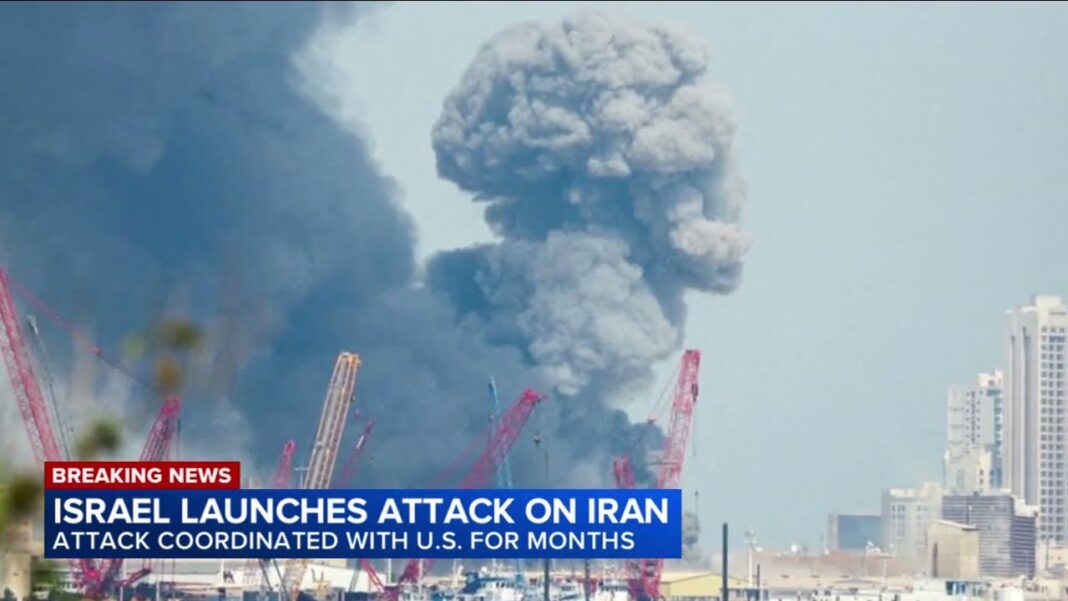
(TJV NEWS) The United States and Israel launched a sweeping military assault on Iran on Saturday, targeting military installations, missile sites and senior leadership compounds in what President Donald Trump described as “major combat operations.”
BBC reported that explosions rocked Tehran shortly after 9:30 a.m. local time, with smoke seen rising over Jomhouri Square and Hassan Abad Square. Blasts were also reported in Karaj, Isfahan, Qom and Kermanshah. Satellite imagery reviewed by BBC showed heavy damage near the compound of Iran’s Supreme Leader, Ayatollah Ali Khamenei, though his status was initially unclear.
Later Saturday evening, The Jerusalem Post reported that senior Israeli officials had been informed Khamenei was assassinated in the strike, with documentation of his body reportedly shown to Prime Minister Benjamin Netanyahu. Iranian officials earlier had insisted both Khamenei and President Masoud Pezeshkian were alive.
LIVE NEWS FROM I24 ISRAEL IN ENGLISH
According to Associated Press, the U.S. military said targets included Revolutionary Guard command centers, air defense systems, missile and drone launch sites, and military airfields. AP reported that at least 201 people were killed and more than 700 injured across Iran, citing Iranian state media and the Red Crescent. Iranian officials claim more than 80 people died in a strike on a girls’ school in southern Iran, though casualty figures remain difficult to independently verify amid widespread communications blackouts.
Trump, in an eight-minute video posted online, said the operation aimed to eliminate imminent threats and prevent Iran from obtaining a nuclear weapon. He urged members of Iran’s armed forces to lay down their weapons and called on Iranian civilians to eventually “take over your government.”
Israel’s Defense Minister Israel Katz described the operation as a “pre-emptive strike” to remove threats to Israel. Netanyahu echoed Trump’s call for regime change, saying joint action would create conditions for Iranians to “take their destiny into their own hands.”
Iran Retaliates Across the Region
Tehran responded within hours. The BBC and AP reported that Iran launched waves of ballistic missiles and drones toward Israel and at U.S. military installations in Bahrain, Kuwait, Qatar and the United Arab Emirates.
In Israel, sirens blared across central and northern regions as at least 125 Iranian missiles were fired in the first barrage, according to The Jerusalem Post. Roughly 35 entered Israeli airspace, with the remainder intercepted. A direct hit was reported on a residential building in northern Israel, and missile shrapnel struck a 20-story building in Tirat Hacarmel, injuring at least one person.
Israel Defense Forces said more than 10 Iranian unmanned aerial vehicles were shot down and that a second barrage of approximately 15 missiles followed later in the afternoon. By evening, over 200 missiles and UAVs had reportedly been launched toward Israel, though Tehran claimed it had fired as many as 1,200 projectiles across the region.
Emergency service Magen David Adom said it treated around 89 people for light injuries, most caused by shrapnel or while running to shelters. Six individuals were treated for anxiety. No widespread serious casualties were immediately reported in Israel.
Bahrain confirmed its U.S. Navy Fifth Fleet headquarters was targeted. Explosions were also heard near Qatar’s Al Udeid Air Base, which hosts thousands of U.S. service members. Kuwait reported intercepting multiple missiles aimed at Ali Al-Salem Air Base. The UAE said falling debris from intercepted missiles killed one person.
Jordan’s military said it intercepted 49 UAVs and missiles crossing its airspace.
Regional Fallout and Global Disruption
AP reported that the U.S. had built up significant forces in the region ahead of the operation, including the aircraft carriers USS Abraham Lincoln and USS Gerald R. Ford, along with accompanying destroyers, adding more than 10,000 troops.
Airspace across much of the Middle East was disrupted. Iran closed its airspace, and Israel halted civilian flights. Major international airlines canceled or diverted hundreds of flights as regional governments, including Iraq and Jordan, shut their skies.
Meanwhile, Iranian-backed Houthi officials in Yemen signaled they may resume attacks on Red Sea shipping routes.
As of Saturday night, uncertainty remained over the fate of Iran’s top leadership and the potential for further escalation, including whether Hezbollah might join the conflict from Lebanon. The IDF said it remains on high alert for the possibility of a broader regional war.
