



|
Getting your Trinity Audio player ready...
|
By: Fern Rosenblatt
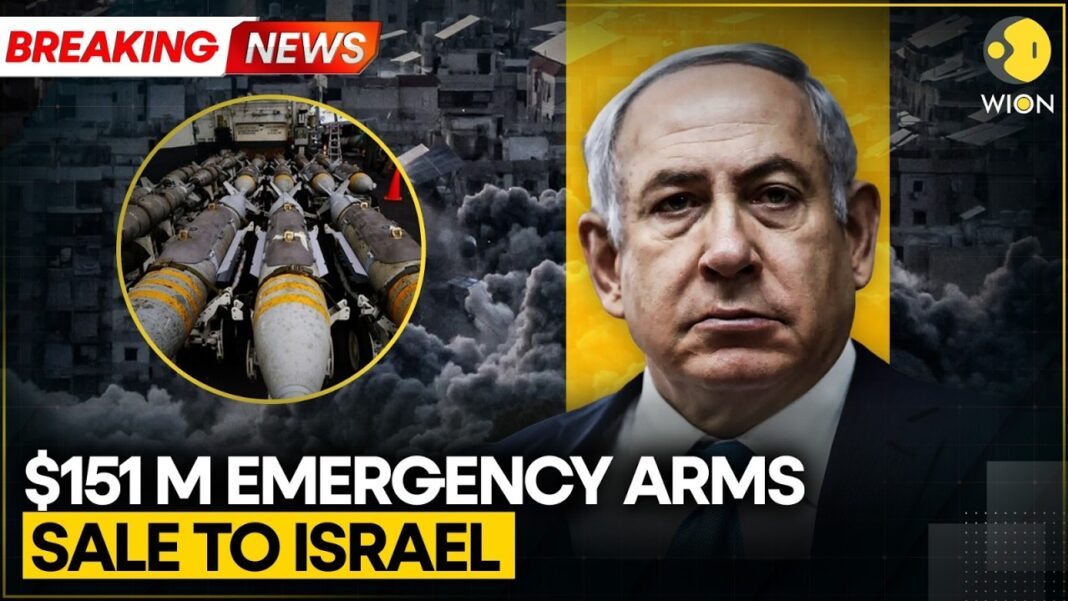
The United States has approved a significant emergency military sale to Israel valued at approximately $151.8 million, providing thousands of heavy aerial bomb components as the two allies continue their ongoing military campaign against Iran. The decision, announced Friday by the U.S. State Department, bypassed the standard congressional review process after Secretary of State Marco Rubio invoked emergency authority, citing urgent security considerations tied to the escalating conflict.
According to details reported by Reuters, the package includes the potential sale of 12,000 BLU-110A/B general-purpose bomb bodies weighing 1,000 pounds each, along with associated munitions support. The BLU-110 bomb body is a widely used component of precision-guided weapon systems and can be fitted with advanced guidance kits that allow aircraft to strike targets with greater accuracy while maintaining the destructive capacity of a heavy conventional munition.
The State Department said the emergency determination was made in light of rapidly evolving security circumstances in the Middle East. As Reuters reported, Secretary Rubio concluded that the situation required the immediate provision of military materiel to Israel without the customary period of congressional oversight that typically accompanies foreign arms sales.
Such emergency authorizations are permitted under U.S. law but are used sparingly, generally when officials believe that delaying a sale could jeopardize the security of an American ally or undermine urgent military operations. The State Department indicated that the measure was necessary to ensure Israel could maintain operational readiness during the ongoing war against Iran.
The announcement comes at a moment of heightened military activity in the region. Israel and the United States have launched coordinated strikes against Iranian military infrastructure, targeting missile launchers, command centers, and other strategic assets associated with the Iranian regime. Tehran has responded with a series of retaliatory missile and drone attacks aimed at Israeli territory and other regional targets.
According to the Reuters report, the war has rapidly intensified in recent days, with both sides expanding the scope of their military operations. The provision of additional munitions is therefore seen as part of a broader effort by Washington to support Israel’s ability to sustain its aerial campaign.
The BLU-110A/B bomb body requested by Israel forms the core of several advanced weapons systems employed by modern air forces. When paired with guidance kits such as the Joint Direct Attack Munition (JDAM) system, the bomb can be transformed into a precision-guided weapon capable of striking targets with a high degree of accuracy even under adverse weather conditions. Military analysts note that such munitions are commonly used to engage fortified structures, weapons depots, and other strategic installations.
As Reuters has noted in its coverage of previous arms transfers, Israel relies heavily on American-made munitions and military technology to sustain its air operations. The United States has long been Israel’s primary defense partner, providing billions of dollars in military assistance annually and maintaining extensive defense cooperation with the Israeli armed forces.
The latest sale underscores the depth of that relationship at a time when regional tensions are reaching some of their highest levels in decades. Officials in Washington have repeatedly affirmed that Israel’s security remains a core component of U.S. foreign policy, particularly as Iran continues to expand its missile capabilities and support proxy forces throughout the Middle East.
While the State Department’s decision reflects a sense of urgency within the administration, it may also spark debate among lawmakers who traditionally review major foreign arms sales. Under normal circumstances, Congress is given an opportunity to examine and potentially block such transactions before they proceed. However, emergency determinations allow the executive branch to circumvent that process when officials believe immediate action is required.
According to the information provided in the Reuters report, the State Department did not elaborate extensively on the specific operational needs prompting the emergency authorization, but officials indicated that the ongoing conflict created circumstances that demanded rapid delivery of munitions.
Defense analysts suggest the request for 12,000 bomb bodies signals that Israel expects its aerial campaign against Iranian military assets to continue at a significant scale. In modern air warfare, the consumption rate of precision-guided munitions can be extremely high, particularly during sustained operations targeting large networks of military infrastructure.
The conflict itself represents a dramatic escalation in the long-running confrontation between Israel and Iran. For years, Israeli leaders have warned that Tehran’s nuclear ambitions and missile programs posed an existential threat to the Jewish state. The current military campaign aims not only to degrade those capabilities but also to weaken the broader network of Iranian-backed groups operating across the region.
Iranian officials have vowed retaliation for the strikes, and regional observers warn that the war could expand further if additional actors become involved. The United States has deployed additional military resources to the region in recent weeks as part of efforts to deter further escalation and protect American personnel and allies.
In this volatile environment, the newly approved munitions sale is likely to play a key role in shaping the trajectory of the conflict. As Reuters reported, the State Department emphasized that providing Israel with the requested weapons would help ensure that it maintains the capability to defend itself against ongoing threats.
The emergency authorization therefore reflects both immediate military considerations and broader strategic calculations about stability in the Middle East. While the long-term outcome of the war remains uncertain, the decision signals Washington’s continued willingness to supply Israel with the resources necessary to prosecute its campaign.
