



|
Getting your Trinity Audio player ready...
|
By: Andrew Carlson
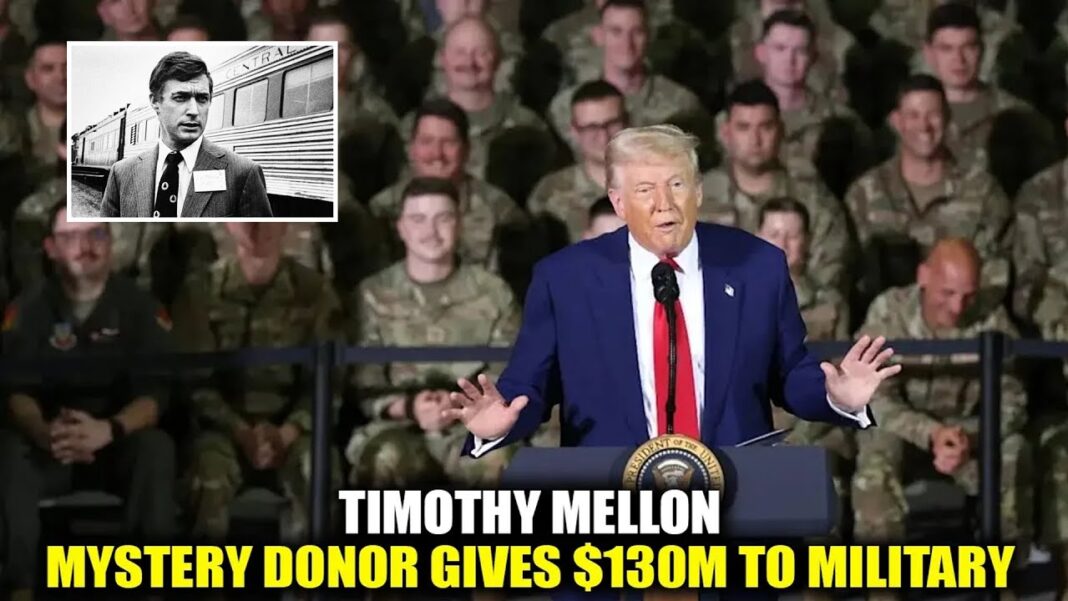
In an extraordinary act of private patriotism that has reignited a debate over wealth, power, and constitutional authority, billionaire businessman Timothy Mellon, heir to one of America’s most storied banking dynasties, has been revealed as the mysterious donor who contributed $130 million to cover U.S. military pay during the ongoing federal government shutdown.
According to a report that appeared on Saturday in The New York Post, the reclusive 83-year-old mogul, grandson of industrialist and philanthropist Andrew Mellon, quietly transferred the funds following a personal request from President Donald Trump, who had publicly referred to the donor only as “a friend who loves the military and loves the country.” The Post confirmed Mellon’s identity after The New York Times first reported it on Saturday, citing sources familiar with the contribution.
President Trump, speaking to reporters aboard Air Force One en route to Asia on Friday night, praised the anonymous benefactor as “a great gentleman” and “a great patriot.” He noted that the donor had insisted on anonymity — “pretty unusual in the world I come from,” Trump added — emphasizing that the gesture reflected “the purest form of love for country.”
While The New York Post reached out for comment, Timothy Mellon could not be immediately contacted, and the White House declined to elaborate, referring questions to the Department of War and the Treasury Department. Both agencies have so far remained silent, as legal experts now wrestle with whether such a donation can even be spent under current federal law.
As The New York Post report recounted, Timothy Mellon is the grandson of Andrew W. Mellon, the legendary banker and industrial titan who served as U.S. Treasury Secretary from 1921 to 1932 under Presidents Harding, Coolidge, and Hoover. Andrew Mellon’s financial empire helped build the modern American industrial economy, with holdings in Gulf Oil, Alcoa, and Westinghouse Electric, among others. His immense fortune eventually seeded major cultural institutions such as the National Gallery of Art in Washington, D.C., and Carnegie Mellon University in Pittsburgh.
The Mellon name, synonymous with wealth, banking, and philanthropy, is estimated to carry a family net worth of $14 billion, according to Forbes. But the younger Mellon, who resides in Wyoming, has cultivated an image of near-total privacy — rarely giving interviews, shunning society events, and eschewing the corporate spotlight that defined his forebears.
Despite his reserved profile, Mellon’s conservative politics have long been an open secret. In recent years, he has become one of Donald Trump’s most prolific donors, giving tens of millions to pro-Trump super PACs. The New York Post report highlighted that in 2024, one day after Trump’s fraud conviction in New York, Mellon donated $50 million to the Make America Great Again PAC, a sum that stunned political observers and underscored his unwavering loyalty to the former president.
Though the Pentagon has formally accepted Mellon’s $130 million donation, it is unclear whether the Department of Defense can actually deploy the funds. As The New York Post reported, the Antideficiency Act — a century-old law that governs federal appropriations — prohibits government agencies from spending money not authorized by Congress during a shutdown.
“The donation was made on the condition that it be used to offset the cost of service members’ salaries and benefits,” Pentagon spokesman Sean Parnell told The New York Post. “We deeply appreciate the patriotism behind it, but the use of such funds must comply with existing law.”
That law effectively bars even the most well-intentioned private gifts from substituting for congressional appropriations. Legal experts told The New York Post that if the Pentagon were to use Mellon’s donation, it might violate the Constitution’s separation of powers, which grants Congress the exclusive right to control federal spending.
Nevertheless, Pentagon officials said they are exploring legal avenues to place the funds in a restricted account, where they may be used once the shutdown concludes. “No one questions Mr. Mellon’s motives,” one defense analyst told the Post. “But this donation highlights a deeper dysfunction — when the government stops functioning, billionaires can start filling the vacuum.”
The unprecedented donation comes amid a bitter federal government shutdown, now stretching into its third week, with tens of thousands of civilian employees furloughed and military paychecks suspended. Despite bipartisan concern for service members’ welfare, the Senate narrowly voted down a measure on Thursday that would have guaranteed payments to active-duty troops, 54-45, deepening public frustration and leaving the White House scrambling for options.
Earlier this month, President Trump announced on his Truth Social platform that he was exercising his authority as Commander-in-Chief to ensure troops would be paid.
“I am using my authority to direct our Secretary of War, Pete Hegseth, to use all available funds to get our Troops PAID on October 15th,” Trump wrote.
As The New York Post noted, the Pentagon identified leftover research and development funds as a temporary measure, though critics warned that such a move risked overriding Congress’s budgetary powers under the Constitution. The decision ignited fierce debate in Washington, with some lawmakers accusing Trump of testing the limits of executive power to score political points during a crisis.
Now, Mellon’s intervention — while financially generous — has only sharpened those concerns. “It’s an extraordinary act of goodwill,” said a senior defense official quoted in The New York Post report, “but it’s also a symptom of a broken system. We are witnessing the privatization of government responsibilities.”
For historians of American wealth, Timothy Mellon’s gesture evokes the gilded philanthropy of the early 20th century, when industrial barons like his grandfather used private fortunes to advance public causes. Yet, as The New York Post report observed, this act of largesse is unique: a private citizen directly attempting to pay the salaries of military personnel — a responsibility traditionally reserved for Congress.
In a sharply worded editorial, The New York Post called the donation “a double-edged symbol of American patriotism,” noting that while Mellon’s generosity is admirable, it also highlights “the dangerous dependence of government on the whims of private capital.”
Political scientist Dr. Leonard Barrett, speaking to The New York Post, echoed that sentiment. “In any other context, a billionaire giving $130 million to the Pentagon would raise eyebrows,” he said. “But in a shutdown, it becomes an act of salvation. That contradiction should trouble every American.”
Unlike his grandfather — whose name adorns museums, universities, and federal buildings — Timothy Mellon has largely avoided public life, preferring to operate through a network of private trusts and holding companies. He has occasionally surfaced in political circles, authoring a 2015 memoir titled Panamint’s Balance, in which he lamented government inefficiency and warned of a nation “drifting toward socialism.”
The New York Post report described him as a “rugged individualist in the classic American mold” — a man who champions self-reliance, distrusts bureaucracy, and believes that wealth carries both freedom and duty. His Wyoming estate, nestled in the shadow of the Big Horn Mountains, is said to be a sanctuary of quiet wealth, where Mellon rarely entertains guests.
That isolation, however, has not shielded him from scrutiny. Over the past decade, Mellon has donated millions to right-leaning causes, including border security initiatives and veterans’ programs, often through anonymous channels. His $130 million donation — the largest single private gift ever directed toward U.S. military pay — may be the culmination of that lifelong worldview: a conviction that private citizens must act when government fails.
For now, Mellon’s contribution remains frozen in bureaucratic limbo, emblematic of a Washington paralyzed by partisanship. But as The New York Post report observed, its symbolic weight cannot be overstated.
“This isn’t just about paying soldiers,” the paper wrote. “It’s about a billionaire reminding America that the spirit of personal responsibility can still eclipse the paralysis of politics.”
Whether the Pentagon can lawfully spend the funds remains uncertain. Yet one thing is clear: in a nation increasingly divided over power, policy, and purpose, Timothy Mellon’s quiet act of generosity has stirred both admiration and unease — a reminder that even in times of government failure, individual conviction can still move mountains.
