



|
Getting your Trinity Audio player ready...
|
By: Fern Sidman
An event intended to spotlight economic opportunity and job creation in San Francisco took a deeply disturbing turn when a crowd chant morphed from a populist rallying cry into a slogan widely condemned as openly antisemitic. According to statements cited in a report published by The Jerusalem Post on Wednesday, individuals gathered at a political event in the city abruptly shifted from chanting “tax the rich” to “tax the Jews,” prompting an immediate and forceful response from San Francisco Mayor Daniel Lurie.
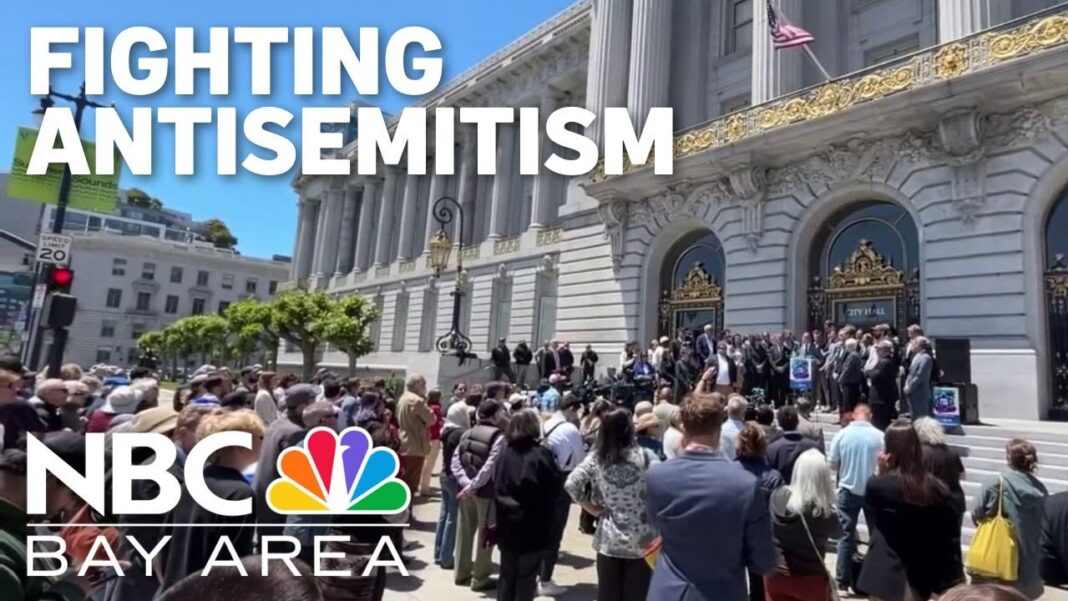
The episode unfolded Wednesday afternoon at a public event organized by Lurie in conjunction with District Five Supervisor Bilal Mahmood, labor leaders, and local workers. The purpose of the gathering, as Lurie explained in remarks later shared publicly, was to announce a plan aimed at expanding employment opportunities and increasing housing access for San Franciscans. What was meant to be a policy-focused event centered on economic development instead became the latest flashpoint in a city that has witnessed a troubling pattern of antisemitic incidents in recent years.
As reported by The Jerusalem Post, Mayor Lurie described the chant as not merely inappropriate but unmistakably antisemitic. “Suggesting that Jews are wealthy is a tired trope,” Lurie stated, emphasizing the long and pernicious history of the stereotype linking Jewish identity to financial power. He further noted that targeting Jews at an event focused on economic opportunity was especially egregious, underscoring how such rhetoric weaponizes economic grievances by directing them at a religious and ethnic minority.
Lurie, a Democrat who has positioned himself as a champion of inclusion and civic unity, declared unequivocally that antisemitism and hatred in any form would not be tolerated in San Francisco. According to the information provided in The Jerusalem Post report, he stressed that such bigotry “does not belong” in the city—a sentiment that, while resonant, now confronts a sobering reality: antisemitic rhetoric and acts have surfaced repeatedly in San Francisco in recent years, often in contexts that blend political protest with historical animus.
The transformation of the chant from “tax the rich” to “tax the Jews” was more than a spontaneous provocation. It echoed a well-worn historical pattern in which economic anxieties are reframed as conspiratorial accusations against Jews. As The Jerusalem Post has frequently noted in its broader coverage of antisemitic rhetoric, the trope of Jewish wealth and control over financial systems has deep roots in European and American history, serving as a catalyst for discrimination, exclusion, and violence. The charge that “the Jews” are synonymous with the “rich” is not merely a mischaracterization; it is a rhetorical device that has fueled centuries of persecution.
In the contemporary American context, such rhetoric has emerged with unsettling frequency amid debates over inequality and capitalism. San Francisco, a city emblematic of both immense wealth and stark economic disparity, provides fertile ground for populist frustration. Yet as Lurie’s response made clear, channeling that frustration into ethnic scapegoating crosses a moral and civic boundary.
The Jerusalem Post report contextualized the incident within a broader climate in which antisemitic language has sometimes been folded into anti-Israel or anti-capitalist demonstrations. While criticism of economic systems or government policies is a hallmark of democratic discourse, conflating Jews as a collective with wealth or power transforms political speech into discriminatory invective. The mayor’s swift condemnation suggests an awareness that silence in such moments can be interpreted as acquiescence.
The episode also arrives against the backdrop of a series of antisemitic acts targeting San Francisco’s Jewish community. As The Jerusalem Post has reported, December of last year saw a suspected arson attack on a dumpster outside the San Francisco Hillel building. The fire broke out while students were inside preparing for the final Shabbat of the academic term. Although an individual was later arrested in connection with the blaze, the incident reverberated deeply within the city’s Jewish community. The proximity of the fire to a Jewish student center during a sacred gathering underscored the vulnerability many felt.
The arson was not an isolated event. A year earlier, the same Hillel had been vandalized with the word “Khaybar,” a reference loaded with historical and ideological meaning. As The Jerusalem Post report detailed, Khaybar refers to a 7th-century battle in which the Islamic prophet Mohammed’s forces defeated Jewish tribes in what is now Saudi Arabia, leading to massacres and expulsions. The chant “Khaybar, Khaybar, oh Jews, the army of Mohammed will return” has become a fixture at certain anti-Israel protests worldwide and is widely interpreted as a threat invoking historical violence against Jews.
The appearance of “Khaybar” on a university-affiliated Jewish building in San Francisco signaled that global conflicts and historical grievances were being transposed onto local Jewish communities. The city’s Jewish residents, including students, found themselves at the intersection of geopolitical protest and personal safety.
In this context, the chant of “tax the Jews” cannot be dismissed as an isolated outburst. Rather, it forms part of a broader pattern in which antisemitic tropes—economic, religious, and historical—are resurfacing in civic spaces. The Jerusalem Post report observed that such rhetoric often gains traction during periods of economic uncertainty or political polarization, when simplistic narratives offer an outlet for complex frustrations.
San Francisco, long celebrated for its progressive values and cultural diversity, now faces a paradox. Its political culture prizes activism and outspoken advocacy, yet the line between protest and prejudice can blur when rhetoric slips into collective blame. Mayor Lurie’s denunciation reflects an attempt to reassert that boundary, to affirm that advocacy for economic reform must not devolve into ethnic scapegoating.
The challenge for city leaders extends beyond condemning a single chant. It involves addressing the conditions under which such sentiments emerge. Economic inequality in San Francisco is real and visible; housing shortages and labor struggles are tangible sources of grievance. But as The Jerusalem Post report highlighted in its analysis of similar episodes elsewhere, redirecting anger toward Jews—whether through insinuations of wealth, influence, or collective guilt—constitutes a moral failure that undermines the very justice such movements purport to seek.
Community leaders have expressed concern that repeated incidents may erode Jewish residents’ sense of belonging. The symbolism of chanting “tax the Jews” at an event dedicated to job creation and housing reform is particularly troubling. It suggests that even initiatives aimed at broad social uplift can become stages for age-old prejudices.
In his statement, Lurie emphasized that San Francisco would not tolerate antisemitism or any form of hatred. The assertion is aspirational as well as declarative. As The Jerusalem Post has reported in other cities confronting similar challenges, combating antisemitism requires more than public denunciations. It demands sustained engagement with educational institutions, law enforcement, civic organizations, and political movements to ensure that harmful tropes are confronted rather than normalized.
The city’s Jewish community, deeply woven into San Francisco’s cultural and civic life, has long contributed to its intellectual, philanthropic, and economic vitality. Episodes like Wednesday’s chant risk casting a shadow over that legacy. Yet they also present an opportunity for reaffirmation: for civic leaders to articulate clearly that the fight against inequality must never target a minority community, and that economic justice cannot be built on ethnic vilification.
As The Jerusalem Post report suggested, the incident serves as a reminder that antisemitism often adapts to contemporary idioms. Whether cloaked in political protest, historical reference, or economic rhetoric, it remains a corrosive force. Mayor Lurie’s swift response signals a recognition that confronting such egregious rhetoric promptly and unequivocally is essential to preserving the inclusive character of the city he governs.
The transformation of a chant from “tax the rich” to “tax the Jews” may have lasted only moments, but its implications linger. It underscores how quickly public discourse can veer into dangerous territory and how vigilant communities must remain in defending the principles of pluralism and mutual respect. In a city that prides itself on progress, the test will be whether it can ensure that calls for justice do not become conduits for hate.
