



|
Getting your Trinity Audio player ready...
|
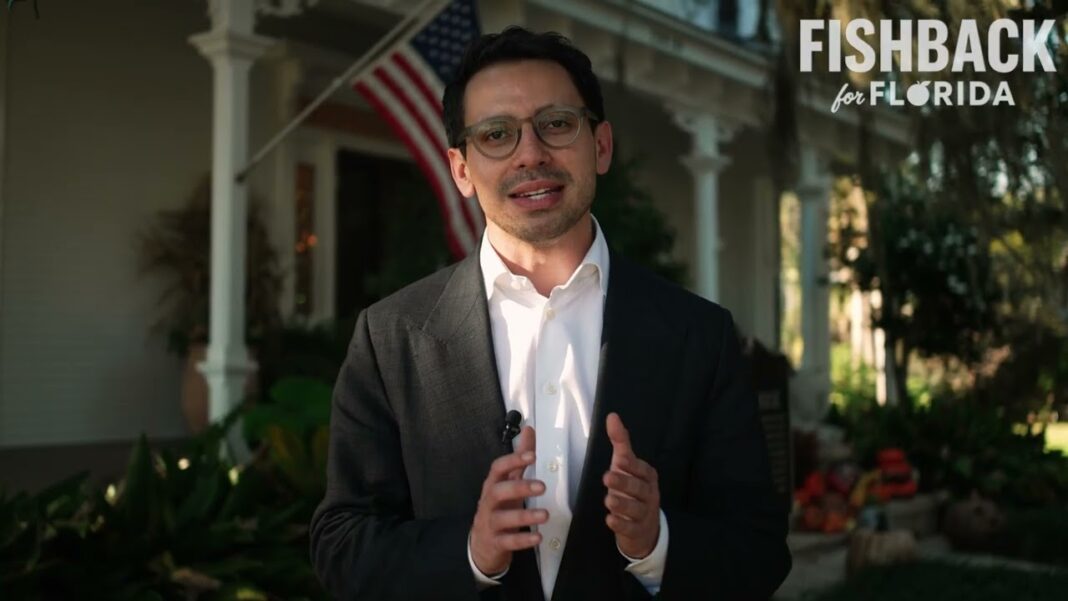
Florida’s Anti-Israel Gubernatorial Hopeful Gains Strong Backing From Young GOP Voters
By: Julie Herndon
A new poll out of Florida has illuminated an unsettling political undercurrent within the Republican Party’s next generation. As reported on Thursday by The Algemeiner, a radically anti-Israel candidate in the state’s Republican gubernatorial primary has emerged as the most popular choice among young GOP voters — despite facing mounting accusations of antisemitism and inflammatory rhetoric.
The survey, conducted by the University of North Florida and released this week, places 31-year-old James Fishback, founder and chief executive of the investment firm Azoria, in a surprisingly strong position among Republican voters aged 18 to 34. According to the poll, Fishback commands 32 percent support within that demographic — far surpassing his closest rival among young voters, U.S. Rep. Byron Donalds, who garnered just 8 percent. A significant 46 percent of younger respondents, however, indicated they remain undecided.
While Fishback’s broader statewide support remains modest — he trails Donalds significantly among the general Republican electorate — the generational divide captured in the polling data has sparked concern among Jewish leaders and political analysts alike. As The Algemeiner report noted, Donalds continues to lead the overall primary field with 31 percent support compared to Fishback’s 6 percent. Yet the fact that Fishback’s message resonates so strongly with younger Republicans signals a potentially transformative shift in the ideological contours of the party.
Fishback has distinguished himself not merely through policy disagreements with Israel but through rhetoric that critics describe as veering into overtly antisemitic territory. Speaking at the University of Central Florida earlier this month, Fishback declared that he would “not visit the country of Israel under any circumstances.” He further mocked the Western Wall — one of Judaism’s most sacred sites — referring to it dismissively as a “stupid wall.”
The Algemeiner report highlighted the swift reaction from Jewish leaders. Rabbi Steven Burg, CEO of Aish, characterized Fishback’s remarks in a sharply worded op-ed as emblematic of how “antisemitism rebrands itself in 2026.” For many observers, the tone and symbolism of Fishback’s comments were not merely critical of Israeli policy but deeply disrespectful toward Jewish religious heritage.
Fishback has also targeted his primary opponent’s engagement with Jewish communities. He criticized Donalds for organizing a political forum at a South Florida synagogue, accusing the congressman of demonstrating favoritism toward Jewish Americans. The insinuation that engagement with Jewish constituents constitutes improper partiality has further fueled allegations that Fishback’s rhetoric crosses from policy critique into ethnic grievance.
Perhaps most controversially, Fishback has praised supporters of Nick Fuentes — a social media personality widely condemned for antisemitic views — describing them as “patriots” and “civil.” Fishback defended his engagement with Fuentes’s followers by asserting that they “have a real pulse for what is going on in the country.” Such statements have drawn alarm not only from Jewish organizations but from mainstream Republican voices wary of extremist infiltration.
The broader context of Fuentes’s influence adds another layer of complexity. In December, the Network Contagion Research Institute (NCRI) released findings indicating that online support for Fuentes may have been artificially amplified by anonymous actors based in foreign countries including India, Pakistan, Nigeria, Malaysia, and Indonesia. This report suggested the appearance of grassroots enthusiasm may, in part, reflect inauthentic digital manipulation. Nonetheless, the domestic resonance of such rhetoric remains a matter of concern.
Fishback’s policy positions extend beyond rhetoric. If elected, he has pledged to direct Florida’s state entities to divest from Israeli government bonds on his first day in office. He has accused Israel of committing “genocide” in Gaza and advocated incorporating that characterization into Florida’s public school curriculum. These positions sharply diverge from longstanding Republican orthodoxy, which has traditionally emphasized robust support for Israel as a key Middle Eastern ally.
By contrast, Byron Donalds has maintained a consistent pro-Israel stance. A close ally of President Donald Trump, Donalds has vocally defended Israel’s right to self-defense following Hamas’s October 7, 2023, massacre across southern Israel. In remarks cited by The Algemeiner, Donalds lamented the surge of antisemitism both domestically and globally, describing it as “out of control” and “insane.” His campaign underscores continuity with the party’s traditional alignment with Israel.
Yet the generational fissure evident in the Florida poll appears to reflect broader national trends. The Algemeiner report pointed to research from the Manhattan Institute, which recently examined evolving attitudes toward Israel and Jewish Americans within the GOP. That survey found that newer entrants to the Republican Party — particularly younger voters and former Democrats — are significantly more likely to express antisemitic views than their older counterparts.
According to the Manhattan Institute’s findings, anti-Jewish Republicans tend to be younger, disproportionately male, more racially diverse, and often less frequent churchgoers. The study also revealed that 25 percent of GOP voters under age 50 express openly antisemitic attitudes, compared to just 4 percent among those over 50. The generational disparity becomes even more stark when examining Holocaust denialism. An astonishing 37 percent of GOP voters overall indicated belief in some form of Holocaust distortion, with majorities of younger men under 50 agreeing that the Holocaust was “greatly exaggerated or did not happen as historians describe.”
Such figures underscore a disturbing ideological drift. Older Republicans remain overwhelmingly supportive of Israel and largely reject antisemitic tropes. However, among segments of younger voters, skepticism toward Israel — and at times hostility toward Jewish Americans — appears increasingly normalized.
The Florida poll’s relatively small sample size for the 18-34 age bracket — just 39 respondents — warrants caution in extrapolation. Nevertheless, political analysts argue that the results align with other data indicating a generational reconfiguration within the party. Younger Republicans, particularly those influenced by online ecosystems and populist rhetoric, may be less anchored to traditional conservative foreign policy doctrines.
Observers suggest multiple factors may be driving this shift. Digital media platforms often amplify provocative narratives and foster ideological echo chambers. Economic anxieties and distrust of institutional authority can fuel conspiratorial thinking. Additionally, as The Algemeiner has reported in other contexts, foreign information operations have exploited polarizing issues — including Israel — to exacerbate divisions within Western democracies.
For Jewish communities in Florida and beyond, the implications are sobering. The Republican Party has long positioned itself as a steadfast ally of Israel and an opponent of antisemitism. The emergence of a candidate whose platform includes divestment from Israel and rhetoric derided as antisemitic challenges that historical alignment.
At the same time, the broader Republican electorate in Florida appears far from embracing Fishback’s candidacy. With over half of voters undecided and Donalds maintaining a commanding lead overall, the primary outcome remains uncertain. Political campaigns often evolve, and early polling can fluctuate dramatically.
Yet the generational divide revealed by the University of North Florida poll raises profound questions about the future trajectory of Republican foreign policy and domestic discourse. Skepticism toward Israel within parts of the GOP mirrors trends previously more associated with progressive segments of the Democratic Party. The bipartisan consensus that once underpinned strong U.S.-Israel relations appears less monolithic than in decades past.
Whether Fishback’s appeal among young voters represents a transient protest candidacy or the early stages of a deeper ideological transformation remains to be seen. What is clear is that the Florida primary has become a microcosm of a larger national reckoning over identity, foreign alliances, and the boundaries of acceptable political rhetoric.
In an era marked by heightened polarization and digital fragmentation, the contest underscores the fragility of long-standing political alignments. As The Algemeiner report noted, one reality stands out: generational currents within the Republican Party are shifting, and their direction may profoundly shape the party’s relationship with Israel and the Jewish community for years to come.

Qatar and Saudi Arabia are investing in taking over Congress, too. They just might do it. I see no one stopping them.