



|
Getting your Trinity Audio player ready...
|
A Night of Ceremony and Subtle Diplomacy: King Charles III Celebrates Enduring Anglo-American Ties at White House State Dinner
By: Fern Sidman
In a display of pageantry, symbolism, and carefully calibrated diplomacy, King Charles III presided over a grand state dinner at the White House on Tuesday evening, reaffirming the enduring alliance between the United Kingdom and the United States while navigating a moment of geopolitical complexity. As reported by The New York Times, the evening served as both a ceremonial celebration and a subtle exercise in international statecraft, blending historical reflection with present-day political sensitivities.
The event, attended by a distinguished gathering of political leaders, jurists, business magnates, and influential figures, marked a high point in the royal couple’s four-day visit to the United States. It followed a day rich in formal engagements, including a ceremonial welcome, a rare address to Congress, and private consultations between the British monarch and President Trump.
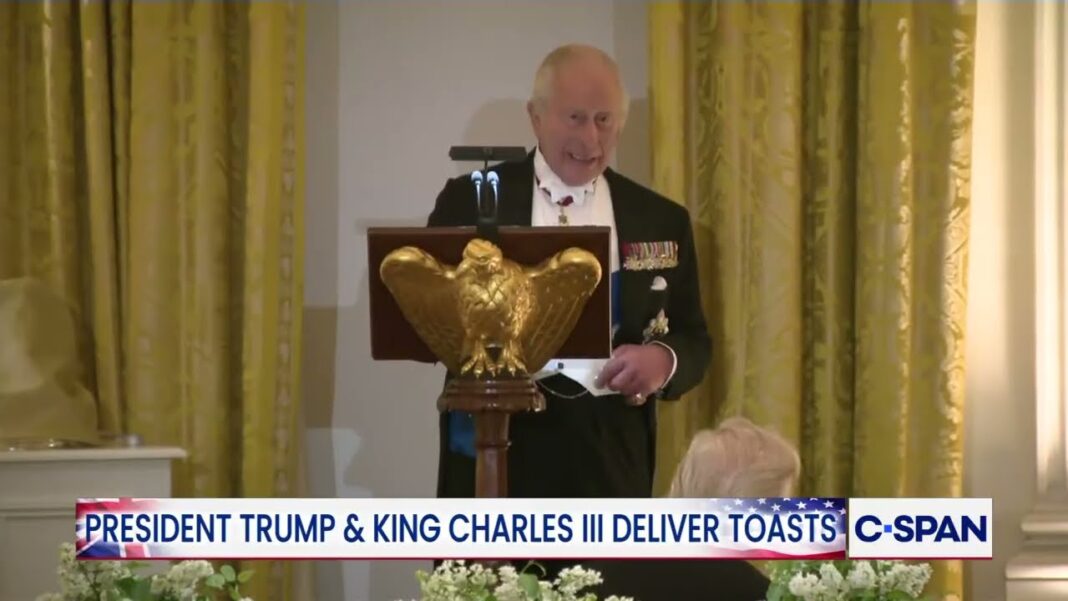
In his remarks before the assembled guests, King Charles struck an optimistic tone, emphasizing the longevity and resilience of the transatlantic relationship. Drawing upon centuries of shared history, he described the alliance as one that has weathered both triumphs and trials, remaining indispensable in moments of both visibility and quiet cooperation.
While the King refrained from explicitly addressing the tensions arising from the ongoing conflict involving the United States and Iran, he alluded to past periods of strain. Notably, he invoked the memory of Queen Elizabeth II’s 1957 visit to the United States in the aftermath of the Suez Canal crisis, a moment when relations between the two nations were under significant pressure.
“It is hard to imagine anything like that happening today,” he observed, before adding that it is equally evident how vital the relationship remains. The reference, as highlighted by The New York Times, served as a reminder that even the most steadfast alliances are not immune to tension, yet possess the capacity for renewal.
Throughout his address, King Charles demonstrated a deft ability to balance gravitas with levity. His remarks were punctuated by carefully crafted humor, including a lighthearted reference to the Boston Tea Party, which he described as having been surpassed in conviviality by the evening’s festivities.
Such moments of levity were not merely ornamental; they functioned as diplomatic tools, softening the edges of more serious themes and reinforcing a sense of shared cultural heritage. The audience, composed largely of allies and supporters of the current administration, responded warmly, underscoring the effectiveness of the King’s approach.
In a gesture rich with symbolic meaning, the monarch presented a gift to President Trump: a meticulously restored bell from the H.M.S. Trump, a British submarine that served during World War II. The offering, steeped in historical resonance, was received with evident appreciation. According to The New York Times report, the President responded by commending the King’s address, offering a brief but enthusiastic acknowledgment.
The state dinner was the culmination of a day marked by ceremonial grandeur. Earlier, President Trump and First Lady Melania Trump had welcomed King Charles and Queen Camilla with the highest honors accorded to a visiting head of state.
The formal reception included a 21-gun salute and a review of the troops, a tradition that symbolizes mutual respect and recognition between nations. These rituals, steeped in tradition, served to underscore the significance of the visit and the enduring bond between the two countries.
In his own remarks, President Trump echoed the King’s emphasis on shared history, describing the Anglo-American relationship in expansive and almost poetic terms. He characterized it as a partnership that has given rise to a “revolution in human freedom,” a force that has transcended time and geography to shape the modern world.
Earlier in the day, King Charles had delivered a speech before a joint session of Congress, marking only the second time a British monarch has addressed the American legislature. As detailed in The New York Times report, the address was notable for its nuanced tone and its engagement with themes of governance, alliance, and shared values.
The King spoke of the importance of checks and balances, drawing connections between British legal traditions and the foundational principles of the American constitutional system. He also touched upon his longstanding commitment to environmental stewardship, a subject that has defined much of his public life.
While the speech avoided direct confrontation with current political disagreements, it nevertheless conveyed a series of subtle messages. The King referenced his service in the Royal Navy, a point of personal pride that also served to counter recent criticisms of British military capabilities.
He further acknowledged the 250th anniversary of American independence, offering a humorous reassurance that his presence did not signal any attempt to revisit historical conflicts. The remark, delivered with characteristic wit, was met with appreciative laughter.
The state visit unfolded against the backdrop of heightened security concerns, following a recent incident in which a gunman, Cole Allen, 31, of Torrance, California breached defenses at Saturday evening’s White House Correspondents Association dinner at the Washington Hilton Hotel that was attended by the President and the First Lady. As reported by The New York Times, the visit was accompanied by extensive protective measures, both visible and discreet.
These precautions reflected the gravity of the situation and the imperative of ensuring the safety of all participants. The presence of layered security underscored the challenges inherent in hosting such events in a time of heightened tension.
The royal couple’s visit extends beyond the nation’s capital, encompassing a series of engagements designed to highlight the breadth of the Anglo-American relationship. On Wednesday, King Charles and Queen Camilla are scheduled to travel to New York City, where they will participate in a range of events.
These include a visit to the September 11 memorial, a site of profound national significance, as well as a gala event expected to draw a wide array of cultural and public figures. The itinerary reflects an effort to connect with diverse segments of American society, reinforcing the multifaceted nature of the bilateral relationship.
The visit will conclude with a series of engagements in Virginia, including a stop at Arlington National Cemetery. There, the King will pay tribute to those who have served and sacrificed, a gesture that resonates deeply within the shared military history of the two nations.
The exchange of gifts during the visit further illustrates the interplay of symbolism and substance in diplomatic relations. In addition to the bell from the H.M.S. Trump, the King has participated in a broader tradition of reciprocal gestures that reflect mutual respect and shared heritage.
These exchanges, while ceremonial, carry deeper meaning. They serve as tangible expressions of the values and history that underpin the relationship, reinforcing connections that extend beyond the realm of policy and politics.
As The New York Times report observed, the visit takes place at a moment when the relationship between the United States and the United Kingdom is both robust and challenged. Differences over international policy, particularly in relation to the conflict involving Iran, have introduced new complexities.
King Charles’s approach throughout the visit has been one of careful balance. By emphasizing shared history and common values, he has sought to reinforce the foundation of the relationship while avoiding direct engagement with contentious issues.
This strategy reflects the unique role of a constitutional monarch, who must navigate political realities without becoming entangled in them. The result is a form of diplomacy that is both subtle and effective, capable of addressing tensions without exacerbating them.
The state dinner at the White House stands as a testament to the enduring partnership between the United States and the United Kingdom. Through a combination of ceremony, rhetoric, and symbolic gesture, King Charles III has reaffirmed the strength of this alliance while acknowledging the complexities of the present moment.
As reported by The New York Times, the visit encapsulates the dual nature of modern diplomacy: rooted in history yet responsive to contemporary challenges. In an era defined by uncertainty, the reaffirmation of such relationships carries particular significance.
The evening’s events, with their blend of tradition and adaptation, serve as a reminder that alliances are not static. They must be continually renewed, not only through formal agreements but through the shared experiences and mutual respect that define them.
In this sense, the state dinner was more than a celebration; it was a reaffirmation of a partnership that continues to shape the global landscape, a partnership that, despite its challenges, remains as vital today as it has been for generations.
