



|
Getting your Trinity Audio player ready...
|
By: Jeff Gorman
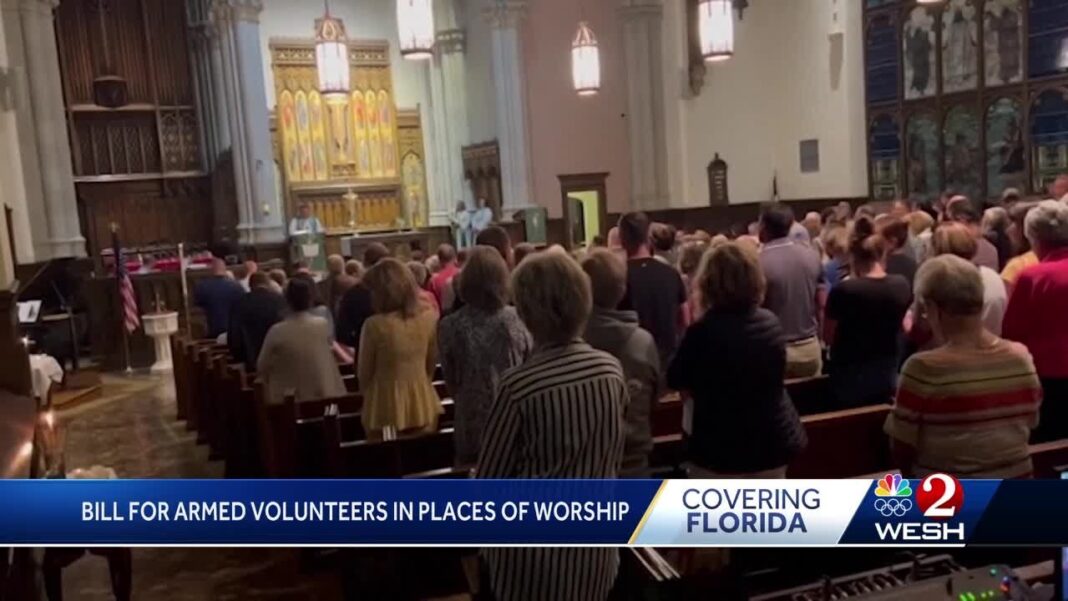
In a move that has ignited both support and apprehension across religious and civic circles, a new law set to take effect on July 1st in the state of Florida will permit churches, synagogues, and other houses of worship to deploy armed volunteers as a means of protecting congregants. As reported on Tuesday by VIN News, the legislation, signed into law by Governor Ron DeSantis, is intended to provide smaller religious institutions with a practical and cost-effective alternative to private security services, which often remain financially out of reach.
The measure arrives at a time of heightened concern regarding threats against faith-based communities in the United States. Over recent years, religious institutions have increasingly found themselves the targets of violence, harassment, and intimidation, prompting leaders to reevaluate security protocols and explore new methods of safeguarding their congregations.
The newly enacted law reflects an effort by Florida lawmakers to address these concerns by expanding the range of options available to religious institutions. Under its provisions, eligible houses of worship may authorize trained volunteers to carry firearms and perform security functions under specific conditions.
According to the information provided in the VIN News report, the legislation is particularly aimed at smaller congregations that lack the financial resources to hire professional security personnel. For many such institutions, the cost of maintaining a continuous security presence can be prohibitive, leaving them vulnerable despite their awareness of potential risks.
Supporters of the law argue that it offers a pragmatic solution to this dilemma. By allowing volunteers to assume security roles, they contend, congregations can enhance their protective measures without incurring unsustainable expenses. The presence of armed individuals, even in a volunteer capacity, is also seen by proponents as a potential deterrent to would-be attackers.
A number of religious leaders have expressed cautious optimism regarding the new policy. They emphasize that the ability to designate trained volunteers for security purposes provides an additional layer of defense in an environment where threats cannot be ignored.
As noted in the VIN News report, some clergy members have pointed to the psychological reassurance that such measures can offer congregants. In an era marked by uncertainty, the knowledge that protective steps are being taken may help restore a sense of safety within sacred spaces.
Advocates also highlight that the law does not mandate the use of armed volunteers but rather grants institutions the discretion to decide whether such measures are appropriate for their specific circumstances. This flexibility, they argue, allows each congregation to tailor its approach to security based on its unique needs and values.
Despite these endorsements, the law has also prompted significant debate and concern. Critics question whether introducing additional firearms into houses of worship is the most effective or appropriate means of ensuring safety.
One of the primary issues raised is the level of training and oversight required for volunteers who would assume security responsibilities. Professional security personnel typically undergo extensive preparation, including instruction in threat assessment, de-escalation techniques, and the lawful use of force. Whether volunteer participants can be held to comparable standards remains a point of contention.
VIN News reported that some opponents fear that the presence of armed volunteers could inadvertently increase the risk of accidents or misunderstandings, particularly in high-stress situations. The possibility of misidentification or unintended escalation is cited as a serious concern, especially in crowded or emotionally charged environments.
Additionally, there are broader philosophical objections rooted in the nature of religious spaces themselves. For many, houses of worship are sanctuaries defined by peace, reflection, and community. The introduction of firearms into such settings raises questions about how best to reconcile the need for security with the preservation of these fundamental qualities.
The debate surrounding the law ultimately centers on the challenge of balancing two deeply held priorities: the imperative to protect human life and the desire to maintain the spiritual integrity of religious institutions.
Supporters argue that the evolving threat landscape necessitates a reevaluation of traditional assumptions about safety. In their view, failing to adopt proactive measures could leave congregations exposed to harm. The law, they suggest, empowers communities to take responsibility for their own security in a manner that is both practical and responsive to current realities.
Critics, however, caution against solutions that may carry unintended consequences. They emphasize the importance of comprehensive planning, professional training, and coordination with law enforcement as essential components of any effective security strategy.
As the VIN News report observed, the issue is not merely one of policy but of principle. It touches on fundamental questions about the role of force in spaces dedicated to faith and the extent to which communities should adapt to external threats.
As the law’s effective date approaches, attention is turning to the details of its implementation. Ensuring that volunteers receive appropriate training and that clear guidelines are established will be critical to its success.
Authorities are expected to work with religious institutions to provide guidance on best practices, including procedures for vetting volunteers, maintaining accountability, and coordinating with local law enforcement agencies. The goal, according to supporters, is to create a framework that maximizes safety while minimizing risks.
VIN News reported that some organizations are already exploring training programs designed to prepare volunteers for their new responsibilities. These initiatives aim to address concerns about competence and to ensure that those entrusted with security roles are equipped to handle them effectively.
The passage of the Florida law is part of a wider national conversation about how best to protect vulnerable communities in an era of increasing threats. Similar measures have been considered or implemented in other states, reflecting a growing recognition of the need for adaptable security solutions.
At the same time, the diversity of opinions on the issue underscores the complexity of the challenge. There is no single approach that satisfies all concerns, and the appropriate balance between security and principle may vary from one community to another.
The new Florida law, as detailed by VIN News, represents a significant development in the ongoing effort to safeguard houses of worship. By allowing the use of armed volunteers, it offers a new tool for congregations seeking to protect their members in a time of heightened risk.
Whether this approach will prove effective remains to be seen. Its success will depend on careful implementation, rigorous training, and a continued commitment to balancing the demands of security with the values that define religious life.
As communities across Florida and beyond grapple with these questions, the law serves as both a response to present concerns and a catalyst for deeper reflection on the future of safety in sacred spaces.
