



|
Getting your Trinity Audio player ready...
|
Luxury Through a War Zone: Russian Oligarch’s Superyacht Slips Through Blockaded Strait of Hormuz
By: Andrew Carlson
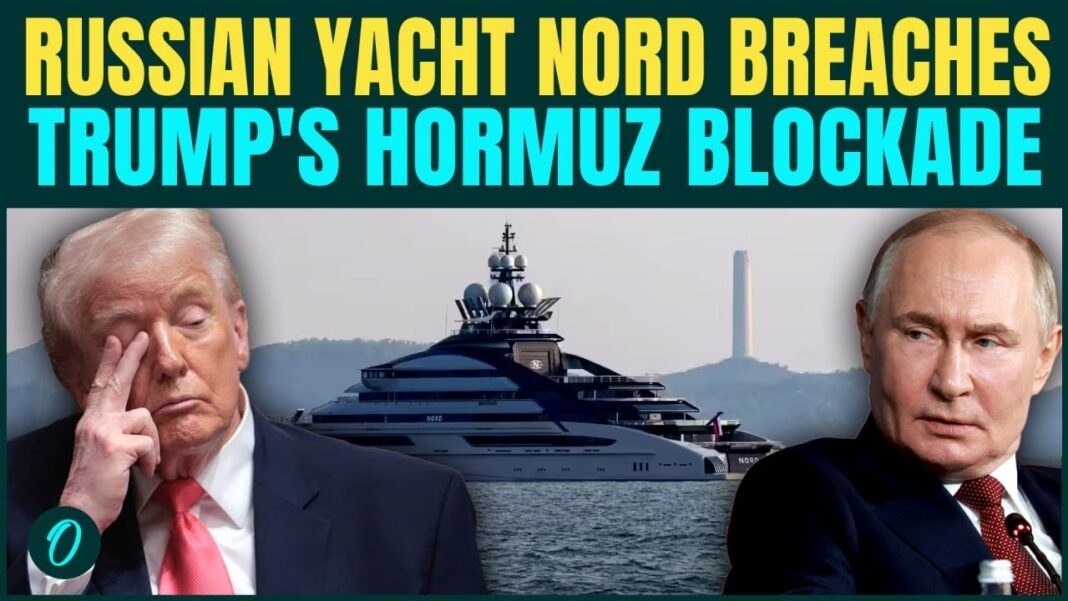
In a striking display of privilege amid geopolitical turbulence, a lavish superyacht tied to one of Vladimir Putin’s most influential allies has successfully navigated the heavily restricted Strait of Hormuz, raising questions about enforcement, influence, and the uneven realities of maritime movement during conflict. As detailed in a report on Tuesday in The New York Post, the vessel’s passage stands in stark contrast to the severe constraints imposed on most commercial shipping traversing the vital waterway.
The vessel in question, the “Nord,” is no ordinary ship. Measuring approximately 465 feet in length and boasting a valuation exceeding $500 million, the multi-deck luxury yacht is widely linked to Russian billionaire Alexei Mordashov, one of the wealthiest individuals in Russia and a prominent supporter of the Kremlin. Its recent journey through the Persian Gulf chokepoint comes at a time when the Strait of Hormuz remains effectively constricted by the combined pressures of regional conflict and military enforcement.
According to the information provided in The New York Post report, the Nord departed Dubai on Friday and transited the Strait of Hormuz on Saturday, ultimately arriving in Muscat, the capital of Oman, on Sunday morning. Data from maritime tracking services corroborated the vessel’s movement, placing it among a very limited number of ships—particularly private ones—to successfully traverse the corridor since hostilities escalated on February 28th.
The rarity of such a passage cannot be overstated. Prior to the outbreak of war involving Iran, the Strait of Hormuz accommodated an average of 125 to 140 maritime journeys daily. Today, that figure has dwindled dramatically, with only a small fraction of vessels—primarily essential merchant ships—managing to pass through the strategic bottleneck.
The strait itself remains one of the most critical arteries in global commerce. Approximately 20% of the world’s oil and natural gas shipments typically flow through this narrow channel, making its accessibility a matter of profound economic and geopolitical consequence.
What makes the Nord’s voyage particularly noteworthy is not merely its success, but the apparent acquiescence of both Iran and the United States, whose opposing military postures have effectively constrained traffic in the region.
A source cited by The New York Post indicated that neither Tehran nor Washington raised objections to the yacht’s movement. Iran reportedly viewed the vessel as a civilian ship belonging to a friendly nation, engaged in what was described as a peaceful transit. Meanwhile, the United States did not intervene, in part because the yacht had no operational or logistical ties to Iranian ports.
This dual tolerance highlights the complex calculus at play in the region. While the strait is subject to significant restrictions, enforcement appears to be selectively applied, with certain vessels permitted to pass under specific conditions.
The Nord’s journey inevitably draws attention to its owner, Alexei Mordashov, a figure whose wealth and influence place him among Russia’s most powerful oligarchs. At 60 years old, Mordashov serves as the chief executive of Severstal, Russia’s largest steel and mining enterprise, and commands an estimated net worth of approximately $37 billion, according to financial assessments.
Though Mordashov is not formally listed as the yacht’s owner, records suggest that the vessel is registered to a company controlled by his wife, a common arrangement among high-net-worth individuals seeking to manage assets discreetly.
Mordashov’s close alignment with President Putin has not gone unnoticed in Western capitals. He has been subject to sanctions imposed in response to Russia’s actions in Ukraine, reflecting his perceived role in supporting the Kremlin’s policies.
The Nord itself is emblematic of extraordinary luxury. The yacht features an array of amenities that rival those of the world’s most exclusive resorts. Among its most notable attributes are two helicopter pads, expansive lounge decks, and an 80-foot swimming pool located at the stern.
Inside, the vessel offers accommodations for 36 guests and a crew of 42, ensuring a level of service commensurate with its opulence. Additional features include a fully equipped gym, a private cinema, multiple jacuzzis, and even a submarine capable of underwater excursions.
Such extravagance underscores the stark disparity between the vessel’s purpose and the environment through which it traveled. While commercial ships face delays, inspections, and potential interdiction, the Nord moved with relative ease, a testament to the unique privileges afforded to its owner.
This is not the first time Mordashov’s maritime assets have attracted international attention. In March of 2022, during the early stages of the Ukraine conflict, Italian authorities impounded one of his smaller yachts, the 215-foot “Lady M,” in the port of Imperia.
That seizure was part of a broader effort by Western governments to enforce sanctions against Russian elites. The Nord, however, has thus far avoided a similar fate, continuing to operate despite the heightened scrutiny surrounding its owner.
The timing of the Nord’s voyage coincides with intensified diplomatic activity involving Russia and Iran. President Putin recently held high-level discussions in St. Petersburg with Iranian Foreign Minister Abbas Araghchi, following a series of talks in Pakistan and Oman.
These engagements reflect the deepening relationship between Moscow and Tehran, a partnership that has significant implications for the balance of power in the region. Both nations have sought to coordinate their strategies in response to Western pressure, further complicating the dynamics of the Strait of Hormuz.
The United States, for its part, maintains a naval presence in the area, enforcing a blockade designed to limit Iranian influence and ensure the security of maritime routes. This overlapping network of alliances and rivalries creates a highly volatile environment in which even routine voyages can carry geopolitical significance.
The successful transit of the Nord serves as a potent symbol of the disparities that define the current moment. While global commerce grapples with disruptions and uncertainty, a privately owned luxury vessel linked to a sanctioned oligarch has managed to navigate one of the world’s most contested waterways without incident.
As The New York Post report emphasized, this episode raises broader questions about the consistency and fairness of enforcement measures in the region. It also highlights the enduring influence of wealth and political connections in shaping outcomes that might otherwise seem improbable.
The journey of the Nord through the Strait of Hormuz is more than a maritime curiosity; it is a reflection of the complex interplay between power, privilege, and geopolitics. In a region defined by tension and restriction, the yacht’s passage underscores the selective nature of access and the enduring capacity of influence to transcend barriers.
As the conflict continues and the strait remains constrained, the Nord’s voyage will likely be remembered as an extraordinary exception—one that illuminates the broader realities of a world in which not all vessels, and not all indi
