



|
Getting your Trinity Audio player ready...
|
By: Fern Sidman
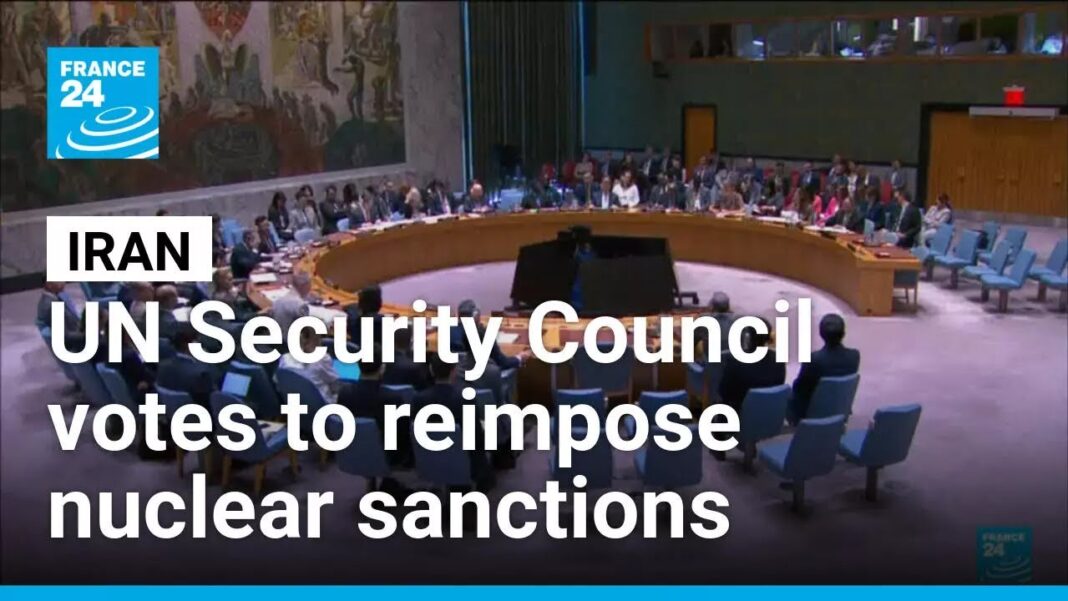
The diplomatic architecture surrounding the Iran nuclear deal has entered a critical new phase after the U.N. Security Council voted down a resolution to provide sanctions relief to Tehran on Friday. The decision marks a decisive step toward reimposing so-called “snapback” sanctions under the terms of Resolution 2231, which enshrined the 2015 Joint Comprehensive Plan of Action (JCPOA).
According to a report that appeared on Friday at The Jewish News Syndicate (JNS), the vote represents a sharp blow to Iran’s efforts to preserve what remains of the nuclear accord, and it underscores the growing consensus among Western powers that Tehran is not in compliance with its obligations.
Under the JCPOA framework, sanctions relief required affirmative support from nine Security Council members. Yet only four countries—Algeria, China, Pakistan, and Russia—voted in favor of easing restrictions on Iran.
As JNS reported, the outcome was never in serious doubt after France, Germany, and the United Kingdom formally notified the Security Council in August that they believed Iran was in material breach of the deal. That notification triggered the snapback mechanism, a controversial provision designed to automatically reimpose sanctions if Iran was found to be noncompliant.
The result is clear: absent a new diplomatic intervention, U.N. nuclear sanctions on Iran will formally return on Sept. 27.
The united front presented by France, Germany, and the United Kingdom was decisive. For years, the three European signatories sought to preserve the JCPOA even as Iran violated enrichment caps and expanded its centrifuge capacity. However, by August they had concluded that Tehran’s behavior left them no choice but to initiate the snapback process.
The JNS report emphasized that the European notification marked a turning point, demonstrating that even governments most committed to salvaging the nuclear accord no longer viewed Iran as a credible partner. Their move placed additional pressure on the United States and Israel’s allies to act in concert against Iranian nuclear ambitions.
In Jerusalem, the decision was greeted with approval. Foreign Minister Gideon Sa’ar applauded the Security Council outcome, describing it as a vital step in preventing Iran from crossing the nuclear threshold.
“Iran’s nuclear program is not intended for peaceful purposes,” Sa’ar said in remarks cited in the JNS report. “A nuclear-armed Iran would mean that the most dangerous regime possesses the most dangerous weapon, dramatically undermining global stability and security. The international community’s goal must remain unchanged: to prevent Iran from ever acquiring nuclear capabilities.”
Israeli officials have long maintained that Iran’s nuclear activities extend far beyond civilian energy needs. The country’s leaders argue that Tehran’s repeated violations of enrichment levels and its stonewalling of International Atomic Energy Agency (IAEA) inspections reveal its true intentions.
The vote also highlighted Iran’s growing isolation. Only four members of the 15-member Security Council backed Tehran’s bid for relief. China and Russia, both of which have sought to expand trade and strategic ties with Iran, were joined by Algeria and Pakistan in supporting the Islamic Republic.
Yet the overwhelming majority of council members either opposed the resolution or abstained, signaling that Iran’s narrative of compliance has lost credibility even among traditionally sympathetic states.
As the JNS report observed, the geopolitical stakes are immense: reimposed sanctions would cut Iran off from key international markets, restrict its ability to import sensitive technologies, and reassert global pressure on Tehran’s destabilizing regional activities.
Resolution 2231 included a unique mechanism to ensure compliance: the automatic reimposition, or “snapback,” of U.N. sanctions if Iran was deemed to be violating its obligations. This design aimed to prevent protracted diplomatic deadlock in the Security Council, where veto-wielding members like Russia and China could otherwise shield Iran from accountability.
As the JNS report explained, once the mechanism is triggered, the return of sanctions becomes virtually automatic unless the Council votes otherwise—a threshold Iran failed to achieve on Friday.
Critics of the JCPOA long argued that the snapback provision was one of its few enforceable safeguards. Supporters, by contrast, saw it as a deterrent mechanism unlikely to be used. That it has now been activated reflects how far the diplomatic environment has shifted.
The reimposition of sanctions is expected to reverberate across the Middle East. Iran’s proxies, from Hezbollah in Lebanon to the Houthis in Yemen, depend heavily on Tehran’s financial and logistical support. Renewed economic pressure could constrain these networks, though Iranian leaders have historically proven adept at exploiting sanctions loopholes.
At the same time, the decision is likely to escalate tensions between Israel and Iran. Jerusalem has consistently warned that it will act unilaterally if necessary to prevent Tehran from acquiring nuclear weapons. JNS has frequently reported that Israeli defense officials are preparing for scenarios in which military action becomes unavoidable should diplomatic efforts fail.
Despite the decisive vote, divisions remain. China and Russia are expected to resist full enforcement of the snapback sanctions, potentially undermining their impact. Both nations have pursued strategic alignments with Iran as part of broader efforts to counter Western influence in the region.
Still, as the JNS report noted, the overwhelming opposition to sanctions relief demonstrates that Tehran cannot count on majority support even in a fractured international system. For the Islamic Republic, the symbolism of isolation may be as damaging as the sanctions themselves.
As Sept. 27 approaches, diplomats are bracing for Iranian countermeasures. Tehran has threatened to expand its enrichment program further and reduce cooperation with international inspectors. Such moves would only deepen its isolation and reinforce the case for tougher measures.
For Israel, the outcome reinforces its argument that sustained international pressure is essential. “The only language Iran understands is strength,” one Israeli defense official told JNS, stressing that concessions or half-measures would embolden Tehran’s nuclear ambitions.
The United States, too, faces a delicate balance. The Trump administration has emphasized solidarity with Israel while also seeking to reassure European partners that Washington will coordinate closely on sanctions enforcement. Whether the snapback will reinvigorate transatlantic unity or expose lingering differences remains to be seen.
Friday’s Security Council vote represents a watershed moment in the long and troubled history of the Iran nuclear agreement. By refusing to grant sanctions relief, the Council set the stage for a full reimposition of international penalties under the JCPOA’s snapback provision.
For Israel, the decision is a welcome vindication of its long-held warnings about Iran’s nuclear ambitions. For Tehran, it is a stark reminder of its growing diplomatic isolation. And for the broader international community, it is a test of whether the mechanisms painstakingly negotiated in 2015 can still serve as a bulwark against nuclear proliferation in one of the world’s most volatile regions.
As JNS has consistently underscored, the stakes could hardly be higher: preventing the Islamic Republic from acquiring the world’s most destructive weapon and preserving a measure of stability in an already turbulent Middle East.
