



|
Getting your Trinity Audio player ready...
|
By: Fern Sidman
A protest that began as a defiant stand against military conscription ended in tragedy on Thursday, when 20-year-old Menachem Mendel Litzman died after falling from a high-rise construction site on Shazar Boulevard in Jerusalem, during a large-scale haredi demonstration against the Israel Defense Forces (IDF) draft.
According to a report on Thursday at Israel National News, the young man plummeted approximately 20 stories from the unfinished structure amid escalating clashes between demonstrators and police. Paramedics from Magen David Adom (MDA), who arrived within minutes, found Litzman with catastrophic, multi-system trauma and no signs of life. Despite immediate medical assessments and attempts to resuscitate, he was pronounced dead at the scene.
The shocking incident has since cast a pall over Jerusalem, sparking grief within the haredi community and fierce recriminations among political leaders.
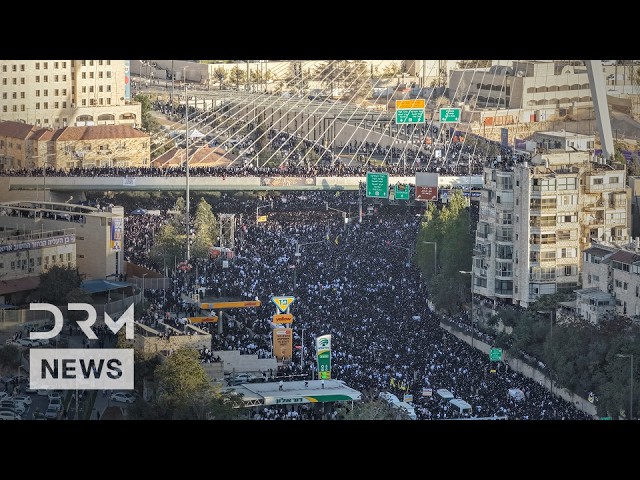
Witnesses told Israel National News that chaos erupted near the towering construction site shortly before 4:00 p.m., as hundreds of ultra-Orthodox demonstrators filled the area to protest ongoing efforts to advance legislation mandating military conscription for yeshiva students.
The protest — one of several held across the country in recent weeks — had already been marked by tense confrontations between demonstrators and police. Stones, bottles, and debris were hurled at officers, who in turn deployed crowd-control measures in an effort to clear the roadway.
Amid the uproar, Litzman was seen climbing an upper level of the building before falling in what many witnesses described as a sudden and horrifying plunge.
“We heard a scream and then people shouting,” one protester told Israel National News. “At first, everyone thought it was an accident. Then, within seconds, everything stopped — even the shouting. It was complete silence.”
MDA paramedic Lishai Shemesh and EMT Daniel Alkayam, who were stationed nearby, recounted to Israel National News the grim scene they encountered: “The teen lay unconscious at the foot of a high-rise construction site without a pulse and not breathing, with very severe multi-system trauma,” they said. “We were told that he fell from a high height. We conducted medical examinations, but his injuries were critical, and unfortunately, we had no choice but to pronounce him dead.”
Authorities have not yet determined whether Litzman’s fall was accidental or intentional. According to Israel National News, the Jerusalem District Police have launched an investigation into the incident, including the possibility of suicide.
Police forces remained on-site for hours after the tragedy, cordoning off the area as forensic units examined the construction zone and reviewed video footage.
Early findings suggest that Litzman may have climbed the scaffolding moments before the fall, though it remains unclear whether he was attempting to gain a vantage point over the crowd, flee the clashes, or make a statement through his actions.
A police spokesperson told Israel National News that while initial evidence does not rule out foul play, investigators are treating the case with “maximum sensitivity given the emotional and religious dimensions involved.”
Following the fatal fall, tensions escalated rapidly at the scene. Israel National News reported that dozens of demonstrators confronted police officers, accusing them of negligence and overreach in their handling of the protest.
As emotions flared, several protesters began throwing stones and bottles toward police units stationed along Shazar Boulevard. Video footage circulated online showed one officer drawing his weapon and raising it in the air after a fellow officer was struck and injured by debris.
While no additional fatalities were reported, Magen David Adom confirmed that 56 individuals received medical treatment during the unrest. Of those, four were transported to hospitals for further care in mild condition — two for fainting, one for a cardiac incident, and one for a minor physical injury.
By evening, the area was sealed off, and police worked to disperse the remaining demonstrators.
The tragedy reverberated far beyond the streets of Jerusalem, triggering a fierce political backlash and reigniting debate over Israel’s long-running dispute over haredi military exemption.
Yisrael Beytenu Chairman Avigdor Liberman issued a blistering statement in the aftermath, placing direct blame on the ultra-Orthodox leadership for what he called a “senseless and preventable” death.
“The rotten haredi leadership is directly responsible for the painful death of a young boy in a despicable and unnecessary demonstration,” Liberman declared, as reported by Israel National News. “He came out on the orders of that leadership to be a human shield for the power and influence of the haredi activists.”
Liberman’s comments, though characteristic of his secularist stance, drew immediate condemnation from religious representatives, who accused him of exploiting tragedy for political gain.
Yet for many Israelis, the event has again drawn attention to the deep ideological rift over the conscription issue — one that pits the secular majority, which demands equal service obligations, against large segments of the haredi public who insist that Torah study is itself a form of national service.
As Israel National News has documented extensively, the renewed wave of demonstrations comes amid mounting pressure on the government to finalize a new framework for military conscription.
The Supreme Court’s invalidation of long-standing exemptions for yeshiva students has left the coalition facing a legislative and moral dilemma — how to balance national security needs with the sensitivities of Israel’s religious communities.
For haredi leaders, the proposed reforms represent an existential threat to their way of life. For secular Israelis, the continued deferrals are an affront to the principle of equality.
The protests, organized primarily by radical factions within the Eda Haredit and Jerusalem Faction, have sought to frame the issue in religious terms — portraying any attempt to enforce conscription as an assault on faith itself. Demonstrators routinely chant slogans such as “We will die and not enlist,” turning public streets into battlegrounds of ideology and faith.
Thursday’s tragedy has now become part of that fraught narrative — an incident that may further harden positions on both sides.
Details about Menachem Mendel Litzman’s background remain limited, but the Israel National News report confirmed that he hailed from a respected haredi family and was known as a gentle and studious young man.
In the aftermath of his death, community leaders called for restraint and introspection. One rabbi who attended the evening vigil told Israel National News that the focus should be on unity and compassion, not recrimination.
“This is not the time for anger,” the rabbi said softly. “A young soul has left this world, and every Jew should weep. We must remember that even in protest, every life is sacred.”
Funeral arrangements are expected to take place in Jerusalem’s Har HaMenuchot Cemetery, with thousands anticipated to attend. Police are coordinating with community representatives to ensure order and security during the proceedings.
As the investigation into Litzman’s death continues, the nation grapples with a grim question: whether this tragedy will serve as a turning point in the debate over faith, duty, and national responsibility, or whether it will deepen an already widening divide.
Israel National News observed that the images from Shazar Boulevard — the flags, the prayers, the chaos, and the fall — encapsulate Israel’s struggle to reconcile its secular and religious identities.
In a statement released late Thursday night, an IDF spokesperson offered condolences to the Litzman family and urged restraint in public discourse: “Every life lost is a tragedy. The IDF respects all communities in Israel and continues to seek paths toward dialogue, understanding, and unity.”
As night fell over Jerusalem, the construction site where Menachem Mendel Litzman fell remained cordoned off — a stark, silent monument to the human cost of a nation’s internal conflict.
And as the Israel National News report noted, “In the echo of one young man’s fall, Israel must confront not only how he died, but why so many have come to see protest as the only way to be heard.”
