



|
Getting your Trinity Audio player ready...
|
By: Fern Sidman
As Israel continues to confront waves of Iranian ballistic missile attacks in the wake of an expanding regional conflict, Taiwan has stepped forward with a gesture of humanitarian support that carries both practical and symbolic weight. The East Asian democracy has donated NT$5.14 million—more than $160,000—to fund emergency operations and lifesaving equipment in Israel, a move officials say reflects solidarity between two societies that view themselves as small democracies confronting persistent external threats.
The donation, announced earlier this week, will support the work of ZAKA, Israel’s volunteer emergency response and rescue organization known for operating at the scenes of terror attacks, disasters, and wartime emergencies. According to a report on Thursday by The Algemeiner, the funds have already been used to procure critical equipment that has assisted rescue workers responding to missile strikes and other wartime incidents.
Taiwan’s representative to Israel, Abby Lee, formally presented the assistance during a conference organized by ZAKA, emphasizing that the contribution was intended not merely as financial aid but as an expression of shared values between two nations separated by geography but linked by political experience.
“Our contribution is more than financial assistance,” Lee said at the event, according to remarks reported by The Algemeiner. “It is a message of hope and solidarity to those affected by the war.”
Lee drew a direct parallel between Israel and Taiwan, describing both as vibrant democracies operating under constant security pressure from powerful adversaries.
“Taiwan and Israel may be geographically distant,” she said, “but we are neighbors in our values, small democracies under constant external threat that continue to thrive and stand by one another.”
The announcement came during a particularly volatile moment in the Middle East. Over the weekend, the United States and Israel launched a major military campaign targeting Iran’s military infrastructure and security apparatus. Tehran has responded with retaliatory attacks involving drones and ballistic missiles aimed at Israeli territory and other locations across the region.
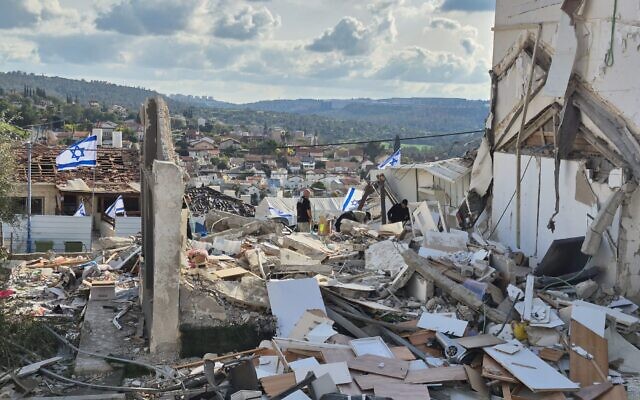
As The Algemeiner has reported, several of these strikes have deliberately targeted civilian areas. One of the most devastating attacks occurred in the Israeli city of Beit Shemesh, where an Iranian missile struck a public bomb shelter on Sunday. The blast killed nine people and wounded dozens more in what authorities described as a direct hit on a location intended to protect civilians.
In the aftermath of the strike, emergency crews rushed to the scene to rescue survivors and recover victims from the rubble. According to Lee, some of the equipment used in those operations had been purchased with Taiwan’s donation.
Among the items funded by the contribution were portable lighting towers that allowed ZAKA volunteers to carry out rescue work under challenging nighttime conditions.
Lee said the equipment proved invaluable during the response to the Beit Shemesh attack.
“We are particularly proud to contribute to initiatives led by ZAKA,” she noted, adding that Taiwan was pleased to see its support translated into tools with immediate impact on the ground.
For Taiwan, the gesture represents the latest chapter in a steadily expanding relationship with Israel that has developed despite the absence of formal diplomatic ties between the two governments.
As The Algemeiner has previously documented, Taiwan has repeatedly expressed support for Israel in moments of crisis. Following the Hamas-led terrorist attacks against southern Israel on Oct. 7, 2023, Taipei was among the first governments to condemn the violence and offer humanitarian assistance to affected communities.
Lee recalled that Taiwan had provided financial aid to kibbutzim, local municipalities, and civilian organizations working to rebuild after the attack and address the security challenges that followed.
Those gestures, she suggested, were rooted in a deeper historical connection between the two societies.
“The Taiwanese people often look to the example of the Jewish people when facing challenges to our international standing,” Taiwanese President Lai Ching-te said in remarks last year that were cited by The Algemeiner.
Lai has frequently invoked the biblical story of David and Goliath to describe Taiwan’s struggle to maintain sovereignty in the face of pressure from China, which claims the self-governing island as part of its territory.
“The people of Taiwan have never become discouraged,” Lai said during a speech delivered at a dinner hosted by the American Israel Public Affairs Committee in Taiwan. “Israel’s determination and capacity to defend its territory provides a valuable model for Taiwan.”
The Taiwanese president has also sought to translate that admiration into concrete policy. In October, Lai unveiled a new air defense initiative known as “T-Dome,” a multilayered missile defense system designed to protect the island against potential attacks from China.
According to reporting referenced by The Algemeiner, the project draws inspiration from Israel’s Iron Dome system, which has become a cornerstone of Israeli defense against rockets and missiles launched by hostile actors.
Lai told the AIPAC audience that Taiwan’s defensive strategy would also incorporate elements from a missile shield proposal put forward by President Trump, known as the “Golden Dome.”
“I believe that trilateral Taiwan-US-Israel cooperation can help achieve regional peace, stability, and prosperity,” Lai said.
While Taiwan and Israel have cultivated quiet but increasingly robust ties, China has moved in the opposite direction by strengthening its relationship with Iran.
Beijing is widely regarded as one of Tehran’s most important diplomatic and economic partners. In recent years, the two countries have deepened their cooperation through a sweeping 25-year strategic agreement that covers trade, energy, infrastructure, and military collaboration.
China has also conducted joint naval exercises with Iran and continues to purchase large quantities of Iranian oil despite U.S. sanctions aimed at isolating the Islamic Republic.
Indeed, China is now the largest importer of Iranian crude, accounting for nearly 90 percent of the country’s oil and condensate exports.
These ties have placed Beijing at odds with both Israel and the United States as tensions in the Middle East intensify.
Diplomatic friction between China and Israel has grown more pronounced in recent years. In one notable episode last year, China sharply criticized Israel after Jerusalem joined a United Nations declaration condemning Beijing’s human rights record.
The statement, backed by the United States and signed by several democratic allies including the United Kingdom, Australia, and Japan, expressed concern over China’s treatment of ethnic and religious minorities.
The signatories cited reports of arbitrary detention, forced labor, mass surveillance, and restrictions on cultural and religious expression.
Israel’s decision to endorse the declaration marked a rare departure from its traditionally cautious approach toward China, which has long been motivated by the desire to preserve economic ties.
The deterioration in relations has continued as geopolitical competition intensifies. Israeli Prime Minister Benjamin Netanyahu accused China last year of participating in what he described as a “media blockade” against Israel during the war in Gaza.
According to the information provided by The Algemeiner, a report by the Institute for National Security Studies concluded that Chinese state media and affiliated networks had actively promoted narratives portraying Israel and the United States as solely responsible for regional instability.
The study also warned that some of these messaging campaigns included antisemitic themes that have contributed to rising anti-Israel sentiment in parts of the world.
“It is evident that China and its proxies play a significant role in the current wave of antisemitism and anti-Israel sentiment in the United States,” Ofir Dayan, a researcher at the Israel-China Policy Center, wrote in the report.
A separate analysis published by the Jewish People Policy Institute reached similar conclusions. The report documented how Chinese domestic propaganda has increasingly incorporated overtly antisemitic messaging as Beijing seeks to cultivate closer relations with Arab and Muslim countries.
Against this backdrop of geopolitical rivalry, Taiwan’s decision to support Israel carries implications that extend beyond humanitarian aid.
By publicly aligning itself with Israel during a period of military crisis, Taiwan is reinforcing a narrative of shared democratic resilience in the face of authoritarian pressure.
As The Algemeiner has noted in its coverage of Taiwan-Israel relations, both societies perceive themselves as frontline democracies confronting adversaries that question their legitimacy and sovereignty.
For Israel, the donation represents not only practical assistance but also a reminder that its struggle resonates far beyond the Middle East.
For Taiwan, it offers an opportunity to signal that even without formal diplomatic recognition, alliances grounded in shared political values can still find meaningful expression.
As the conflict with Iran continues to unfold and great-power competition shapes the international landscape, such gestures of solidarity may play an increasingly important role in defining the alliances of the future.
