



|
Getting your Trinity Audio player ready...
|
By: Fern Rosenblatt
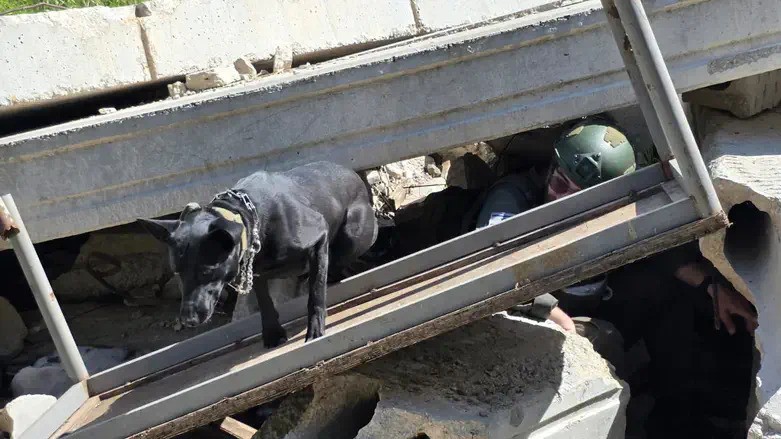
Amid an increasingly volatile security landscape and the ever-present possibility of large-scale emergencies, Israel’s specialized canine rescue teams are intensifying their preparations for scenarios that demand speed, precision, and extraordinary skill. In a carefully orchestrated training exercise designed to simulate the aftermath of catastrophic structural collapse, the Israel Dog Unit, a nonprofit organization renowned for its work with highly trained search-and-rescue dogs, carried out an extensive drill aimed at enhancing its ability to locate individuals trapped beneath rubble.
The exercise, which took place on Monday at a specially prepared site resembling the debris field of a collapsed building, reflects Israel’s broader effort to maintain readiness in the face of both natural disasters and the complex security threats that have become a defining feature of life in the region. According to reports highlighted by Israel National News, the training session focused on refining the techniques used by canine teams to detect and pinpoint survivors buried under layers of concrete, steel, and shattered infrastructure.
The drill unfolded against the tense backdrop of Operation Roaring Lion, Israel’s ongoing military campaign against hostile forces in the region. With missile attacks, structural damage, and the possibility of mass-casualty incidents looming as potential consequences of regional conflict, authorities are increasingly prioritizing the readiness of specialized rescue units capable of operating in chaotic and hazardous environments.
At the heart of the training was a meticulously constructed environment designed to replicate the conditions encountered after a building collapse. Piles of concrete slabs, twisted metal, and broken masonry formed an obstacle-filled landscape in which rescuers and their canine partners practiced locating victims hidden beneath the debris.
Handlers guided their dogs through the rubble as the animals relied on their acute sense of smell to detect human scent traces emanating from concealed volunteers positioned beneath the simulated wreckage. According to accounts cited by Israel National News, the exercise emphasized real-time response capabilities, enabling the teams to practice rapid identification of potential survivors in situations where every second can determine the difference between life and death.
Search-and-rescue dogs are uniquely suited to such missions. With olfactory capabilities estimated to be tens of thousands of times more sensitive than those of humans, these animals can identify the faintest traces of scent even when individuals are buried under thick layers of debris. In disaster zones where heavy equipment may take hours to reach victims, canine units often provide the fastest and most reliable means of locating survivors.
The Israel Dog Unit has earned a reputation as one of the country’s leading organizations specializing in working dogs trained for a variety of missions, including search-and-rescue operations, locating missing persons, and assisting in emergency response efforts.
While the organization operates as a nonprofit entity, its teams frequently collaborate with government agencies, security services, and local authorities. Over the years, its dogs have been deployed in a range of scenarios—from searching for missing hikers in remote areas to assisting in rescue efforts after natural disasters and acts of terrorism.
The Israel National News report noted that exercises such as Monday’s training are a crucial component of maintaining operational readiness. Because the conditions encountered in real disasters are unpredictable and often extremely dangerous, rescue teams must continually refine their techniques and ensure that both dogs and handlers remain capable of performing under pressure.
The importance of the exercise was underscored by the presence of local government officials who came to observe the training firsthand.
Among those attending were Yochai Faragi, the acting mayor of the city of Harish, and Moshe Ben Zikri, the city’s deputy mayor and security director. Both officials monitored the proceedings closely and spoke with trainers and handlers about the role that canine rescue teams can play in protecting communities during emergencies.
According to coverage cited by Israel National News, the municipal leaders expressed strong support for the Israel Dog Unit’s efforts to enhance emergency preparedness not only at the local level but across the nation. Their presence at the drill highlighted the growing recognition among Israeli officials that rapid-response capabilities are essential in an era where both natural disasters and security incidents can occur with little warning.
Beyond rehearsing immediate response procedures, the exercise also served another important purpose: preparing additional rescue dogs to join the ranks of operational search teams.
Training a dog for search-and-rescue work is an intensive and time-consuming process that requires months—and sometimes years—of specialized instruction. Dogs must learn to navigate unstable terrain, remain focused despite loud noises or chaotic environments, and signal clearly when they detect a human scent.
Handlers, in turn, must develop a deep understanding of their canine partners’ behavior and signals. The relationship between dog and handler is built on trust and constant practice, making regular training exercises indispensable. As explained by the Israel Dog Unit and reported by Israel National News, expanding the number of trained rescue dogs ensures that teams can respond simultaneously to multiple incidents should the need arise.
The timing of the drill was particularly significant given the current security environment surrounding Operation Roaring Lion.
In recent weeks, Israel has faced missile barrages and other threats linked to regional hostilities. Such attacks carry the potential to cause structural damage to residential buildings or infrastructure, creating precisely the kind of rescue scenarios that canine units are designed to address.
Maintaining readiness under these circumstances is not merely a precaution but a necessity. “Maintaining a high level of operational readiness is essential,” the Israel Dog Unit stated, according to reporting highlighted by Israel National News. “Our canine teams and handlers must be prepared to respond quickly to a wide range of potential incidents.”
The emphasis on readiness reflects a broader national ethos in Israel, where emergency response agencies frequently conduct drills to ensure that systems remain effective under the pressures of real-world crises.
Behind the technical aspects of canine search operations lies a deeply human mission: saving lives in moments of extraordinary vulnerability.
When buildings collapse or disasters strike, survivors often find themselves trapped in darkness and silence, uncertain whether anyone will find them before their strength runs out. The arrival of a rescue dog—trained to detect the faintest trace of life—can represent the first glimmer of hope in such circumstances.
Handlers participating in Monday’s exercise described their work not merely as a profession but as a calling. For them, the partnership with their dogs embodies a shared commitment to protecting human life, even in the most perilous conditions.
As Israel continues to navigate an uncertain security landscape, the importance of specialized units like the Israel Dog Unit is likely to grow. Their work represents a critical intersection between preparedness and compassion, combining advanced training techniques with an unwavering dedication to saving lives.
Exercises like Monday’s drill serve as a reminder that behind the headlines of conflict and geopolitics lies an equally vital effort to prepare for the aftermath of disaster—and to ensure that when tragedy strikes, rescuers and their canine partners are ready to respond.
As coverage by Israel National News makes clear, the commitment of these teams to constant training and readiness reflects a broader national determination: that even in the most challenging circumstances, every possible effort will be made to find those who are lost and bring them safely home.
