



|
Getting your Trinity Audio player ready...
|
By: Fern Sidman
The escalating confrontation between the United States, Israel, and the Islamic Republic of Iran has taken a dramatic turn in the waters of the Persian Gulf, as American forces launched a series of strikes that destroyed a fleet of Iranian vessels suspected of preparing to mine the strategically vital Strait of Hormuz. The operation, announced Tuesday by U.S. military officials, underscores the rapidly intensifying stakes of a regional conflict that now threatens to disrupt one of the most critical arteries of global commerce.
According to reports cited by Israel National News, the United States Army confirmed that American forces eliminated 16 Iranian naval vessels believed to be capable of deploying naval mines near the narrow maritime corridor that links the Persian Gulf with international shipping lanes.
The announcement came as U.S. Central Command (CENTCOM) released footage documenting the strikes, which targeted what officials described as a cluster of Iranian minelaying craft operating in proximity to the Strait of Hormuz. The destruction of the vessels represents one of the most direct maritime confrontations between American forces and Iranian military assets in recent years.
CENTCOM said in a statement accompanying the video that “U.S. forces eliminated multiple Iranian naval vessels, including 16 minelayers near the Strait of Hormuz,” an operation intended to neutralize a potentially catastrophic threat to global shipping.
The development has added a new dimension to an already volatile regional conflict, as Israeli forces simultaneously intensify their own operations against Iranian military infrastructure under the ongoing campaign known as Operation Roaring Lion.
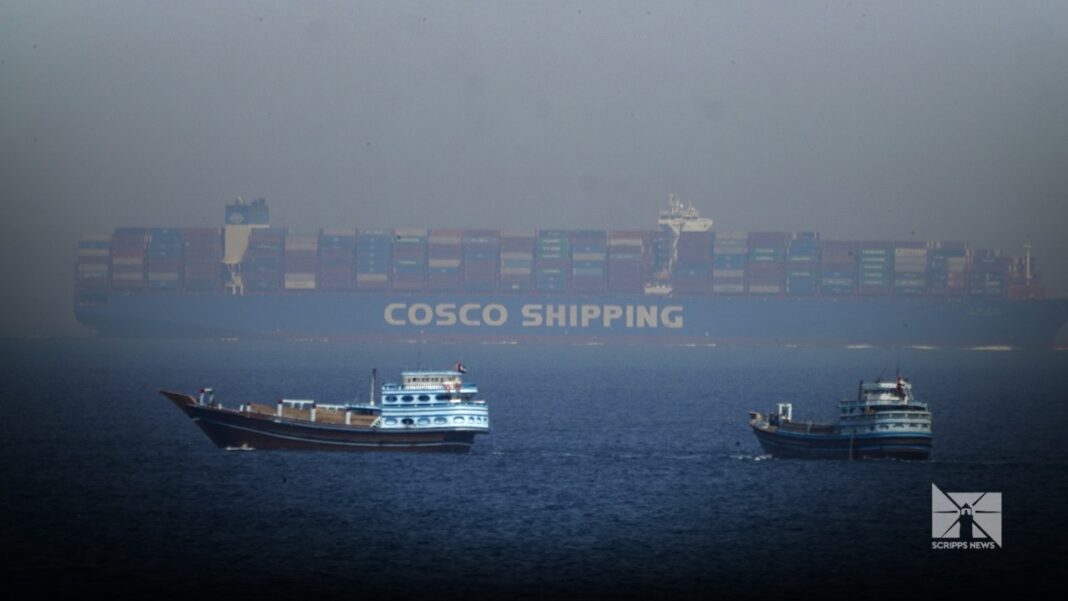
The geographic location of the latest confrontation is no coincidence. The Strait of Hormuz remains one of the most strategically consequential maritime chokepoints in the world. Positioned between Iran and Oman at the entrance to the Persian Gulf, the narrow channel serves as the primary conduit through which energy exports from the Gulf region reach global markets.
According to international energy analysts referenced in reports cited by Israel National News, roughly 20 percent of the world’s oil supply transits through the strait on any given day.
Even minor disruptions to traffic through the passage can send shockwaves through global energy markets, triggering sharp increases in oil prices and raising concerns about supply shortages.
For decades, Iran has repeatedly threatened to close the Strait of Hormuz during periods of heightened tension with the West. The Islamic Republic views the waterway as one of its most powerful geopolitical levers.
Naval mines represent one of the simplest and most effective methods of achieving that objective. Even a limited number of explosive devices deployed in the narrow shipping lanes could deter commercial tankers from entering the strait, effectively choking off energy exports from the region.
Earlier this week, American intelligence officials warned that Iran appeared to be preparing for precisely such an operation.
According to reports referenced by Israel National News, U.S. officials believed Tehran might deploy naval mines using small boats capable of transporting multiple explosives at once. These vessels, often fast and highly maneuverable, can operate close to shorelines or within congested maritime environments.
Such tactics fall squarely within Iran’s long-standing doctrine of asymmetric naval warfare, which relies on small, inexpensive platforms capable of threatening much larger and more sophisticated naval forces.
When the intelligence reports surfaced, President Trump responded swiftly and publicly.
Writing on his Truth Social platform, Trump issued a stark warning to Tehran, demanding that any mines placed in the Strait of Hormuz be removed immediately.
“If Iran has put out any mines in the Hormuz Strait, and we have no reports of them doing so, we want them removed immediately,” Trump wrote.
The president added that if such devices were deployed and not promptly removed, the consequences for Iran would be severe. “The military consequences to Iran will be at a level never seen before,” Trump warned.
The subsequent destruction of the 16 vessels appears to reflect Washington’s determination to enforce that warning.
Despite mounting reports of damage inflicted by U.S. and Israeli operations, Iranian officials have attempted to project an image of steadfast resilience. General Ebrahim Jabari, a senior adviser to the commander of the Islamic Revolutionary Guard Corps (IRGC), declared in remarks cited by Israel National News that the Islamic Republic is fully prepared for a prolonged war.
In an interview with the Arabic-language outlet Al-Araby, Jabari insisted that Tehran remains undeterred by the combined military pressure exerted by Washington and Jerusalem. “We have prepared ourselves for a prolonged war,” he said. Jabari went even further, invoking historical precedent.
“If the war between Iraq and Iran in the 1980s lasted eight years, today we are ready for a war that could last a decade,” he declared.
The Iran–Iraq War, which raged from 1980 to 1988, remains one of the bloodiest conflicts of the late twentieth century. By referencing that protracted struggle, Jabari appeared to signal that Iran’s leadership believes it possesses the endurance required for a similarly long confrontation.
Iranian officials have also attempted to counter reports that the country’s military infrastructure has been severely degraded by Israeli airstrikes.
Under Operation Roaring Lion, Israeli forces have targeted missile production facilities, air defense systems, drone bases, and other critical components of Iran’s military apparatus. While Israeli officials have reported extensive damage to these systems, Jabari insisted that the regime’s capabilities remain intact.
“Our warehouses are full of missiles and UAVs,” he claimed, according to reporting cited by Israel National News. “We are launching missiles while continuing to produce new ones and replenish our stockpiles.” He further asserted that Iran’s initial missile barrages represented only the opening phase of a broader strategy.
According to Jabari, early launches consisted primarily of older missile models intended to degrade Israeli air defenses. “We launched a large number of first- and second-generation missiles to destroy their air defenses and radars,” he said.
Iran, he suggested, still possesses more advanced weapons that have yet to be deployed. “We possess capabilities that we have kept hidden, and if necessary, we will bring them into the battle.”
Even as Iran projects defiance, Israel has continued to expand its military operations. According to coverage cited by Israel National News, Israeli forces are focusing heavily on dismantling Iran’s missile infrastructure, which Jerusalem regards as one of the most immediate threats to its national security.
Military planners believe that destroying missile launchers, storage depots, and production facilities could dramatically reduce Iran’s ability to strike Israeli territory. Israeli officials have also emphasized that degrading Iran’s military capabilities serves a broader strategic purpose: weakening Tehran’s network of proxy militias across the Middle East.
Groups such as Hezbollah in Lebanon and the Houthis in Yemen have long relied on Iranian missiles and drones to project power across the region.
The intensifying confrontation has already begun to ripple across global markets. Energy analysts warn that any sustained disruption to shipping through the Strait of Hormuz could trigger significant volatility in oil prices. Financial markets are watching closely for signs that the conflict could escalate further.
If Iran were to attempt large-scale mining operations in the strait, international naval forces would likely be forced to conduct complex and time-consuming mine-clearing missions.
Such operations could take weeks or even months, depending on the scale of the threat.
For now, the destruction of the Iranian vessels represents a tactical success for U.S. forces and a warning to Tehran that attempts to disrupt maritime traffic will be met with immediate force.
Yet the broader trajectory of the conflict remains uncertain. Iranian leaders continue to signal their willingness to endure a prolonged war, while Israeli and American officials appear determined to dismantle Tehran’s military capabilities.
As Israel National News has emphasized in its coverage, the stakes extend far beyond the immediate battlefield. The outcome of the conflict could reshape the strategic balance of power across the Middle East—and determine whether one of the world’s most vital shipping corridors remains secure.
For the moment, the waters of the Strait of Hormuz remain navigable. But the shadow of war looms ever closer over the narrow passage through which so much of the world’s energy supply must pass.
