



|
Getting your Trinity Audio player ready...
|
By: TJVNews Staff
In one of the most dramatic institutional upheavals in recent Israeli memory, IDF Military Advocate General (MAG) Maj. Gen. Yifat Tomer-Yerushalmi resigned from her post on Friday — barely an hour after Defense Minister Israel Katz moved to fire her. The chain of events, which unfolded with startling speed and near-total confusion, has exposed deep fissures at the intersection of Israel’s defense establishment, judiciary, and politics.
As The Jerusalem Post reported on Friday, the catalyst for Tomer-Yerushalmi’s downfall was a revelation she made in her own resignation letter: “I approved the leaking of evidence to the media in an attempt to confront the false propaganda against the law enforcement officials in the military. I take full responsibility for all of the evidence which was sent out to the media by this unit. Based on this responsibility, I also have decided to conclude my role as the MAG.”
That admission — a rare act of accountability in Israel’s tightly disciplined military culture — immediately transformed her from a possible witness in the Sde Teiman abuse case leak investigation into a potential central defendant. What began as a disciplinary probe has now spiraled into a constitutional controversy about who controls Israel’s military justice system, who can fire its chief legal officer, and what this crisis means for Israel’s credibility before international tribunals.
Until last week, Maj. Gen. Tomer-Yerushalmi was regarded by peers and international observers as one of the IDF’s most disciplined legal minds — a jurist who had successfully steered the army’s legal corps through the storm of International Criminal Court (ICC) and International Court of Justice (ICJ) scrutiny following the Gaza war. Her resignation, as The Jerusalem Post report emphasized, therefore “shook the defense establishment at its foundations.”
The sequence of events was dizzying. Early Friday morning, Defense Minister Katz issued a stunning directive redefining her status from “suspended” to “fired,” claiming she was responsible — directly or indirectly — for leaking video evidence from the Sde Teiman detention facility, where several soldiers were accused of abusing Palestinian detainees. Within an hour, Tomer-Yerushalmi pre-empted him by resigning outright.
In her letter, she not only accepted personal responsibility for authorizing the leak but also justified her action as a defense of Israel’s military legal establishment against “false propaganda.” In essence, she implied that releasing the evidence — a move that breached military confidentiality — was intended to protect the integrity of IDF prosecutors who had been vilified by political figures and far-Right activists as “traitors” for investigating the abuse.
According to the information provided in The Jerusalem Post report, her letter was an “extraordinary moment of candor and defiance” — an acknowledgment that her decision, while unlawful in form, was made in service of the truth.
While the legal and ethical implications of her admission are complex, the political consequences were immediate. Katz’s move to fire Tomer-Yerushalmi without consultation with Attorney-General Gali Baharav-Miara or IDF Chief of Staff Lt. Gen. Eyal Zamir ignited a firestorm. Former senior IDF legal officials told The Jerusalem Post that Katz “did not have the authority” to dismiss her unilaterally. Under Israeli law, they argued, only the Chief of Staff can formally appoint or dismiss the Military Advocate General — with the defense minister’s role limited to approval of appointments, not removals.
Nonetheless, Baharav-Miara — a frequent target of the government’s anti-judiciary rhetoric — chose not to intervene. According to The Jerusalem Post report, that non-action may have encouraged Tomer-Yerushalmi to step down voluntarily, sparing the system a protracted constitutional battle.
The IDF’s official statement later that day confirmed that Chief of Staff Zamir would now compile a list of potential successors “capable of meeting the significant challenges currently facing the Military Advocate General’s Corps, foremost among them the protection of IDF soldiers.”
But Katz’s own follow-up remarks revealed a deeper political agenda. He declared that “all required sanctions will be taken against her, first and foremost the stripping of her ranks. Whoever levels blood libels against IDF soldiers and prefers the welfare of terrorists over theirs is not fit to wear an IDF uniform.”
That language — invoking “blood libels,” a phrase historically associated with antisemitic persecution — sent shockwaves through Israel’s legal community. As The Jerusalem Post report observed, Katz’s statement was “not merely punitive but symbolic,” signaling an attempt to reframe the entire MAG Corps as a political enemy of the nationalist camp.
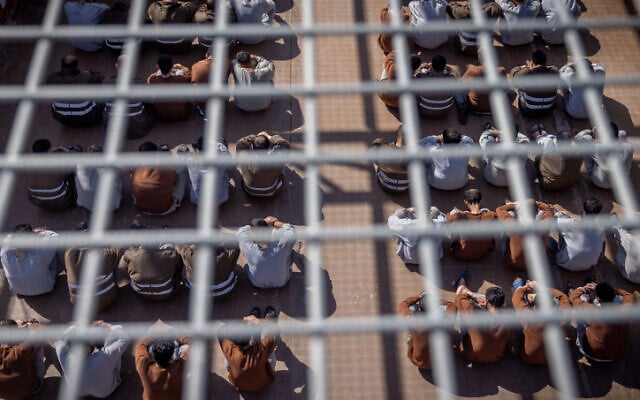
The roots of this extraordinary confrontation lie in the Sde Teiman detention facility, a military base in the Negev repurposed during the Gaza war to hold Palestinian detainees under the Unlawful Combatants Law. Reports of systematic abuse — including beatings, prolonged blindfolding, and denial of medical care — first surfaced in the summer of 2024.
As The Jerusalem Post meticulously documented, the case evolved into two major criminal files:
The “small” Sde Teiman case, in which an IDF reservist confessed to physically assaulting detainees and received a seven-month prison sentence; and the “large” Sde Teiman case, in which five soldiers were indicted for sexual assault and aggravated abuse of detainees.
The “small” case drew criticism from human-rights advocates such as the Public Committee Against Torture in Israel (PCATI), who called the sentence “woefully inadequate.” Yet even that limited accountability enraged segments of the Israeli Right, who argued the accused soldiers were being “sacrificed on the altar of international opinion.”
The “large” case became a political powder keg. In July 2024, when military police arrested nine reservists suspected of severe abuse, far-Right activists, families of soldiers, and several Knesset members staged mass demonstrations outside Sde Teiman and later at Beit Lid, where the suspects were held. Some broke through military gates — an extraordinary breach of discipline within the state’s own defense ecosystem.
It was during the prosecution’s handling of these cases that a surveillance video from Sde Teiman — allegedly showing soldiers severely beating a Palestinian detainee — was leaked to the media. The footage triggered public outrage and prompted an internal investigation ordered by Attorney-General Baharav-Miara.
That probe eventually pointed toward the MAG’s office itself. Reports surfaced that Tomer-Yerushalmi’s own spokeswoman had informed the Shin Bet that the MAG had authorized the leak — ostensibly to expose the truth and defend the prosecution against accusations of fabrication.
As The Jerusalem Post reported, this revelation “upended the moral narrative” surrounding the scandal. The legal system, previously portrayed as the guardian of discipline, was now implicated in breaking its own rules.
By publicly admitting to approving the leak, Tomer-Yerushalmi moved herself from the periphery of the investigation to its center. Legal analysts cited in The Jerusalem Post report noted that her statement could be construed as a confession to misconduct — potentially a violation of Israel’s Military Justice Law and of classified-information statutes.
At the same time, her defenders argue that the leak may be judged within the context of “necessity” — an attempt to protect the integrity of the IDF’s legal institutions amid a campaign of delegitimization.
One senior military lawyer told The Jerusalem Post, “Yifat acted out of conviction that the truth needed to be seen. She wanted to prove that the legal system inside the IDF does not invent evidence or betray soldiers, as some politicians claim. She broke procedure, yes — but she did so to preserve the rule of law itself.”
Her critics, however, see it differently. To them, the leak not only endangered classified information but also undermined the credibility of Israel’s self-investigating mechanisms — the very systems that the International Criminal Court examines when deciding whether to assert jurisdiction. “If the MAG herself cannot follow the rules,” one former attorney-general told The Jerusalem Post, “then how can we argue that the IDF’s internal investigations are sufficient to avoid external prosecution?”
That question cuts to the heart of Israel’s defense before international bodies, which rely heavily on demonstrating that its domestic institutions are independent and capable of prosecuting wrongdoing.
Tomer-Yerushalmi’s resignation has implications far beyond the borders of Israel. As The Jerusalem Post report explained, she was the primary legal authority guiding Israel’s responses to allegations of war crimes at both the ICJ and ICC. Her suspension — now resignation — could disrupt ongoing efforts to compile evidence and defend IDF conduct in Gaza, where international scrutiny remains intense.
Moreover, her departure may embolden Israel’s detractors abroad. “This will be portrayed as chaos within the Israeli legal system,” a former senior diplomat told The Jerusalem Post. “It plays directly into the narrative that Israel cannot police its own ranks.”
The timing is particularly delicate. The Hague-based courts are currently weighing multiple petitions related to Israel’s military operations, and the absence of a stable MAG could weaken the state’s coordination with its legal defense teams abroad.
For that reason, Chief of Staff Eyal Zamir and Defense Minister Katz have moved quickly to stabilize the corps, announcing that Zamir will soon propose candidates to replace her. The most likely interim successor, according to The Jerusalem Post, is Col. Gal Asael, her deputy — though sources caution that Katz may seek a more politically aligned appointee.
Inside Israel, the episode has become a flashpoint in the broader struggle between the military-legal establishment and the populist right-wing government. Over the past two years, Katz and other coalition leaders have repeatedly accused Israel’s judiciary, prosecutors, and human-rights investigators of “tying the hands of our soldiers.”
The Sde Teiman cases, in particular, became a rallying cry for those who claim that Israel’s own institutions have been “hijacked by left-wing elites.” The image of IDF soldiers being investigated for mistreating Hamas prisoners after the horrors of October 7 was used by hardliners as proof that the “deep state” favored enemies over patriots.
By targeting Tomer-Yerushalmi — who had become the face of military legal oversight — Katz effectively cast himself as the defender of the rank-and-file soldier against what he termed “blood libels.”
As The Jerusalem Post editorialized, this framing “weaponizes the language of justice for political gain,” pitting loyalty against legality. The risk, it warned, is that “the erosion of the army’s internal legal authority will ultimately erode the very moral foundation that distinguishes Israel from its adversaries.”
This is not the first time an Israeli defense minister has clashed with the IDF chief over the appointment of a MAG. As The Jerusalem Post report recalled, a similar confrontation occurred in 2011, when then-Defense Minister Ehud Barak overrode IDF Chief Gabi Ashkenazi to appoint Danny Efroni as MAG. But even that contentious decision followed proper procedural norms.
Katz’s unilateral dismissal of Tomer-Yerushalmi represents an unprecedented assertion of civilian control over what has historically been a professional, quasi-autonomous office. Analysts note that if the minister’s move goes unchallenged, it could permanently alter the balance between the defense establishment and civilian political authority.
“This is not just about one general,” a former Supreme Court justice told The Jerusalem Post. “It is about whether the army’s legal system will remain independent or become another political branch.”
The public reaction to Tomer-Yerushalmi’s fall reflects Israel’s deepening divide over the role of law, morality, and accountability in wartime. For many Israelis, particularly those who lost loved ones on October 7, sympathy lies with the soldiers accused of excesses against Palestinian detainees. For others — including jurists, human-rights advocates, and moderate conservatives — the integrity of the IDF’s internal justice mechanisms is what shields Israel from international isolation.
The Jerusalem Post, in a recent analysis, described this divide as “a war over the soul of the army itself.” The MAG Corps, it argued, is the institutional expression of Israel’s claim to be a nation governed by law even in the fog of battle. Weakening it may yield short-term political satisfaction, but it risks long-term strategic damage.
The paper also noted that, ironically, Tomer-Yerushalmi’s decision to leak evidence — an attempt to defend the military’s credibility — may now accelerate its politicization. “In trying to protect the institution,” the Post wrote, “she may have inadvertently handed its detractors the very weapon they sought.”
At the core of the crisis lies a paradox that The Jerusalem Post has underscored repeatedly: both the abuse and the leak can be true simultaneously. Soldiers may indeed have committed criminal acts, and yet the exposure of those acts through unauthorized leaks also constitutes a breach of law.
The case illustrates the moral complexity facing Israel’s military in a time of existential war. On one hand, the state must demonstrate adherence to international norms; on the other, it must maintain morale and unity among troops scarred by unprecedented brutality.
For Tomer-Yerushalmi, balancing those imperatives proved impossible. Her resignation statement implicitly recognized this tension — that truth and loyalty had collided, and that she chose truth, however flawed her method.
As Israel awaits the appointment of her successor, questions abound about the future of the MAG Corps and the broader legitimacy of Israel’s legal system.
The Jerusalem Post reported that both Chief of Staff Zamir and Attorney-General Baharav-Miara are keen to restore stability swiftly, aware that prolonged uncertainty could embolden both domestic radicals and international critics. Yet the deeper wounds — institutional, political, and moral — will take far longer to heal.
Within the army, morale among legal officers has plummeted. Many fear that the message from the top is clear: uphold the law, and you may be punished; bend it for politics, and you will be protected. Outside the military, far-Right activists celebrate Tomer-Yerushalmi’s ouster as a victory over what they deride as “the legal dictatorship.”
Meanwhile, Israel’s adversaries — from Hamas propagandists to anti-Israel campaigners in The Hague — have already seized upon the episode as evidence of internal collapse.
The Jerusalem Post described the resignation of Yifat Tomer-Yerushalmi as “a parable of modern Israel — a nation torn between justice and survival, transparency and loyalty.” Her decision to leak evidence, it wrote, was “both a sin and a confession,” reflecting the unbearable moral pressures on those charged with preserving Israel’s ethical compass amid relentless warfare.
What remains now is the aftermath — a legal corps in turmoil, a political establishment emboldened, and a society forced once again to ask what it means to be both Jewish and democratic, moral yet militant, faithful yet accountable.
Whether history will judge Tomer-Yerushalmi as a martyr for integrity or a cautionary tale of hubris may depend on what happens next: if the IDF reasserts its legal independence or succumbs to political capture.
For now, as The Jerusalem Post concluded, “The resignation of the Military Advocate General is not the end of a scandal. It is the beginning of a reckoning — one that will test the very soul of the Israel Defense Forces.”
