



|
Getting your Trinity Audio player ready...
|
By: Fern Sidman
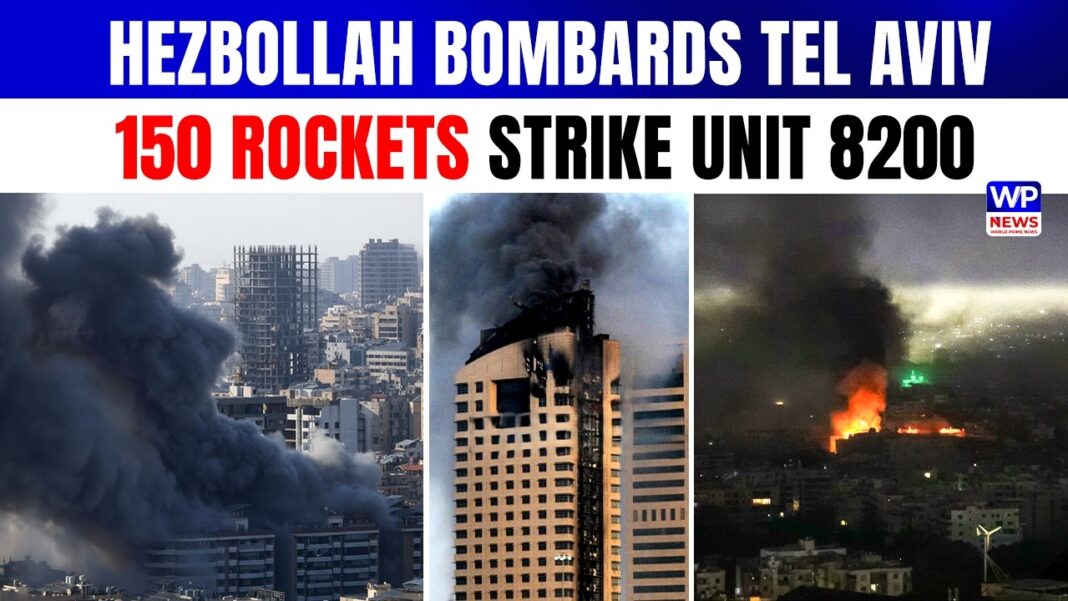
Northern and central Israel were thrust into a tense and volatile evening Wednesday after the Iranian-backed Hezbollah terrorist organization unleashed a large-scale rocket barrage that sent civilians scrambling for shelter and prompted immediate retaliatory strikes by the Israeli military. The attack—one of the most significant cross-border bombardments in recent months—has intensified fears that the regional conflict engulfing Israel, Iran, and their respective allies may soon widen into a more expansive war along Israel’s northern frontier.
According to a report on Wednesday from Israel National News, Hezbollah fired approximately 100 rockets toward Israeli territory shortly after 8:20 p.m., targeting multiple communities across the northern region. The sudden wave of projectiles triggered air raid sirens in several areas and forced thousands of residents to seek immediate refuge in bomb shelters and fortified safe rooms.
The Israeli military responded within minutes, launching a combination of aerial interception operations and counterstrikes inside Lebanon, underscoring the increasingly combustible nature of the confrontation between Israel and the Iranian-backed terrorist organization.
The Israel Defense Forces confirmed the attack in an official statement released shortly after the rockets were detected.
“In the past few minutes, the Hezbollah terrorist organization launched rockets toward several areas in Israel,” the IDF Spokesperson’s Unit said in remarks quoted by Israel National News.
The statement added that the Israeli Air Force immediately began targeting “ready-to-launch projectile launchers and additional infrastructure sites belonging to the Hezbollah terrorist organization across Lebanon.”
Israeli defense officials emphasized that the strikes were part of a broader effort to neutralize Hezbollah’s launch capabilities before additional salvos could be fired.
The IDF reiterated its longstanding policy regarding attacks against civilian populations. “The IDF will not tolerate any harm to Israeli civilians and will forcibly respond against any threat posed to the State of Israel,” the military said.
Israel’s multilayered air defense systems—including Iron Dome and other interception platforms—were activated to neutralize incoming rockets. While many of the projectiles were intercepted before reaching their targets, several impacts were reported across northern communities.
Emergency responders from Magen David Adom (MDA) quickly mobilized to treat casualties and assist residents in affected areas. According to reports cited by Israel National News, one man in his 50s sustained light injuries when a flying object struck his hand during the barrage. Additional reports indicated that two people were injured in a residential area after a direct hit damaged a private home. Firefighters and rescue crews arrived at the scene to assess structural damage and ensure that no residents were trapped inside the building.
Rabbi Reshef Mordi Neuman, the incident commander overseeing the response, described the situation faced by emergency crews. “This was a direct hit on the roof of a one-story private house,” Neuman explained. “The firefighters searched for anyone trapped, cut off power sources and helped the injured get out of the building.”
Paramedics arriving at the scene described a chaotic environment marked by shattered debris, smoke, and frightened residents. Senior MDA paramedic David Basudo and emergency medical paramedic Tal Eliyahu Yifrach recounted the dramatic moments following the impact.
“We arrived in ambulances and MDA intensive care units to a building with destruction, shrapnel and smoke,” the two paramedics said in a joint statement reported by Israel National News. “Miraculously, there were two injured people in light condition. When we approached the scene, one of the injured people walked towards us with her family and she was evacuated to the hospital. There were several other panic-stricken victims at the scene.”
Such scenes have become increasingly familiar in Israel’s northern communities, where residents live with the constant possibility of rocket fire from across the Lebanese border.
Following the attack, Hezbollah publicly claimed responsibility for the barrage, announcing that it had launched a military operation titled “Al-ʿAṣf al-Ma’kūl.” The phrase—translated as “like devoured chaff”—is drawn from Surah Al-Fil, a passage in the Quran describing divine punishment inflicted upon an invading army. The symbolic reference was widely interpreted by analysts as an attempt by Hezbollah to frame the attack as part of a religiously infused struggle against Israel.
Hezbollah has long used religious language and imagery to mobilize support among its followers while portraying its military campaigns as part of a broader ideological conflict.
Interestingly, the rocket barrage came only hours after local leaders issued unusual warnings to residents along Israel’s northern frontier. Earlier Wednesday evening, Moshe Davidovich, chairman of the Mate Asher Regional Council and head of the Confrontation Line Forum, urged residents to remain close to protected areas. Davidovich cited an accumulation of concerning intelligence alerts when issuing the directive.
Residents were advised to reduce non-essential activities and ensure that they could reach shelters quickly if necessary. In several communities, extracurricular activities and public gatherings scheduled for the evening were cancelled.
The atmosphere of tension was further heightened by a wave of messages circulating across social media and private messaging platforms. Many of these posts warned of an impending “significant missile barrage” expected to occur within hours. Despite these rumors, the IDF Home Front Command initially reported no change to official civil defense guidelines.
Brigadier General Efi Defrin, the IDF’s chief spokesperson, sought to calm public fears while emphasizing the importance of preparedness. “I am aware of the public discourse in recent hours regarding the possibility of increased shooting,” Defrin said in remarks quoted by Israel National News. “I want to emphasize that there is no change in the Home Front Command’s defense policy as of this moment.”
The rocket barrage represents another chapter in a rapidly evolving regional conflict. Since the outbreak of war between Israel and Iran earlier this year—known in Israel as Operation Roaring Lion and in Washington as Operation Epic Fury—Hezbollah has increasingly signaled its willingness to escalate hostilities along Israel’s northern border.
The Lebanese-based organization is widely considered Iran’s most powerful proxy force, possessing an arsenal estimated to include tens of thousands of rockets and missiles capable of striking deep inside Israel. Military analysts have long warned that a full-scale war between Israel and Hezbollah could dwarf previous conflicts due to the sheer volume and sophistication of the group’s weaponry.
The Israeli military’s response to Wednesday’s rocket barrage may signal a new phase in the conflict. According to information provided by an IDF source to New York Post, Israeli forces are now preparing contingency plans for a potential ground invasion of Lebanon. Such a move would represent a dramatic escalation and could fundamentally alter the trajectory of the war.
A ground operation would likely aim to push Hezbollah forces farther away from Israel’s northern border and dismantle rocket launch infrastructure embedded within southern Lebanon. However, such a campaign would also carry significant risks, including the possibility of prolonged urban combat and broader regional escalation.
For residents of northern Israel, the events of Wednesday night served as a stark reminder of the fragile security environment they face daily. Communities along the Lebanese border have endured intermittent rocket fire for decades, but the scale and intensity of recent attacks have raised concerns that the region may be sliding toward full-scale war.
Local authorities have worked extensively to prepare residents for such scenarios, constructing shelters, strengthening emergency response systems, and conducting regular preparedness drills. Yet the psychological strain of living under constant threat remains profound.
Parents worry about the safety of their children. Businesses struggle to operate amid recurring disruptions. Entire towns can grind to a halt when sirens sound.
As Israeli fighter jets continue striking Hezbollah targets across Lebanon and defense systems remain on high alert, the region appears to be entering an increasingly volatile phase. The rocket barrage, though largely intercepted, illustrates the growing determination of Iranian-backed groups to challenge Israel across multiple fronts.
Whether the confrontation escalates into a broader war now depends on the decisions made by military and political leaders in Jerusalem, Beirut, Tehran, and Washington. For now, Israel’s message remains clear. “The IDF will not tolerate any harm to Israeli civilians,” a military spokesperson said, according to Israel National News. “We will respond forcefully to any threat against the State of Israel.”
And as the echoes of sirens fade across northern communities, the uneasy question remains: Was this barrage merely another attack—or the opening salvo of a much larger war yet to come?
