



|
Getting your Trinity Audio player ready...
|
No Half Measures: MK Moshe Saada Demands Total Destruction of Hamas — ‘No Ceasefire Unless All Hostages Return’
By: Fern Sidman
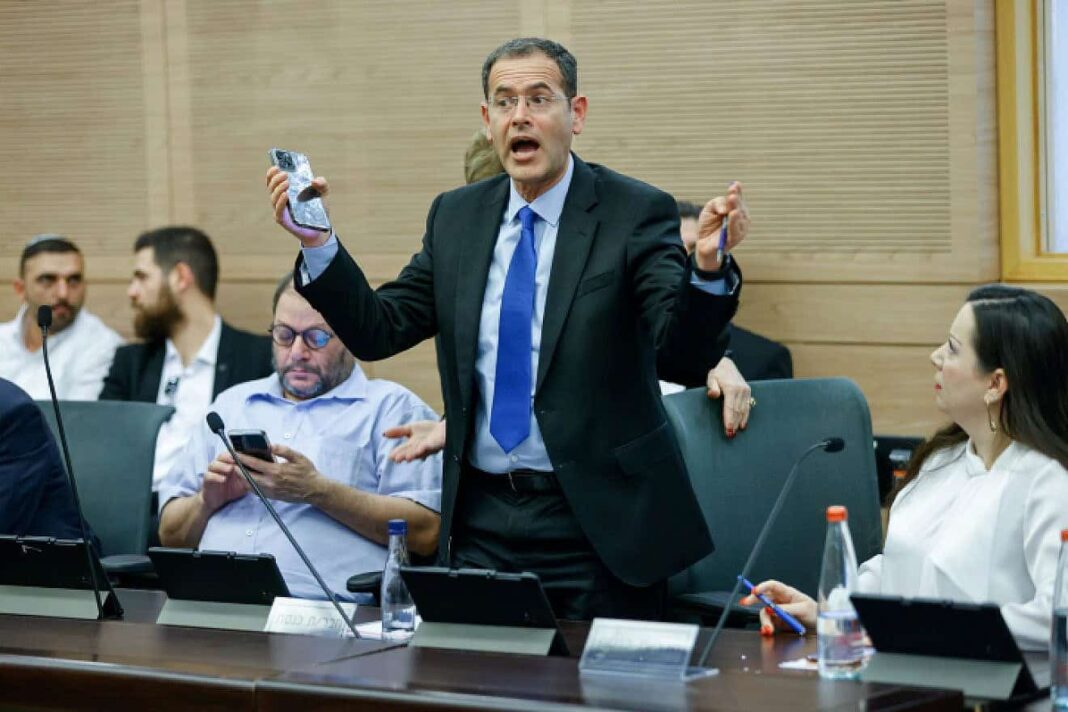
In a forceful interview with Arutz Sheva–Israel National News (INN) on Tuesday, Likud MK Moshe Saada delivered a stark appraisal of the Israeli campaign in Gaza and an uncompromising political prescription for how the state should prosecute the war. Saada’s comments — issued as Israel broadened its ground offensive into Gaza City and the political temperature in Jerusalem rose over investigations into the prime minister — crystallize a combative strand within the ruling coalition that rejects any partial or prolonged pause in fighting and demands maximal pressure until Hamas is eradicated and every hostage is returned.
Saada’s central demand was unambiguous: there must be no ceasefires that do not secure the immediate and unconditional release of all Israeli hostages. “We’re finally launching a powerful operation,” he told INN. “The most important thing now is one thing: a relentless campaign to conquer every inch, without ceasefires. A ceasefire is only acceptable in one scenario — if all the hostages are brought home. But there’s no way we stop the war halfway.”
That position captures the prevailing frustration in large segments of Israeli public opinion and among bereaved families who have been pressing government and military leaders for a single, overriding objective: return the captives. Saada’s insistence that no interim pause be allowed unless accompanied by the release of all hostages reflects the hardline calculus of those who see Palestinian terrorist groups’ willingness to hold captives as the strategic fulcrum that must be removed before any political horizon can be reached.
On operational questions, Saada struck a similarly uncompromising tone. He argued for a stringent blockade and sharply criticized what he portrayed as the current policy’s permissiveness regarding the flow of goods into Gaza. “The proper approach would have been a complete blockade of the Gaza Strip, with food distribution only in the designated humanitarian zone,” he said. “Instead, the opposite is happening — Israel is supplying Hamas with fuel, oxygen, and aid from Arab countries. No one is supervising this. This isn’t aid — it’s ammunition for Hamas.”
Saada’s remarks call attention to one of the most fraught dilemmas of the campaign: how to protect civilian life and provide humanitarian relief while denying Hamas the ability to exploit aid flows for military purposes. The allegation that aid can be diverted to support terrorist infrastructure is a charge frequently voiced by Israeli officials; whether the United Nations and other agencies can operate safely and verifiably in such an environment has been a subject of repeated dispute between Israel and international bodies.
The law-and-order tenor of Saada’s interview extended beyond battlefield tactics to searing criticism of Israel’s domestic political and judicial environment. He attacked the decision to summon Prime Minister Benjamin Netanyahu for court hearings even as the government conducts an intensive military campaign. “What’s happening here is utterly absurd,” Saada said. “I want a Prime Minister operating at 120%, because we’re in a tough war. They’re taking the Prime Minister’s most valuable resource — his time — for a legal process that’s irrelevant right now.”
Saada framed the legal challenges facing Netanyahu as not merely procedural but as a politically driven “witch hunt” designed to distract and diminish the leadership at a time of national peril. He urged the judiciary to postpone hearings until after the war, invoking the service of his own children — who have been in uniform for more than 350 days — as a personal appeal for deference to wartime exigencies. “I expect the judges to look at my children, who have been fighting for you for 350 days. Postpone this case until after the war,” he implored INN’s audience.
His critique of the judicial apparatus extended to Attorney General Gali Baharav-Miara. “We have an agent of chaos named Gali Baharav-Miara,” Saada declared. “She wasn’t appointed for her qualifications, but to serve certain interests. She’s sowing division and paralyzing law enforcement. As long as she’s in office, this country cannot unite or heal. She must be removed immediately.” Such rhetoric — calling for the removal of a sitting attorney general — marks a significant escalation in the public tensions between elements of the executive and the legal establishment, and it reflects a deepening mistrust among some coalition politicians of institutions they perceive as adversarial.
Saada did not confine himself to the institutional critique; he also sounded an alarm about the potential for violent unrest at home. Pointing to international episodes of mass unrest, he warned that Israel could see similar eruptions if the state does not clamp down on violent demonstrations. “I’m saying this clearly: we all saw what happened in the United States. It will happen here. If we don’t wake up and enforce the law, that incident will come — and we’ll be left asking how it happened,” he said.
Those remarks reveal an anxiety at multiple levels: that judicial and political processes may distract senior leaders from battlefield decisions; that porous controls over goods and services risk strengthening Hamas even as Israel conducts an intensive campaign; and that social fissures at home could widen into civil disorder if the authorities are perceived — rightly or not — as ineffective or partisan.
Saada’s intervention, carried by INN, also highlights the strategic and political stakes that animate the current Israeli debate. For hardline figures in the governing bloc, the Gaza campaign is not simply a military operation to degrade Hamas capabilities; it is a moment to redefine control over contested terrain, to reassert Israeli sovereignty in the face of what they perceive as existential threats, and to consolidate national resolve.
Yet the practicality of such maximal objectives is contested. Military planners must balance operational tempo with force protection, manage the realities of urban combat in densely populated Gaza City, and weigh the imperative to recover hostages against the risks of endangering them amid kinetic operations. Internationally, Israel faces intense scrutiny over proportionality and civilian harm; domestically, the government navigates a citizenry exhausted by war and divided over its political management.
INN’s coverage framed Saada as a vocal proponent of no-compromise action — and his words are likely to resonate with Israelis who prioritize decisive military outcomes over negotiated pauses. At the same time, the hardline posture adds to the pressures bearing on Israel’s political leadership: reconciling immediate security imperatives, satisfying the demands of bereaved families and hawkish constituents, addressing humanitarian concerns, and preserving institutional integrity.
As the campaign in Gaza City advances, Saada’s message — broadcast through Israel National News — will remain a touchstone for those advocating relentless pressure until Hamas is destroyed and every hostage is returned. Whether the nation’s leadership can translate that imperative into a strategy that secures those ends without catastrophic costs, both human and political, is the central question confronting Israel today.

Agreed! It is an anti-Israel propaganda DISTRACTION to even mention Israel’s seditious deep state “judicial” harassment of PM Netanyahu. The Big Lie is again repeated here: there is no distinction between the Gazan Hamas terrorists and supposed “civilians”. The “international bodies“ are agents and partners of Hamas. We do not want to “degrade Hamas’ capabilities”. It must be destroyed. The few remaining hostages cannot and will not be “recovered” and the propaganda about the enemy antisemite “intense scrutiny” is absurd. The enemy’s propaganda claiming the “citizenry (is) exhausted” is wishful thinking. Despite this enemy propaganda, the vast majority of Israelis remain resolute! Am Yisrael Chai! We will survive and prevail! With the antisemite Western world already in a catastrophic “political” and military war against Israel, there is no avoiding the necessary human costs, which Israel has shown itself more than capable of surviving with courage and tenacity!