




|
Getting your Trinity Audio player ready...
|
Edited by: Fern Sidman
Israel’s president Isaac Herzog on Tuesday called on Prime Minister Benjamin Netanyahu’s coalition to seek dialogue and compromise after it pushed ahead with a controversial judicial overhaul in a turbulent parliamentary session overnight, the Associated Press reported.
Herzog said it was a “difficult morning” following the late-night parliamentary vote that saw two contentious pieces of legislation pass a preliminary hurdle.
The Knesset on Monday night approved the first reading of the first two laws of the judicial reform being promoted by Minister Yariv Levin, as was reported by Israel National News.

Two bills, which relate to the Basic Law: The Judiciary, were voted upon, INN reported. The two clauses which were approved are a clause dealing with changing the composition of the Judicial Selection Committee, so that it has a majority of members of the coalition, as well as a clause that will prevent the Supreme Court from striking down Basic Laws.
The bills were approved by a majority of 63 MKs who voted in favor and 47 who voted against, INN reported. They will now be returned to the Knesset Constitution Committee, which will prepare them for their second and third readings.
Justice Minister Yariv Levin, who spoke in the Knesset before the vote, said, “Tonight, masses of citizens whose voices have not been heard for decades by the justice system, which was blind to their needs, which disregarded them, are raising their heads. Tonight I stand with great determination to ensure that from now on, their voices will be heard. They will be heard in the judicial system, and as a result also in other places, in academia, in the media, places where today’s discourse is one-sided, and ignores the great majority of Israeli citizens,“ INN reported.
The votes were preceded by disturbances in the Knesset plenum: Israeli flags were waved and protesters banged on the glasses in the balcony of the Knesset plenum reserved for guests. During the day dozens of people protested outside the Knesset.
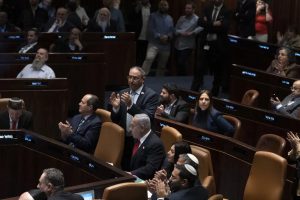
INN reported that after the vote, Levin said, “We have taken a very important step in the process of correcting the judicial system. No longer a legal system that belongs to the elites, no longer an aristocracy. From now on – the court will belong to everyone. I am again calling on the leaders of the opposition and its members – show responsibility. Sit down and negotiate. Understandings can be reached. But the legislation cannot be watered down. I am determined to pass the reform – and nothing will deter me.”
Prime Minister Benjamin Netanyahu told reporters upon leaving the plenum, “An important night and a big day. We need to enter into negotiations without preconditions.”
The chairman of the National Unity Party, MK Benny Gantz, wrote on his Twitter account, “A dark evening for democracy. Tomorrow morning we continue the fight!”
INN also reported that the Knesset members from the Yisrael Beytenu Party walked out of the plenum before the vote and did not participate in the vote.
Yisrael Beytenu chairman MK Avigdor Liberman said, “We left the plenum so as not to be complicit and not to give legitimacy to voting for the most illegitimate laws. We did not cause a riot, we do not want to harm the dignity of the Knesset. Unruly behavior in the plenum does not harm the coalition, but instead harms the status of the Israeli Knesset. We think that the very vote, even voting against, is legitimizing an illegitimate process. I hope that the coalition will not exist by the end of the year.”
The chairwoman of the Labor Party, MK Merav Michaeli, said after the vote in the Knesset plenum, “The conduct of the coalition is unequivocal proof that there is no desire for negotiations. I call again on my friends Lapid and Gantz to inform the President that despite the good will, we will not have any contacts and no conversations with this destructive group,” as was reported by INN.
The AP reported that the legislation is part of sweeping changes proposed by the government that have prompted vocal criticism in Israel and abroad, drawn tens of thousands of protesters to the streets and threw a scare into investors and financial markets.
On Tuesday, the dollar gained over 2% against the shekel, continuing a month long slide that has seen the Israeli currency lose over 5% of its value against the dollar, the AP reported. Several Israeli companies have said they are withdrawing money from the country, while Israeli newspapers have reported even larger withdrawals of cash as investors have grown jittery about the business climate due to the internal strife that has engulfed Israel over the issue of judicial reform.
Critics say the judicial overhaul underway will concentrate power in the hands of the ruling coalition in Israel’s parliament, the Knesset, and erode the democratic system of checks and balances, the AP reported.
Netanyahu and his allies insist the changes will better curb an overly powerful Supreme Court that often intervenes in governmental and legislative matters. Unlike the United State Supreme Court, the Israeli Supreme Court rules on governmental procedures and even rules on the termination of government officials.
“Many citizens across Israeli society, many people who voted for the coalition, are fearful for national unity,” Herzog said at a conference organized by the Yedioth Ahronoth newspaper, the AP reported. He exhorted Netanyahu and his allies to enable dialogue to reach a consensus on judiciary reform.
Late on Tuesday, Netanyahu issued an appeal for dialogue, saying he believed that the gaps could be reduced or closed, according to the AP report. “Let’s talk, here and now, without preconditions or excuses, so together we can achieve a broad agreement for the good of all citizens of Israel,” he said.
His critics have called on Netanyahu to freeze the legislation and start negotiations. The AP reported that opposition leader Yair Lapid mocked the premier’s appeal. “Citizens of Israel, I have no pleasant way to say this: Prime Minister Netanyahu is lying,” Lapid said in a statement. “We have been trying to hold talks with them for many weeks.”
Lapid condemned the vote, claiming it marked the annulment of Israeli democracy, as was reported by World Israel News. “The government is bringing to a vote two laws to annul democracy in Israel. Every effort to bring about dialogue, that of the President Herzog, the Opposition, civil society, even the Americans, has been met with total refusal, “ he said.
Lapid vowed that the protest movement would continue on, defying the government as it works to pass its entire judicial reform plan.
“We will continue to work across all fronts, here in the Knesset, in the streets, in the courts,” Lapid said, according to the WIN report. “We are working for the future of our children, for the future of our country and we do not intend to give up.”
Herzog’s remarks came on the morning after tens of thousands of Israelis protested outside the Knesset (parliament)in Jerusalem, ahead of the vote, the AP reported. This marked the second mass demonstration in Israel’s capital in recent weeks.
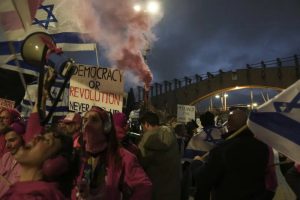
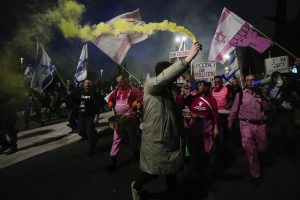
On Monday afternoon, opponents of the proposed judicial reform plan gathered en masse in Jerusalem to stage a raucous protest against the Knesset vote on two key measures, as was reported by World Israel News. Tens of thousands of protesters rallied, waving flags and carrying banners decrying the reform plan as a threat to Israeli democracy, WIN reported.
A parallel protest was organized in Haifa ahead of the Knesset vote. WIN reported that earlier on Monday, thousands of protesters shut down roads across the country, including Route 1, the primary thoroughfare linking Tel Aviv with Jerusalem.
Smaller groups of protesters confronted Coalition lawmakers at their homes, attempting to prevent them from reaching the Knesset, WIN reported.
One group of demonstrators blocked the car of MK Simcha Rothman (Religious Zionist Party), the chairman of the Knesset’s Constitution, Law and Justice Committee – and one of the two architects of the judicial reform plan, the WIN report stated.
As fuming protesters attempted to prevent coalition lawmakers from attending the Knesset vote on the amendments on Monday morning, one of their targets was Likud MK Tali Gottlieb, WIN reported. As a result, her special-needs child was traumatized.
“I opened the door at 6:10 a.m., and I live in an apartment house, not some villa that has a fence where demonstrators can protest as they wish,” Gottlieb, a single mother who lives in the Tel Aviv suburb of Givat Shmuel, told Ynet Radio.
“The anarchists sat at my door, when I took out the garbage in my nightgown. I closed the door and called the police, and then asked them to be quiet because I have a low-functioning autistic daughter.”
WIN reported that according to Gottlieb, they told her, “You can take a vacation day in order to stop the judicial revolution,” and “Find someone else to take the girl, because you’re staying at home today, ma’am.”
“Thank God, my daughter is now at her daycare. I already heard from her caregivers that her condition has deteriorated as a result of this demonstration, it shook her routine and sense of security,” the MK said, as was reported by WIN.
A poll conducted for Channel 13 News by Prof. Camil Fuchs, which was published on Monday evening, found that 55% of respondents are in favor of stopping the legislation process of the judicial reform in favor of negotiations, and only 31% support the continuation of the legislation process, Israel National News reported. Among Likud voters, the results are different – 52% are in favor of continuing the legislation, compared to 32% who think it should be stopped in favor of negotiations.
INN also reported that in addition, the respondents were asked, “If the coalition agrees to freeze the legislation in favor of negotiations – should the protest be stopped during this time?” 53% responded that the protest should be stopped in such a situation, while 33% answered that they think the protest should continue even if the legislation process in the Knesset is stopped.
Among the voters of Yesh Atid, the largest party in the opposition, 53% think that the protest should continue, while 39% answered that the protest should be stopped during the negotiations, as was reported by INN. On the economic question, 43% said they are concerned over their economic situation following the legislation and the same percentage of respondents answered that they are not concerned over their economic situation.
Among Likud voters the picture is slightly different: 62% are not concerned, while 26% of Likud voters are concerned that their economic situation will be harmed, INN reported. To the question of whether the respondents considered withdrawing their money and depositing it in bank accounts located outside of Israel, the large majority of respondents, 73%, answered that they had not considered it, compared to 17% who had considered it. 10% replied, “I don’t know”.
Another interesting question that poll respondents were asked dealt with their opinion on the law banning the entry of chametz into hospitals during the holiday of Passover, which was approved in its first reading in the Knesset on Sunday, according to the INN report. 57% of the respondents answered that they oppose the law, compared to 32% who support the law and 11% who replied, “I don’t know”.
The poll found that, if Knesset elections were held today, Likud would remain the largest party, with 27 seats, Yesh Atid is gaining strength and stands at 26 seats, compared to 24 it received in the last elections, according to the INN report. The National Unity Party wins 14 seats, the Religious Zionist and Otzma Yehudit joint ticket wins 12 seats, Shas weakens slightly and receives 10 seats, and United Torah Judaism remains with 7 seats.
The Labor Party would win 4 seats if elections were held today, and the Yisrael Beytenu Party would win 5 seats, as does as the Hadash-Ta’al Party, INN reported. Mansour Abbas’ Ra’am Party gains strength and wins 6 seats, Balad wins 4 seats, while Meretz does not pass the electoral threshold.
Arab citizens of Israel are not widely participating in the protests against the proposed reforms to the judicial system, despite concerns from Arab-Israeli leaders that changes to the Supreme Court could hurt the community, World Israel News reported.
WIN reported that because the Supreme Court has sided with Israel’s Arab minority on multiple occasions, some Arab-Israeli politicians are attempting to mobilize the population to join left-wing Jews at the demonstrations, though results so far have been minimal.
“The Supreme Court is our last defense for our rights as a minority,” Malik Azzem, the deputy mayor of Taybeh, a large Arab city in central Israel, told the Jewish Telegraphic Agency (JTA.) “The struggle for our rights is not separate from this struggle. We need to mobilize the public.”
Historically, Arab-Israelis have had an ambivalent relationship with Israeli politics, as was reported by WIN. Despite making up more than one-fifth of Israel’s population, they don’t hold significant political power, due in part to low voter turn-out rates and a frustration with the Arab parties that purport to represent them.
In 2021, Mansour Abbas’ Islamist Ra’am party became the coalition kingmaker that paved the way for the so-called change government, headed by Naftali Bennett, according to the WIN report. But Abbas kept mum about policy, diplomacy, and matters of national security, emphasizing that his party’s priority was obtaining funding for Arab communities.
The AP reported that the United States has called for restraint, and on Tuesday, the United Nations human rights chief called on Israel “to pause the proposed legislative changes and open them up for wider debate and reflection.”
(Sources: AP.com, WorldIsraelNews.com, IsraelNationalNews.com)
